
Biscuit Manufacturing in Nigeria: How to Build a Competitive Biscuits Production Business
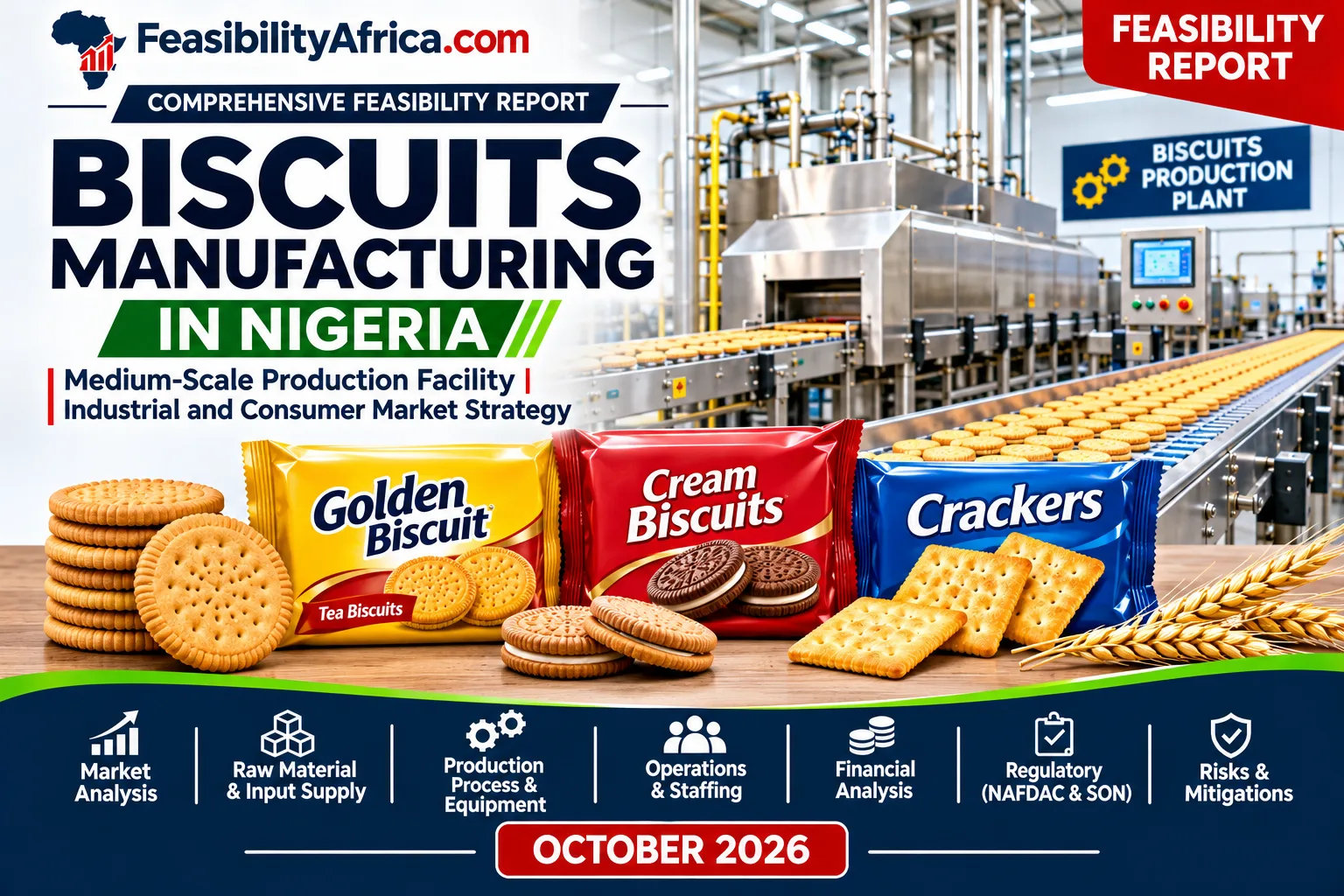
Biscuits are among Nigeria's familiar everyday snacks, creating opportunities for local manufacturers who can deliver affordable products consistently. Discover how commercial biscuits are made, the machinery and ingredients required, how manufacturers reach distributors and retailers, and the challenges involved in building a competitive biscuit brand.
By FeasibilityAfrica Research Team · · 14 min read
Introduction: A Familiar Snack with a Place in Nigeria's Food Industry
From neighbourhood kiosks and school shops to supermarkets, offices, markets and roadside vendors, biscuits are part of everyday life in Nigeria.
They are convenient, affordable, easy to carry and available in a wide range of varieties. Some consumers buy them as breakfast accompaniments, others as snacks between meals, while parents often include them in children's lunch packs.
For food entrepreneurs, this widespread consumption creates an interesting manufacturing opportunity.
Biscuit production is an established food-processing activity, and the products can be manufactured locally using a combination of agricultural ingredients, food-processing machinery and packaging materials. Unlike highly perishable foods, properly manufactured and packaged biscuits can be stored and distributed over a longer period.
But a large consumer market does not automatically guarantee success for a new manufacturer.
The biscuit industry is competitive. Established brands have built customer recognition and extensive distribution networks, while regional producers compete on price, availability and local relationships.
A new entrant must therefore do more than manufacture a good biscuit. It must select the right product, manage ingredient costs, maintain consistent quality, package attractively and build a distribution network that can move products efficiently.
Why Biscuit Manufacturing Is an Attractive Food-Processing Opportunity
Several characteristics make biscuits an interesting category for Nigerian food entrepreneurs.
1. Everyday consumption creates repeat-purchase opportunities
Biscuits are not limited to special occasions. They are purchased by households, students, workers, travellers and consumers looking for convenient snacks.
This creates opportunities for repeat purchases when a product offers acceptable taste, quality and value.
2. Different consumer groups support different product categories
The market accommodates economy biscuits, sweet cookies, crackers, cream-filled products and more premium varieties.
A manufacturer can focus on a specific consumer segment rather than trying to serve every category from the beginning.
For example, an economy biscuit brand may compete through accessible pricing, dependable availability and efficient production. A premium product may focus more on flavour, texture, packaging and differentiation.
3. Products can move through established retail channels
Biscuits are sold through a wide network of distributors, wholesalers, supermarkets, provision stores, kiosks and open-market retailers.
A manufacturer does not necessarily need to build a nationwide retail network from scratch. It can work with existing distribution businesses that already serve the target market.
4. Shelf stability supports wider distribution
Compared with products such as fresh bread, biscuits generally offer a longer shelf life when properly formulated, baked, cooled and packaged.
This provides more flexibility for inventory management, warehousing and transportation.
The actual shelf life depends on the recipe, moisture content, packaging barrier properties, storage conditions and product quality.
5. Local manufacturing creates room for regional brands
A new manufacturer does not have to compete with the largest national brands across the whole country immediately.
It can begin by serving a defined geographical market, establishing distributor relationships and gradually expanding as production and sales become more reliable.
Understanding the Main Types of Biscuits
Choosing the right product range is one of the first strategic decisions in biscuit manufacturing.
Different biscuits require different formulations, forming methods, processing conditions and equipment configurations.
Sweet biscuits
Sweet biscuits are among the most familiar products in the mass market.
They are generally made using flour, sugar, fats and other ingredients, with formulations adjusted to achieve the desired taste, colour, crispness and texture.
Their commercial appeal often depends on affordability, consistency and convenient packaging.
Crackers
Crackers are typically less sweet and may have a savoury flavour profile.
They can be sold as standalone snacks or consumed with tea, spreads, cheese and other accompaniments.
Their production may require dough sheeting and laminating equipment to achieve a consistent structure.
Cookies
Cookies are available in many formulations, including plain, flavoured and enriched varieties.
Some use a softer dough that is shaped using a rotary moulder or other forming equipment.
The category offers opportunities for product differentiation through ingredients, flavours, shapes and pack sizes.
Cream-filled biscuits
Cream-filled biscuits consist of two biscuit pieces joined by a flavoured filling.
They can command a different market position from basic economy biscuits, but their production introduces additional machinery, ingredients, quality controls and packaging considerations.
For a new manufacturer, it may be more practical to establish a simpler product range before introducing cream-filled varieties.
The Ingredients Behind Commercial Biscuit Production
A biscuit factory depends on a consistent supply of food-grade ingredients.
The formulation determines the product's taste, texture, appearance, structure and production behaviour.
Wheat flour
Wheat flour is the principal structural ingredient in many biscuit formulations.
Its quality and functional properties influence dough handling, gluten development, spread, texture and final product characteristics.
Manufacturers should work with dependable flour suppliers and evaluate batches for consistency.
Sugar
Sugar contributes sweetness, colour development, texture and other functional properties.
The quantity and type used depend on the product being manufactured.
Fats and shortening
Vegetable fats, shortening or margarine help influence biscuit texture, tenderness, mouthfeel and processing characteristics.
Their selection should be based on the product formulation and the performance required during mixing and baking.
Milk powder
Milk powder may be included in selected formulations to contribute flavour, colour and product characteristics.
It also introduces an additional procurement cost that must be considered when developing an affordable product.
Cocoa and flavourings
Cocoa powder, vanilla and other approved flavouring ingredients can be used to develop different product variants.
Ingredient quality and supplier reliability are important because inconsistent or adulterated inputs can affect the finished product.
Leavening agents and minor ingredients
Biscuit formulations may also contain salt, emulsifiers, raising agents and other ingredients, depending on the recipe and product type.
Each ingredient should be weighed accurately and used according to a standardised formulation.
How Biscuits Are Manufactured
Commercial biscuit production is a sequence of interconnected operations. The process must be controlled because mistakes in one stage can affect the final product.
1. Raw material inspection and weighing
Incoming ingredients are inspected before being released for production.
Flour, sugar, fats and minor ingredients are weighed according to the approved recipe.
Accurate weighing is essential. Small formulation variations can change taste, texture, spread and finished-product weight.
2. Dough mixing
The ingredients are combined in an industrial mixer to form a uniform dough.
Mixing time, temperature and ingredient addition sequence depend on the formulation.
Over-mixing or inconsistent mixing can affect dough handling and the texture of the finished biscuits.
3. Dough sheeting or forming
The dough is prepared for shaping.
For crackers and certain hard biscuits, it may be passed through rollers to form a sheet of consistent thickness.
For rotary-moulded cookies, the dough may be fed directly into a moulding machine.
4. Cutting and shaping
The dough is shaped into individual biscuit pieces.
Rotary cutters can be used for sheeted dough, while rotary moulders are suitable for certain cookie and shortbread products.
Mould design is important because it influences product shape, appearance and brand identity.
5. Baking
The shaped dough passes through an oven where controlled heat transforms it into biscuits.
Baking temperature, time and oven-zone conditions must be matched to the recipe, biscuit thickness and moisture characteristics.
Uneven baking can produce burnt, under-baked or inconsistent products.
6. Cooling
Freshly baked biscuits must cool before packaging.
Packaging biscuits while they are still warm can cause moisture condensation inside the wrapper, potentially affecting crispness and encouraging quality deterioration.
Cooling conveyors should be designed to provide adequate cooling time in a clean environment.
7. Creaming and sandwiching
For cream-filled products, a filling is deposited onto one biscuit and another biscuit is placed on top.
This stage requires additional equipment and careful control of filling quantity, consistency and product alignment.
8. Packaging
The finished biscuits are packed into suitable food-grade wrappers.
Flow-wrap packaging is commonly used for individual biscuit packs. Printed laminated films can provide product protection and brand presentation.
Smaller packs may then be grouped into cartons for wholesale distribution.
Machinery Required for a Biscuit Factory
The equipment required depends on the product range, production capacity, automation level and available capital.
A semi-automated production line may include:
- Industrial dough mixer.
- Dough sheeter or laminator, where required.
- Rotary cutter or rotary moulder.
- Tunnel baking oven.
- Cooling conveyor.
- Automatic flow-wrap packaging machine.
- Food-grade weighing scales.
- Metal detector.
- Ingredient handling and storage equipment.
- Electrical and utility installations.
- Quality-control and testing equipment.
The tunnel oven is a particularly important part of the production line because baking performance directly affects product quality and energy consumption.
Equipment should be selected as an integrated system. A high-speed packaging machine cannot compensate for a production line that delivers inconsistent biscuit sizes or insufficient cooling.
Before purchasing machinery, investors should confirm the actual output capacity, product compatibility, energy requirements, spare-parts availability, installation costs and local technical support.
It is also important to request product trials and inspect operating factories using similar equipment.
Choosing a Factory Location
The location of a biscuit factory affects raw material procurement, labour availability, energy expenses, transportation and access to customers.
A suitable site should provide:
- Appropriate industrial zoning and factory-use approval.
- Good road access for incoming raw materials and outgoing finished products.
- Reliable water supply.
- Adequate electrical infrastructure.
- Space for production, storage and future expansion.
- Access to skilled and semi-skilled workers.
- Reasonable proximity to target distribution markets.
- Adequate security.
The report considers the Ogun State industrial corridor, including Mowe/Ibafo, Sagamu and Agbara, as an attractive location option because of its access to Lagos markets and established industrial infrastructure.
It also discusses industrial locations in Lagos, while noting their higher land and operating costs.
Location selection should be based on a proper comparison of rent or land costs, logistics, utilities, zoning and market access. A site that appears inexpensive may become costly if it is far from suppliers and customers.
Packaging: Protecting the Product and Selling the Brand
Packaging is more than a finishing operation. It protects the biscuit and communicates the brand to consumers.
The primary packaging must protect against moisture and other environmental factors that can affect crispness and product quality.
Printed laminated BOPP film is identified in the report as a suitable packaging material for pillow-pack biscuit wrappers.
The choice of film, sealing method and pack dimensions should be tested with the actual product.
Secondary packaging is also important. Corrugated cartons help organise individual packs for storage, handling and wholesale distribution.
A manufacturer should pay attention to:
- Attractive and readable packaging design.
- Consistent pack weight.
- Reliable seals.
- Appropriate food-contact materials.
- Clear product identification.
- Batch coding and date marking.
- Storage and handling instructions.
- Required regulatory information.
Printed packaging can have long lead times. Manufacturers should plan orders carefully to avoid production interruptions caused by a shortage of printed film.
How to Build a Biscuit Brand in a Competitive Market
A new biscuit manufacturer faces competition from national brands, regional producers and smaller local bakeries.
The best entry strategy is usually to focus on a clearly defined market segment.
Start with a focused product range
Launching too many products at once increases formulation complexity, raw material requirements, packaging inventory and production changeovers.
A more disciplined approach is to begin with two or three high-volume variants and expand after establishing reliable production and sales.
Compete on consistency
Consumers expect a familiar product to taste and feel the same each time they buy it.
Standardised recipes, accurate weighing, controlled baking and effective quality assurance help build repeat purchases.
Make affordability part of the product strategy
The economy biscuit market is sensitive to retail price points.
Manufacturers must work backwards from the final consumer price to determine the factory selling price, distributor margins, wholesaler margins and retail margins.
A product may be attractive to consumers but commercially unsustainable if the manufacturer leaves insufficient margin for the distribution chain.
Use packaging to create recognition
A clear brand name, distinctive colours and readable product information can help a new product stand out.
Packaging should be designed for the intended retail environment and consumer segment.
Support distributors
Distributors and wholesalers can provide access to retail outlets that would be difficult for a new manufacturer to serve individually.
They need dependable supply, competitive margins, clear order terms and responsive customer service.
The Importance of Distribution in Biscuit Manufacturing
A biscuit factory can produce excellent products and still struggle if it cannot sell and distribute them efficiently.
Distribution is therefore a core part of the business model, not an activity to consider after production begins.
Distributors and wholesalers
These businesses purchase in bulk and supply smaller retailers.
They are particularly important for reaching informal retail markets and high-volume trading locations.
A manufacturer should identify target distributors, understand their preferred pack formats and negotiate commercially sustainable terms.
Supermarkets and modern retail
Supermarkets can provide visibility and access to organised retail customers.
However, they may require product documentation, listing arrangements, quality checks and longer payment terms.
A new manufacturer should assess the cash-flow implications before relying heavily on this channel.
Kiosks and neighbourhood shops
These outlets are important points of sale for affordable snack products.
Manufacturers generally reach them through wholesalers and distributors rather than attempting to serve every small retailer directly.
Institutional and bulk buyers
Schools, hospitals, feeding programmes and other institutions may offer bulk-purchase opportunities.
However, orders should be assessed for pricing, payment terms, delivery requirements and consistency before being included in production plans.
Quality Assurance and Food Safety
Food safety is fundamental to commercial biscuit manufacturing.
A quality product must be safe, consistent and suitable for its intended shelf life.
A factory should establish quality checks at every stage, including:
- Inspection of incoming flour, sugar, fats and other ingredients.
- Verification of ingredient weights and recipes.
- Monitoring of dough consistency.
- Control of baking conditions.
- Inspection of biscuit colour, texture and dimensions.
- Monitoring of cooling conditions.
- Verification of pack weight and sealing quality.
- Metal detection and other appropriate foreign-material controls.
- Finished-product testing and batch traceability.
Food-contact surfaces should be made from suitable food-grade materials. The production environment should have effective cleaning, pest-control and personnel-hygiene procedures.
A documented quality-management system helps reduce waste, prevent customer complaints and support regulatory compliance.
Regulatory Requirements for Biscuit Manufacturers in Nigeria
A biscuit factory must plan for the relevant corporate, food-safety, product and environmental requirements.
The report identifies several important regulatory areas.
Corporate Affairs Commission
The business should be properly registered with the Corporate Affairs Commission.
A formal company structure supports commercial contracts, regulatory applications and business banking.
NAFDAC
The National Agency for Food and Drug Administration and Control regulates processed food products.
Manufacturers must address the applicable facility, hygiene, product-registration, testing and labelling requirements before commercial sales.
Standards Organisation of Nigeria
The Standards Organisation of Nigeria is relevant to product standards and conformity assessment, including the MANCAP programme where applicable.
Environmental requirements
The factory should assess its environmental obligations, including waste management, emissions, energy use and relevant permits.
The report also identifies local government permits and fire-safety requirements as part of the establishment process.
Regulatory requirements and fees should be confirmed directly with the relevant agencies or qualified advisers before investment.
The Major Challenges Facing Biscuit Manufacturers
Despite the market opportunity, biscuit manufacturing presents several operating challenges.
Imported wheat and foreign-exchange exposure
Wheat is a major raw material, and its price is influenced by global commodity markets and exchange-rate movements.
A manufacturer must monitor supplier prices, maintain alternative sourcing relationships and avoid excessive dependence on spot purchases.
Energy costs
Mixing, baking, cooling and packaging all require energy.
The oven is particularly important because inefficient heating can increase production costs and reduce margins.
A factory should evaluate grid electricity, generator requirements and appropriate hybrid energy options.
Packaging cost and availability
Printed film, cartons and other packaging materials can be affected by polymer prices, foreign exchange and supplier lead times.
A shortage of packaging can stop production even when all food ingredients are available.
Equipment downtime
A breakdown in the mixer, oven, conveyor or packaging machine can interrupt the entire production process.
Preventive maintenance, trained operators, critical spare parts and reliable technical support are essential.
Product consistency
Changes in flour quality, ingredient proportions, mixing conditions and baking temperatures can affect the finished product.
Standard operating procedures and quality checks help maintain consistency.
Distributor credit and cash flow
Distributors may request credit to build their markets.
However, excessive credit can tie up working capital and prevent the manufacturer from purchasing raw materials.
New businesses should establish clear payment terms and extend credit cautiously.
Sustainability and Waste Management
A modern biscuit factory should consider resource efficiency from the beginning.
Reducing production waste
Careful weighing, controlled mixing, accurate forming and proper baking can reduce rejected products and unnecessary ingredient losses.
Some dough trimmings may be suitable for controlled rework, depending on the product and food-safety procedures.
Improving energy efficiency
Oven insulation, burner maintenance, proper temperature control and efficient production scheduling can help reduce energy consumption.
Managing packaging waste
Manufacturers should work with packaging suppliers and recycling operators to improve waste segregation and recovery where feasible.
Water conservation
Water is required for cleaning, sanitation and selected production activities.
Efficient cleaning procedures and leak prevention can reduce unnecessary consumption.
Environmental compliance
Wastewater, emissions, solid waste and other environmental impacts should be managed in line with applicable requirements.
Sustainability is not only an environmental responsibility. It can also improve resource efficiency and operating costs.
Is Biscuit Manufacturing Suitable for Every Entrepreneur?
Biscuit production can appeal to food entrepreneurs, existing bakery operators, FMCG professionals and investors seeking to enter packaged-food manufacturing.
However, it is not necessarily suitable for every investor.
The business requires adequate capital, practical production management, procurement discipline, quality assurance and an active sales strategy.
It may be particularly attractive to an entrepreneur who already understands food distribution or has relationships with wholesalers and retailers.
It may be more challenging for a first-time entrepreneur with limited capital, no manufacturing experience and no established route to market.
The most important preparation is to understand the complete business system: ingredients, production, packaging, compliance, distribution and cash flow.
Conclusion: Build a Biscuit Business Around the Customer, Not Just the Machine
Nigeria's biscuit market offers room for manufacturers who can deliver affordable products, maintain consistent quality and establish dependable distribution.
The opportunity is not simply in purchasing machinery and producing biscuits. It is in building a business that understands consumer preferences, controls ingredient and energy costs, manages production efficiently and gives distributors a product they can sell profitably.
Starting with a focused product range, testing the market and expanding gradually can help a new manufacturer manage operational complexity.
Before committing capital, investors should evaluate the required equipment, raw material supply, production economics, regulatory obligations and distribution strategy.
Considering a biscuit manufacturing business in Nigeria?
The Biscuits Production Business Feasibility Report in Nigeria (2026) provides a detailed assessment of the proposed manufacturing opportunity, including market analysis, product selection, raw material sourcing, production technology, machinery, factory location, staffing, quality assurance, regulatory requirements, marketing, distribution, capital requirements, operating costs, financial projections, risks and implementation planning.
It is designed to help entrepreneurs and investors understand the practical requirements of establishing a commercial biscuit factory and make a more informed investment decision.
Get the complete 130-page feasibility report from FeasibilityAfrica.com and take the next step towards evaluating your biscuit manufacturing investment.
Enjoyed this? Get the next one free
Every new article, straight to you. Free. Choose email, WhatsApp — or both.
Email newsletter
New articles in your inbox. Unsubscribe anytime.
WhatsApp newsletter
Get new articles directly on WhatsApp. No spam, just new ideas.
Related articles
Manufacturing
Starting a Garri Processing Business: A Step-by-Step Guide
Machinery, raw material sourcing and why processed cassava beats raw cassava on margin.

Manufacturing
Bottled Water Manufacturing in Nigeria: How to Build a Competitive Business in the Packaged Drinking Water Market
Nigeria's demand for safe, conveniently packaged drinking water creates opportunities for regional manufacturers with reliable production and distribution. Discover how bottled water is produced, the machinery and regulatory approvals required, how to build a distributor network, and the financial and operational challenges investors must understand before setting up a plant.
Manufacturing
Margarine Manufacturing in Nigeria: Exploring Opportunities in the Table and Baking Margarine Market
Nigeria's margarine industry offers opportunities for food manufacturers supplying households, bakeries and commercial food businesses. Discover how table and baking margarine are made, the vegetable oils and specialised equipment involved, the importance of cold-chain management, and the challenges of building a competitive local margarine brand.