
Bottled Water Manufacturing in Nigeria: How to Build a Competitive Business in the Packaged Drinking Water Market
Nigeria's demand for safe, conveniently packaged drinking water creates opportunities for regional manufacturers with reliable production and distribution. Discover how bottled water is produced, the machinery and regulatory approvals required, how to build a distributor network, and the financial and operational challenges investors must understand before setting up a plant.
By FeasibilityAfrica Research Team · · 19 min read
Introduction: Why Bottled Water Remains an Essential Product
Clean drinking water is a basic necessity, but reliable access to safe public water remains a challenge for many Nigerian households, businesses and institutions.
For millions of consumers, packaged drinking water provides a convenient option at home, at work, during travel and at social gatherings. Bottled water is sold in supermarkets, neighbourhood shops, restaurants, hotels, offices, event centres and roadside outlets. It is also an important product for businesses that need dependable supplies of drinking water for employees and visitors.
This everyday demand has helped create a substantial market for bottled water manufacturers in Nigeria.
However, entering the industry is not simply a matter of drilling a borehole, buying a filling machine and putting a brand name on a bottle. A commercial bottled water plant must combine a reliable water source, effective treatment technology, hygienic production, regulatory compliance, attractive packaging and a distribution system capable of moving large volumes of product.
It is also a capital-intensive business with significant energy, packaging and logistics costs.
For an entrepreneur considering this opportunity, the real challenge is to build a manufacturing operation that can deliver consistent quality at a competitive cost while keeping distributors supplied and customers satisfied.
Understanding the Bottled Water Business
Bottled water manufacturing involves extracting water from an approved source, treating it to meet the required quality standards, filling it into suitable containers, sealing and labelling the bottles, packaging the finished products and distributing them to customers.
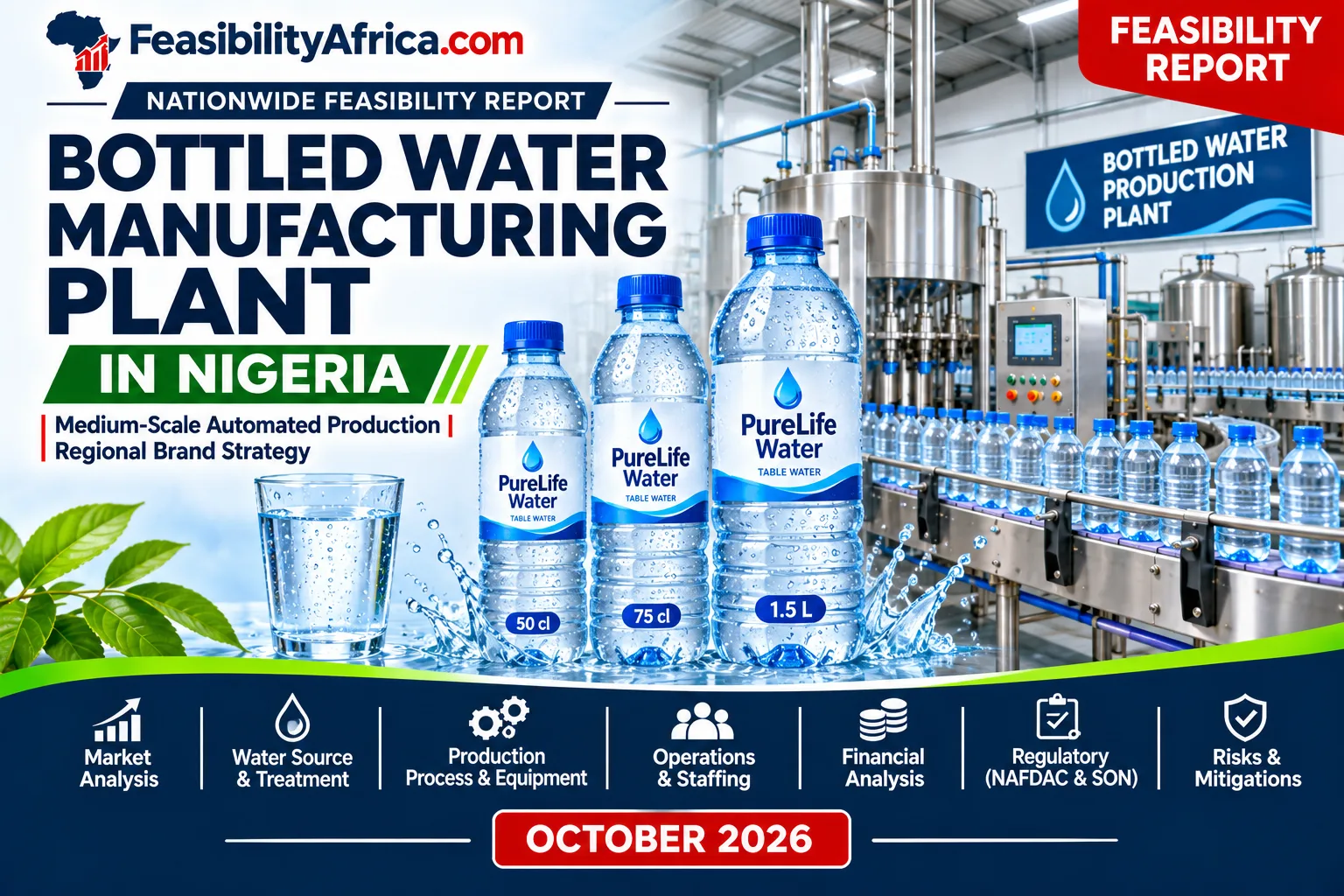
The business evaluated in the October 2026 feasibility report focuses on PET-bottled table water. It is not a sachet-water operation.
The proposed production model uses a dedicated deep borehole, multi-stage filtration, reverse osmosis, ultraviolet sterilisation and ozone treatment. The treated water is then filled into virgin PET bottles in a controlled production environment.
The business is therefore both a water-treatment operation and a consumer-goods manufacturing and distribution business.
Its product must satisfy two expectations simultaneously: consumers must trust the water, and distributors must be able to sell it profitably.
Why Nigeria Offers an Opportunity for Bottled Water Manufacturers
The demand for packaged drinking water is supported by several everyday consumption patterns.
1. Limited access to reliable public water
In many communities, households cannot depend entirely on public water systems for safe drinking water. Packaged water provides a convenient alternative for consumption at home and outside the home.
This creates repeat-purchase demand rather than a market based solely on occasional discretionary spending.
2. Urbanisation and changing lifestyles
Urban and peri-urban populations create demand for convenient products that can be purchased in shops, supermarkets, restaurants and other retail outlets.
Workers, commuters, students and travellers regularly purchase bottled water because it is portable and easy to consume.
3. Hotels, restaurants and institutional buyers
Hotels, schools, hospitals, offices and restaurants need regular supplies of drinking water.
These customers can become valuable accounts for manufacturers that offer consistent quality, reliable delivery and professional invoicing.
4. Events and social gatherings
Weddings, conferences, religious programmes, parties and corporate events can generate substantial orders.
Event planners and caterers may purchase large quantities, sometimes with opportunities for customised labels or event branding.
5. Retail and wholesale distribution
Neighbourhood shops, supermarkets, wholesalers and beverage distributors provide multiple routes to market.
A manufacturer that develops dependable relationships with these channels can build recurring sales across its target region.
The October 2026 report estimates total Nigerian bottled-water market revenue, including at-home and out-of-home consumption, at approximately US$1.25 billion in 2026. It also describes the market as fragmented, with national brands, regional producers and a large sachet-water segment.
These estimates provide market context, but an investor should still validate demand and achievable selling prices in the specific city or region where the plant will operate.
Choosing the Right Bottled Water Products
A new manufacturer should resist the temptation to launch too many product sizes at once.
The report recommends concentrating on three core product formats.
50cl bottled water
The proposed pack configuration is 20 bottles per carton or shrink-wrapped pack.
This is the principal volume-driving product. It is suitable for everyday retail purchases, events and general drinking-water consumption.
75cl bottled water
The proposed pack configuration is 12 bottles per carton.
This format is intended for restaurants, households and offices. The report identifies it as an important core product and potential margin contributor.
1.5L bottled water
The proposed pack configuration is six bottles per pack.
It is suitable for families, hotels, catering operations and events where larger quantities of water are preferred.
The report suggests considering 18.9L dispenser bottles and private-label contract bottling as possible Year 2 additions. It does not recommend launching flavoured water, sachet water or additional sizes in Year 1 because they can distract management and require additional operational or regulatory attention.
The strategic lesson is simple: establish a dependable core product range before expanding.
How Bottled Water Is Manufactured
Modern bottled water production involves a sequence of treatment, packaging and quality-control operations.
1. Raw water extraction
Water is pumped from a dedicated borehole into raw-water storage tanks.
The source must provide sufficient water throughout the year. A borehole that performs well immediately after drilling may not necessarily sustain continuous commercial production.
The report recommends a 24-hour continuous pump test before committing to a site.
2. Pre-treatment and filtration
The raw water passes through multi-media filtration systems, commonly using sand and activated carbon.
These stages help remove suspended particles, sediment, odour and other unwanted materials before the water enters the main treatment system.
Additional treatment may be required depending on the mineral composition and quality of the source water.
3. Reverse osmosis
Reverse osmosis is used to remove dissolved substances and reduce the concentration of unwanted contaminants.
The system must be specified according to the actual water analysis rather than simply purchasing a machine based on advertised capacity.
The report identifies a proposed treatment capacity of 3,000–5,000 litres per hour.
4. UV sterilisation and ozone treatment
After filtration and reverse osmosis, the water passes through polishing and sterilisation stages.
Ultraviolet treatment and ozone injection are included in the proposed production process to support microbiological control and maintain product quality.
5. Bottle blowing
PET preforms are heated and expanded using compressed air to form bottles of the required size and shape.
Some manufacturers purchase ready-made bottles, while others produce bottles on-site using a bottle-blowing machine.
The proposed plant includes semi-automatic bottle-blowing equipment.
6. Bottle rinsing, filling and capping
The bottles are rinsed, filled with treated water and sealed with caps.
This operation must take place in a clean production environment. Consistent fill levels, reliable cap sealing and hygienic handling are essential.
Poor capping or leaking bottles can damage customer confidence and cause losses during transportation.
7. Labelling and shrink wrapping
The bottles receive labels displaying the approved product information and regulatory details.
Shrink-sleeve labels are recommended in the report because they are waterproof and provide a professional appearance.
The bottles are then grouped into packs using shrink-wrap packaging.
8. Storage and dispatch
Finished products are stored in an organised warehouse before distribution.
Stock rotation, batch identification and proper handling help prevent damage and support traceability.
The report recommends a first-in, first-out inventory system.
Machinery and Equipment Required
A bottled water factory requires more than a filling machine. It needs an integrated production system in which water treatment, bottle production, filling, packaging and utilities work together.
Major equipment in the proposed plant includes:
- Reverse osmosis water-treatment system.
- Multi-media and activated-carbon filters.
- UV sterilisation and ozone injection equipment.
- Raw-water and treated-water storage tanks.
- PET bottle-blowing machine.
- Bottle rinsing, filling and capping line.
- Shrink-sleeve labelling machine and heat tunnel.
- Shrink-wrapping machine.
- Air compressor.
- Generator.
- Conveyors and interconnecting utilities.
- Laboratory and quality-control equipment.
The report estimates landed-and-installed equipment costs of approximately ₦75 million–₦119 million for the proposed configuration.
The actual cost will depend on machine capacity, automation level, supplier location, shipping, customs, installation and after-sales support.
Investors should obtain at least three written quotations and compare complete production-line specifications rather than comparing machine prices in isolation.
A cheaper filling machine may create problems if it cannot operate at the required speed or integrate properly with the treatment and packaging systems.
Selecting the Right Location for a Bottled Water Factory
Location is one of the most important investment decisions.
A suitable site should provide a reliable water source, access to fuel and electricity, reasonable land or rental costs, good roads, available labour and proximity to customers.
The report evaluates five broad regional markets.
South-West
Ogun, Oyo and the Lagos fringe offer access to large consumer markets, established road networks and a substantial distributor base.
The main challenges are competition, land costs and price pressure.
North-Central
Nasarawa, Niger, Kwara and the FCT fringe offer a central position for distribution between northern and southern markets.
The region may provide lower land and labour costs, although security and long-distance logistics must be considered.
North-West
Kaduna and Kano offer large population centres, wholesale networks and potential for high-volume regional distribution.
The report considers this region suitable for northern market development, subject to careful site selection and security assessment.
South-East
Enugu and Anambra have active trade networks and demand associated with commercial activity and events.
A manufacturer can target regional distribution while considering the cost of transporting products to distant markets.
South-South
Edo and Delta offer access to industrial infrastructure and markets across the South-South and South-East.
However, water quality can vary, making site-specific testing especially important.
The report recommends a North-Central or South-West location as the base case for an investor with nationwide ambitions. It also identifies Kaduna and Kano as potential locations for northern regional dominance.
The final decision should never be made on population size alone. A site must first pass water-yield and water-quality tests, and its transport economics must be assessed.
Why Borehole Testing Is Non-Negotiable
The water source is the foundation of the business.
A factory can have modern equipment and attractive packaging but still fail if its borehole cannot provide sufficient water or if the raw water requires expensive treatment.
The report recommends:
- Conducting a 24-hour continuous pump test.
- Obtaining a complete mineral and bacteriological water analysis.
- Checking pH and total dissolved solids.
- Testing iron and manganese levels.
- Assessing the need for additional treatment stages.
- Evaluating the borehole's ability to support the proposed production capacity.
It identifies a borehole yield below approximately 5,000–10,000 litres per hour as potentially inadequate for a commercial line operating two shifts.
The required yield must be matched to the actual production schedule and water-treatment capacity.
An investor should not purchase land or commit to factory construction before establishing that the site can support the intended operation.
Understanding Packaging and Raw Material Costs
Bottled water is a volume business, but the cost of packaging can significantly affect profitability.
Important inputs include PET preforms, bottle caps, labels and shrink-wrap materials.
PET preforms
Preforms are used to manufacture bottles through the bottle-blowing process.
Their cost is influenced by PET resin prices and foreign-exchange movements. Even when preforms are purchased from local suppliers, imported resin prices can affect the local market.
The report recommends sourcing from at least two suppliers and maintaining a safety stock.
Caps
Caps should be sourced from a dependable supplier, with consistent dimensions and sealing performance.
A faulty cap can result in leakage, product rejection and reputational damage.
Labels
Labels should be professionally designed and printed using approved artwork.
The report specifically warns against printing commercial labels before the NAFDAC registration number has been assigned.
Shrink wrap
Packaging film must be strong enough to withstand handling, stacking and transportation.
Poor-quality shrink wrap can break during distribution and result in damaged packs.
The report discusses shrink-wrapped trays as a possible way to reduce packaging costs, while noting that they require careful handling.
Building a Brand Consumers Can Trust
Bottled water is a product where customer confidence matters.
Consumers cannot easily assess the treatment process inside a factory. They judge the product through its taste, clarity, packaging and reputation.
A new brand should therefore communicate reliability rather than compete only on the lowest price.
Product consistency
Water should have a consistent taste and appearance. Consumers who notice changes in taste or quality may quickly switch brands.
Professional packaging
Clean bottles, secure caps, readable labels and strong shrink wrapping contribute to the perception of quality.
Clear brand identity
The brand name should be easy to pronounce and remember across the languages spoken in its target markets.
The report recommends blue as the dominant colour, with green or white as complementary colours.
Visible compliance information
Product labels should carry the required registration and manufacturing information, including the NAFDAC number, batch number, manufacturing and expiry dates, and manufacturer details.
Reliable availability
A brand that disappears from retail outlets loses repeat sales.
Maintaining sufficient stock and dependable delivery schedules is therefore part of brand building.
Finding Customers and Building a Distribution Network
Manufacturing the water is only half the business. The other half is getting it into the hands of customers.
The report identifies four important sales channels.
Wholesale distributors
Distributors are the primary route to market because they already serve shops, retailers and other customers.
A new manufacturer should recruit a small group of dependable distributors in its home market before expanding geographically.
Institutional buyers
Hotels, schools, hospitals and offices can provide recurring orders.
These accounts require professional sales engagement, dependable delivery and careful management of payment terms.
Event planners and caterers
Events can generate large orders, although demand may be irregular.
A manufacturer can develop relationships with wedding planners, caterers, conference organisers and event centres.
Supermarkets and modern retail
Supermarkets can improve visibility and brand credibility.
However, listing fees and extended payment terms can place pressure on working capital. The report therefore recommends approaching this channel more aggressively from Year 2.
Why distributor economics matter
A distributor must have enough margin to justify the effort and cost of selling the product.
The report uses an illustrative target distributor margin of 15–20%.
It also recommends starting new distributor relationships with cash-on-delivery arrangements, then considering limited credit only after a reliable payment history has been established.
A manufacturer should reward actual sales volume rather than promises to purchase.
Pricing: Competing Without Destroying Your Margins
Bottled water is a competitive market. National brands, regional manufacturers and smaller local producers all compete for retail space and customer attention.
A new entrant may be tempted to reduce prices to attract distributors.
This can become dangerous if the selling price does not cover production, packaging, energy, labour and distribution costs.
The report provides illustrative ex-factory prices for the proposed products:
- 50cl × 20: ₦1,400–₦1,600 per carton.
- 75cl × 12: ₦1,700–₦1,900 per carton.
- 1.5L × 6: ₦1,800–₦2,100 per pack.
These figures are planning benchmarks, not guaranteed current market prices. They must be tested against competitor prices and actual distributor negotiations in the selected region.
The strongest positioning is not necessarily to be the cheapest bottled water brand. It is to become a brand known for consistent quality, reliable availability and professional service.
Regulatory Requirements for Bottled Water Manufacturing
Packaged drinking water is regulated in Nigeria. A manufacturer must understand the relevant approvals before commencing commercial sales.
Corporate Affairs Commission
The report recommends registering a limited liability company rather than operating informally.
A formal company structure supports regulatory applications, business banking and institutional contracts.
NAFDAC registration
NAFDAC registration is a critical requirement for packaged water.
The facility and product must satisfy the applicable requirements, including inspection, laboratory testing, labelling and product registration.
The report estimates a practical planning period of approximately six to eight months for the regulatory process.
It specifically warns against selling products before registration or printing commercial labels before the registration number is issued.
SON MANCAP certification
The Standards Organisation of Nigeria's Mandatory Conformity Assessment Programme is identified as a key requirement for locally manufactured products.
The process involves assessment of product conformity and factory inspections.
Environmental and local approvals
Depending on the facility and location, the manufacturer may also need environmental approvals, waste-management arrangements and local government business permits.
The report provides an illustrative total regulatory budget of approximately ₦1.2 million, subject to confirmation of actual fees, testing requirements and professional costs.
Regulatory planning should begin early. Delays can postpone commercial launch while rent, salaries and other expenses continue.
Staffing and Factory Management
A bottled water plant requires personnel with technical, operational, quality-control and commercial skills.
The report's proposed Year 1 staffing structure includes:
- Plant manager.
- Production supervisor.
- Quality-control officer.
- Maintenance technician.
- Machine operators.
- Line attendants.
- Store officer.
- Sales representatives.
- Drivers, where delivery vehicles are owned.
- Security personnel.
The illustrative total workforce is approximately 19 people, with monthly salary costs estimated at ₦2.5 million–₦3.2 million, excluding the owner's salary.
The plant manager must supervise production, regulatory compliance and operational efficiency.
The quality-control officer must monitor water quality and production standards.
The maintenance technician is important because equipment downtime can interrupt production and affect delivery commitments.
The owner should remain actively involved in the business, particularly during the first two to three years. The report cautions against absentee ownership and recommends daily supervision or the appointment of a highly trusted and competent plant manager.
Power Supply and Operating Costs
Energy is one of the most significant challenges facing Nigerian manufacturers.
A bottled water plant requires electricity for pumps, compressors, treatment equipment, filling machinery, lighting and other factory operations.
The report recommends a 125 KVA generator as part of the proposed plant configuration.
It benchmarks diesel prices at approximately ₦1,785–₦1,840 per litre in Lagos depots in late October 2026, with higher prices in some other locations.
It also considers industrial grid electricity under Band A as a supplement rather than a dependable primary supply.
A solar hybrid system may help reduce generator runtime for water pumping and office loads.
However, energy planning must be based on the actual equipment load, daily operating hours and local energy costs.
Other recurring expenses include:
- PET preforms, caps, labels and shrink wrap.
- Production and administrative salaries.
- Machinery maintenance and spare parts.
- Marketing and distributor commissions.
- Transportation and third-party haulage.
- Water, utilities and general administration.
A manufacturer should monitor energy consumption and packaging usage daily. Small inefficiencies can become significant when multiplied across thousands of bottles.
Understanding the Investment and Financial Requirements
Bottled water manufacturing is a capital-intensive business.
The investment includes factory preparation, borehole drilling, water treatment, production machinery, power infrastructure, laboratory equipment, regulatory costs and working capital.
The October 2026 report provides an illustrative capital expenditure range of ₦123 million–₦184 million for a rented factory using a semi-automatic configuration.
It separately recommends a planning figure of ₦220 million–₦280 million for a nationwide-ready operation with an adequate working-capital buffer.
The report identifies ₦150 million as the minimum liquid capital threshold for a single-region launch.
These are planning estimates. Land purchase, a fully automatic line, site-specific infrastructure and working-capital needs can increase the total requirement.
Revenue potential
The report models a 2,000-bottle-per-hour production line operating initially on one eight-hour shift.
Its illustrative utilisation assumptions are:
- Year 1: 50%.
- Year 2: 65%.
- Year 3: 75%.
Based on its pricing and output assumptions, the model projects annual revenue of approximately:
- Year 1: ₦150 million.
- Year 2: ₦214 million.
- Year 3: ₦270 million.
These projections depend on achieving the assumed production utilisation and selling prices.
Profitability expectations
The report expects the first year to be financially challenging, with possible losses or only a small profit.
It models improvement as production volumes increase and fixed costs are spread across more units.
The illustrative Year 3 net profit before tax is ₦35 million–₦60 million, with a projected net margin range of 13–22%.
The report gives a base-case payback period of approximately 4.5–5.5 years.
These are projections, not guaranteed returns. Actual results will depend on raw material prices, diesel costs, production efficiency, selling prices, distributor performance and financing arrangements.
Working capital is critical
A plant can be profitable on paper and still run out of cash.
The report identifies a potential cash-flow trough between Months 6 and 12, partly because institutional customers may take time to pay their invoices.
It recommends opening working capital of approximately ₦25 million–₦35 million and a separate cash buffer for unexpected costs and delayed receivables.
A manufacturer should be especially cautious about granting credit to distributors and large customers before establishing a reliable payment history.
Risks That Can Affect the Business
The bottled water business has a strong underlying demand base, but it is not risk-free.
Regulatory delays
NAFDAC approval delays can postpone sales and increase pre-launch expenses.
Mitigation: Engage an experienced consultant, prepare the factory properly and maintain a complete compliance file.
Diesel price increases
Rising energy costs can reduce margins.
Mitigation: Monitor generator consumption, improve operating efficiency and evaluate appropriate hybrid energy options.
PET preform price volatility
Exchange-rate movements and imported resin costs can increase packaging expenses.
Mitigation: Maintain relationships with multiple suppliers and plan inventory purchases carefully.
Competition and price pressure
Established brands and low-overhead local producers may compete aggressively.
Mitigation: Build a brand around quality and reliability, select a focused geographic market and develop distributor relationships.
Distributor bad debt
Excessive credit can create cash-flow problems.
Mitigation: Use cash-on-delivery for new distributors and apply strict credit limits to established customers.
Equipment breakdown
Production interruptions can affect orders and damage distributor relationships.
Mitigation: Maintain critical spare parts, implement preventive maintenance and secure supplier support.
Water source failure
A borehole may fail to deliver the expected quantity or quality.
Mitigation: Conduct a continuous pump test and laboratory analysis before committing to the site.
A Practical Strategy for Expanding Beyond One State
A new manufacturer should not attempt to distribute across Nigeria immediately.
The report recommends a phased hub-and-spoke strategy.
Years 1–2: Establish the home market. Operate from one production plant and focus on the home region and nearby states, generally within a 200–300km radius. Use third-party haulage for distant orders.
Years 2–3: Open satellite depots. Establish two or three warehouses and sales offices in priority markets outside the home region. These depots receive truckloads from the production plant and supply local distributors.
Year 4 onward: Consider another production plant. A second plant should only be considered when sales volume, brand strength and distribution density justify the additional investment.
This approach allows the business to grow geographically without immediately carrying the cost of multiple production facilities and a large vehicle fleet.
Sustainability and Additional Opportunities
Bottled water production also creates opportunities to improve resource efficiency.
Reusing reverse-osmosis reject water
The report notes that reverse osmosis can reject approximately 30–40% of incoming water as concentrate.
Where suitable, this water can be collected for toilet flushing, floor cleaning and truck washing rather than being wasted.
Recycling plastic waste
Clean scrap plastic can be separated and sold to recycling companies.
This can help reduce waste and support environmental compliance.
Solar hybrid energy
A solar hybrid system can support water pumping and office loads, reducing generator runtime.
The report estimates that a meaningful system may require additional capital, so the investment should be assessed against expected diesel savings.
Future product and service expansion
Once the core bottled water operation is stable, the business may consider dispenser bottles and private-label contract bottling.
These opportunities should be evaluated separately because they introduce additional equipment, logistics, customer-service and working-capital requirements.
Is Bottled Water Manufacturing Right for You?
Bottled water manufacturing may appeal to entrepreneurs and investors looking for an entry into Nigeria's fast-moving consumer goods and food-processing sectors.
It is particularly relevant to investors who can secure a reliable water source, mobilise adequate capital, manage technical operations and develop a strong distribution network.
However, it is not an ideal business for an investor seeking passive income or immediate returns.
The business requires close supervision, careful cash management, regulatory patience and constant attention to production and distribution costs.
A strong market does not automatically guarantee a profitable factory.
The manufacturer must be able to produce consistently, sell at viable prices, protect margins and keep distributors supplied.
Conclusion: Build a Reliable Water Brand, Not Just a Factory
Nigeria's bottled water market offers opportunities for manufacturers that can combine safe water, consistent production, professional packaging and dependable distribution.
The strongest competitive advantage is not simply access to a borehole or ownership of a filling machine. It is the ability to deliver a product that customers trust and distributors can sell profitably.
For a new entrant, success begins with a properly tested water source, a realistic equipment specification, sufficient working capital and a clear regional distribution strategy.
The October 2026 feasibility assessment classifies the project as conditionally feasible. It identifies a viable opportunity for a well-capitalised, hands-on operator, while warning that Year 1 is likely to be financially challenging and that regulatory and operating costs must be carefully managed.
Planning to establish a bottled water manufacturing plant in Nigeria?
The Bottled Water Manufacturing Business Feasibility Report in Nigeria (October 2026) provides a detailed assessment of the opportunity, including market analysis, regional location strategy, production technology, machinery requirements, borehole and water-treatment considerations, packaging, staffing, regulatory approvals, distribution, capital expenditure, operating costs, revenue projections, profitability and risk mitigation.
It is designed to help entrepreneurs and investors understand what it takes to establish and operate a medium-scale bottled water manufacturing business.
Get the complete 29-page feasibility report from FeasibilityAfrica.com and make a more informed investment decision before committing your capital.
Enjoyed this? Get the next one free
Every new article, straight to you. Free. Choose email, WhatsApp — or both.
Email newsletter
New articles in your inbox. Unsubscribe anytime.
WhatsApp newsletter
Get new articles directly on WhatsApp. No spam, just new ideas.
Related articles
Manufacturing
Starting a Garri Processing Business: A Step-by-Step Guide
Machinery, raw material sourcing and why processed cassava beats raw cassava on margin.
Manufacturing
Margarine Manufacturing in Nigeria: Exploring Opportunities in the Table and Baking Margarine Market
Nigeria's margarine industry offers opportunities for food manufacturers supplying households, bakeries and commercial food businesses. Discover how table and baking margarine are made, the vegetable oils and specialised equipment involved, the importance of cold-chain management, and the challenges of building a competitive local margarine brand.
Manufacturing
Medicated Shampoo Manufacturing in Nigeria: Exploring Opportunities in the Therapeutic Hair-Care Market
Nigeria's growing hair-care market presents opportunities for entrepreneurs interested in local shampoo manufacturing. Discover how medicated and antiseptic shampoos are formulated and produced, the ingredients and equipment required, the importance of NAFDAC compliance, potential customers, distribution strategies and the challenges of building a trusted personal-care brand.