
Margarine Manufacturing in Nigeria: Exploring Opportunities in the Table and Baking Margarine Market
Nigeria's margarine industry offers opportunities for food manufacturers supplying households, bakeries and commercial food businesses. Discover how table and baking margarine are made, the vegetable oils and specialised equipment involved, the importance of cold-chain management, and the challenges of building a competitive local margarine brand.
By FeasibilityAfrica Research Team · · 14 min read
Introduction: An Everyday Food Product with Industrial Potential
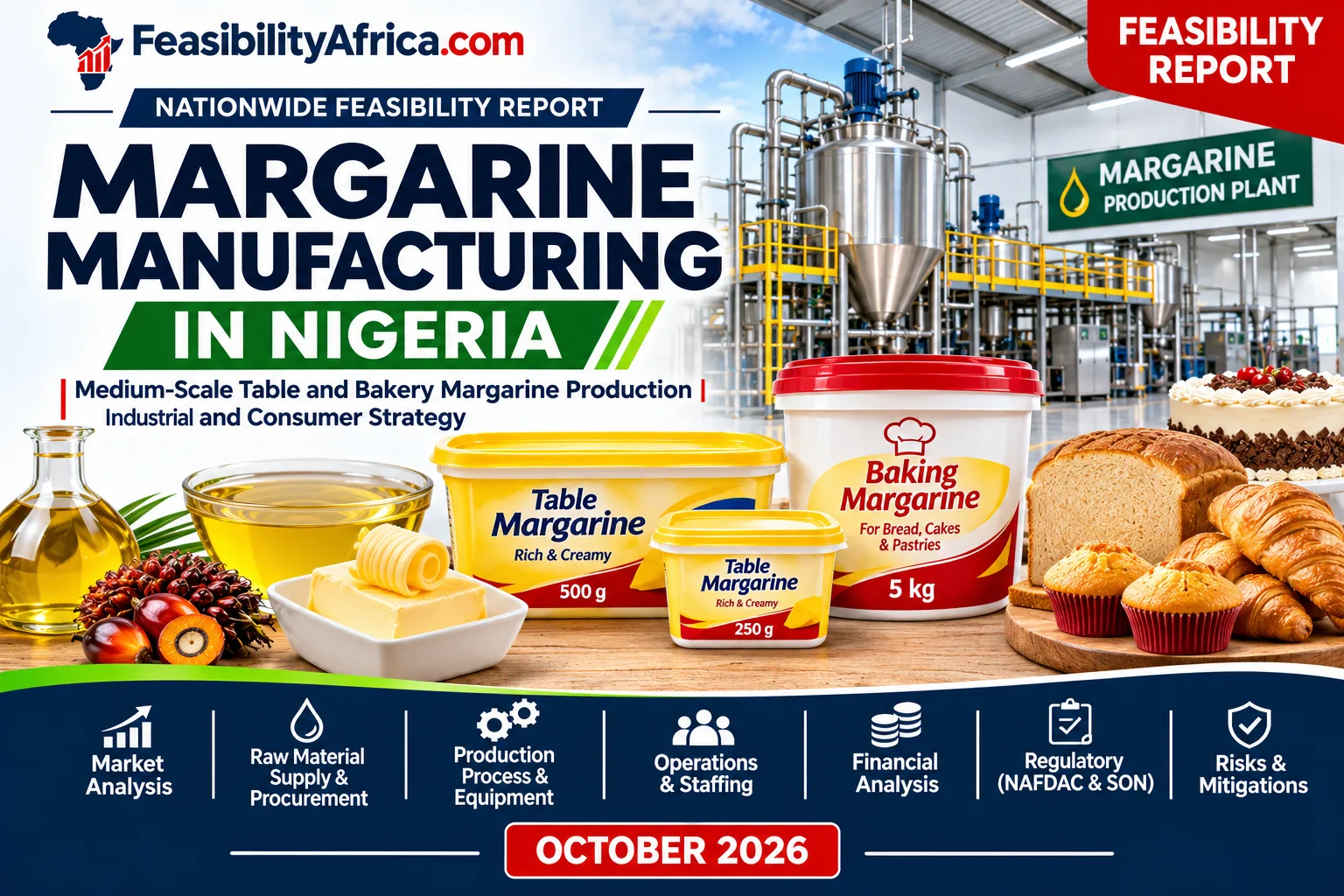
Margarine is one of those food products whose importance is easy to overlook. It appears on breakfast tables, inside loaves of bread, in cakes and pastries, and in the kitchens of restaurants and food-service businesses.
Behind this familiar product is a specialised food-processing industry that combines vegetable oils, food ingredients, emulsification technology, temperature control and carefully managed production processes.
For entrepreneurs and investors, margarine manufacturing presents an opportunity to participate in Nigeria's food-processing value chain. A locally established manufacturer can supply household consumers, bakeries, pastry businesses, hotels and other institutional buyers.
However, this is not a simple repackaging business. Margarine production requires specialised equipment, technical expertise, reliable raw material procurement and uninterrupted chilling and cold storage.
The opportunity is therefore best understood as a capital-intensive, volume-driven food manufacturing business.
Understanding the Two Main Margarine Markets
A prospective manufacturer must understand that table margarine and baking margarine serve different customers and commercial purposes.
Table margarine: Serving household consumers
Table margarine is designed for everyday household use.
It is commonly used as a spread on bread and other foods and is sold through supermarkets, open markets, neighbourhood shops and other retail outlets.
Typical consumer pack sizes include:
- 250g tubs.
- 500g tubs.
- 1kg tubs.
For a new manufacturer, table margarine offers an opportunity to build a recognisable consumer brand.
Packaging, appearance, taste, spreadability, price and availability all influence purchasing decisions.
Baking margarine: Supplying commercial food producers
Baking margarine serves a different market.
It is used by bakeries, pastry shops, confectioneries, hotels and food-service operators in the production of bread, cakes, biscuits, pastries and other baked goods.
It is generally supplied in larger packs, including:
- 5kg blocks.
- 10kg blocks.
- 20kg blocks.
Commercial customers are particularly interested in consistency, functionality, reliable supply and competitive pricing.
A bakery needs an ingredient that performs predictably in its production process. A manufacturer that consistently delivers the required quality and quantity can develop long-term business relationships.
The two product categories can complement each other: table margarine supports consumer-brand development, while baking margarine can generate bulk orders from commercial customers.
Why Nigeria Presents an Opportunity
The feasibility report describes Nigeria's margarine market as a large, established market with moderate growth.
It estimates market-volume growth of approximately 4–7% annually over the 2025–2035 period.
It also estimates that shortening accounts for approximately 55–65% of market volume, while table margarine represents about 35–45%.
These are research estimates cited in the October 2026 report, not guaranteed future demand.
Several characteristics of the market are particularly relevant to prospective manufacturers.
1. A substantial bakery and food-processing customer base
Bread, cakes, pastries and other baked products are consumed across different income groups.
Every bakery that produces these products is a potential customer for baking margarine.
Small and medium-sized bakeries may value affordable bulk packs, dependable delivery and responsive customer service. Larger industrial bakeries may require more formal supply arrangements and consistent product specifications.
This creates opportunities for manufacturers that can develop a strong business-to-business sales network.
2. Opportunities for local production
The report identifies significant import dependence in the supply of key vegetable-oil feedstocks.
It estimates that 60–80% of palm oil and palm stearin feedstock is sourced through imports or import-linked supply chains.
This exposes manufacturers to foreign-exchange movements, international commodity prices and trade-policy changes.
Local production can offer advantages in delivery time, customer support, flexible pack sizes and naira-based commercial arrangements.
However, local manufacturing does not eliminate foreign-exchange exposure. The prices of locally purchased refined oils can also respond to international market conditions.
3. Different customer segments require different products
A manufacturer does not have to rely on a single market.
Households, open-market retailers, bakeries, pastry shops, hotels and institutional food-service operators have different purchasing requirements.
A carefully selected product range can serve several of these segments while keeping production operations manageable.
What Goes into Margarine Manufacturing?
Margarine is produced by combining a fat phase and an aqueous phase into a stable emulsion.
The selection and quality of ingredients influence the finished product's texture, flavour, colour, spreadability and stability.
Vegetable oils and fats
The main raw material identified in the report is refined, bleached and deodorised (RBD) palm olein.
It may be blended with palm stearin or other suitable vegetable oils to achieve the required fat characteristics.
The fat phase is particularly important because it influences the product's melting behaviour, texture and functionality.
The report identifies local refiners as potential sources of base oils, while noting that prices remain connected to international palm oil markets.
Water and aqueous-phase ingredients
The aqueous phase may contain treated water, salt, milk solids, citric acid and suitable preservatives.
Water quality and ingredient compatibility are important to the stability and safety of the finished product.
Emulsifiers
Margarine requires an emulsification system to help maintain a stable mixture of fat and water.
The report identifies lecithin and monoglycerides among the relevant functional additives.
The formulation must be designed to achieve the desired emulsion characteristics and product performance.
Vitamins, flavours and colours
Vitamins A and D may be incorporated as part of nutritional fortification.
Flavours and permitted colours help establish the desired sensory and visual characteristics.
The precise ingredients and quantities depend on the approved product formulation and applicable food standards.
Packaging
Packaging protects the product and helps maintain quality during storage, transportation and sale.
Table margarine commonly uses food-grade polypropylene tubs with secure lids.
Baking margarine can be supplied in cartons lined with greaseproof paper or in suitable reusable containers for larger customers.
Packaging must protect against moisture and light and withstand stacking and distribution.
How Is Margarine Manufactured?
Commercial margarine manufacturing involves several specialised processing stages.
The sequence matters because the product must develop the correct emulsion and fat-crystal structure.
1. Oil-phase preparation
The selected vegetable oils are heated under controlled conditions.
The report describes heating RBD palm olein to approximately 45–50°C before dissolving suitable emulsifiers, oil-soluble colours and vitamins.
2. Water-phase preparation
The aqueous ingredients are prepared separately.
Water is heated, and ingredients such as salt, preservatives, milk solids and citric acid are dissolved according to the formulation.
3. Emulsification
The oil and water phases are combined using a high-shear mixer.
The objective is to create a stable water-in-oil emulsion.
Mixing conditions are important. Inadequate emulsification can result in separation and inconsistent product quality.
4. Pasteurisation
The report describes heating the emulsion to approximately 80–85°C for 15–20 seconds.
The time-temperature combination must be controlled as part of the process.
5. Chilling and crystallisation
The hot emulsion passes through a scraped-surface heat exchanger, commonly known as a votator.
This is one of the most important stages of margarine production.
Rapid cooling helps develop the required fat-crystal structure, which influences texture and spreadability.
6. Texturising and resting
The product passes through a resting tube or related equipment to allow crystallisation to develop further.
Residence time and process conditions influence the final texture.
7. Filling and packaging
The margarine is filled into the appropriate tubs or blocks while it is still sufficiently workable.
The packages are sealed and allowed to set under controlled conditions.
8. Cold storage
Finished products are stored at the required temperature before distribution.
The report identifies a storage range of approximately 10–15°C for its proposed operating model.
Temperature stability is essential. Interruptions during chilling or storage can compromise product quality.
Machinery and Equipment: Why the Technology Matters
Margarine manufacturing requires more specialised equipment than many conventional food-processing businesses.
The feasibility report identifies the following major equipment categories:
Oil and water mixing tanks: Stainless-steel tanks used to prepare the two phases before emulsification.
High-shear emulsifier: Equipment that combines the phases into a stable emulsion.
Plate heat exchanger: Used for the pasteurisation stage.
Scraped-surface heat exchanger (votator): The critical chilling and crystallisation equipment in the production line.
Filling and forming machines: Used to package table margarine in tubs and baking margarine in blocks.
Cold room: Maintains the required storage temperature.
Packaging and sealing equipment: Supports filling, lidding, sealing and carton preparation.
Water-treatment system: Provides water of appropriate quality for production.
Laboratory equipment: Supports quality checks and product testing.
Generator and electrical infrastructure: Provide the power reliability required by the process.
The report's illustrative equipment estimate is ₦77 million–₦127 million, depending on specifications and supplier arrangements.
The votator is identified as the most critical and expensive individual item. The report recommends sourcing it from a reputable specialist supplier with proven experience in margarine production.
Equipment should not be selected on purchase price alone. Installation, commissioning, spare parts, operator training and after-sales support can significantly affect the success of the plant.
Location Strategy: Where Should a Margarine Plant Be Established?
A factory location affects raw material costs, customer access, energy expenses and distribution economics.
The report evaluates several Nigerian regions.
South-West
Ogun, Oyo and the Lagos fringe offer proximity to a large bakery and food-processing customer base, access to refiners and important distribution markets.
The report identifies Ogun or Oyo as attractive locations for the proposed base case.
South-South
Edo and Delta may offer access to some palm-oil refining capacity and markets in the South-South and South-East.
South-East
Anambra and Abia benefit from established trade networks, including Onitsha and Aba, as well as a substantial population and bakery activity.
North-Central
Kwara, Nasarawa and the Federal Capital Territory offer a central position for distribution between northern and southern markets.
North-West
Kano and Kaduna have substantial populations, wholesale networks and growing bakery activity.
The report identifies longer logistics routes to some southern raw material sources and security considerations as factors that must be assessed.
The important lesson is that a factory should not be located simply because land is cheap.
Investors should compare the delivered cost of raw materials, the concentration of potential customers, road access, power reliability and the cost of distributing finished products.
The Cold-Chain and Energy Challenge
One of the most important operational issues in margarine manufacturing is electricity.
Unlike some food products that can tolerate interruptions during processing, margarine requires controlled chilling and cold storage.
A power failure during crystallisation or storage can damage a batch.
The report therefore treats generator power as a primary operating cost rather than an occasional backup expense.
Its illustrative operating assumptions include a 60–80 KVA generator and diesel consumption of approximately 15–20 litres per hour at load.
The report's example of a 70 KVA generator operating for 10 hours per day at the stated late-October 2026 diesel price produces an estimated annual diesel cost of approximately ₦10.3 million over 312 operating days, before maintenance.
Actual consumption and cost will depend on equipment loading, generator efficiency, operating hours and prevailing fuel prices.
A prospective manufacturer should evaluate power requirements before choosing a site or purchasing machinery.
Who Will Buy the Finished Products?
The business has several potential customer segments.
Industrial bakeries
These are important buyers of baking margarine because they require consistent product performance and reliable bulk supply.
Small and medium-sized bakeries
Smaller bakeries may provide a broad customer base for manufacturers that can supply affordable pack sizes and dependable deliveries.
Confectioneries and pastry shops
These customers use margarine in cakes, biscuits, cookies and other products where texture and functionality matter.
Hotels, caterers and institutions
Food-service businesses may purchase margarine for cooking, baking and catering operations.
Open-market retailers
These outlets are important for distributing table margarine to household consumers.
Supermarkets
Modern retail outlets can help build brand visibility, although listing fees, promotional requirements and payment terms should be considered.
A new manufacturer should not assume that nationwide distribution must begin immediately. Building a strong regional customer base can be a more manageable starting point.
Competing Against Established Margarine Brands
The Nigerian market includes established multinational brands, regional producers, local manufacturers and imported products.
Well-known brands benefit from consumer recognition, established distribution and significant marketing resources.
A new local producer may find it difficult to compete directly with them on advertising expenditure.
The report therefore recommends a different competitive strategy.
Reliable supply
Bakeries and distributors need products available when they are required.
A manufacturer that delivers consistently can become a preferred supplier.
Consistent quality
Customers need margarine that performs predictably in their production processes.
Variations in texture, flavour or functionality can damage customer relationships.
Flexible pack sizes
A local producer can serve different customers through household tubs and bulk institutional packs.
The report recommends beginning with a focused range rather than introducing too many products at launch.
Responsive customer service
Direct relationships with bakeries and distributors can help a manufacturer understand customer requirements, respond to complaints and provide technical support.
Competitive but sustainable pricing
The objective should not be to become the cheapest producer.
The business needs sufficient margin to cover raw materials, packaging, energy, labour, maintenance and distribution.
Regulatory Requirements and Food Safety
Margarine is a processed food product and must comply with applicable Nigerian food-safety and product-registration requirements.
The report identifies two important regulatory bodies:
National Agency for Food and Drug Administration and Control (NAFDAC): Product registration, facility inspection, product testing and labelling requirements.
Standards Organisation of Nigeria (SON): MANCAP certification and applicable product conformity requirements.
The report also discusses company registration, environmental permits, waste-management requirements, business-premises permits and fire-safety certification.
A manufacturer should establish appropriate Good Manufacturing Practice procedures, maintain production records and ensure that the product meets the relevant quality and safety specifications.
The report's planning estimate for NAFDAC registration is approximately 4–8 months from application in practice. It also provides an illustrative total regulatory budget of approximately ₦1.18 million for the listed approvals and permits.
These are estimates in the report, not official quotations or guaranteed timelines. Requirements and fees should be confirmed with the relevant agencies before investment.
The Financial Realities of Margarine Manufacturing
Margarine manufacturing is a capital-intensive business with relatively thin margins.
The largest financial pressures include vegetable-oil procurement, specialised equipment, energy, packaging, staffing, distribution and working capital.
The October 2026 feasibility report evaluates a medium-scale plant with an installed capacity of two metric tonnes per day on a single eight-hour shift.
Its recommended capital planning figure is ₦140 million–₦180 million, including working capital and contingency.
It also identifies a lean entry threshold of approximately ₦100 million in available liquid capital, with a smaller one-tonne-per-day line and leased facility as a possible lower-capital option.
The detailed capital expenditure estimate is ₦153 million–₦224 million, while the report's recommended planning range is lower because it assumes a particular equipment and working-capital configuration.
These figures are illustrative. Actual investment requirements depend on site conditions, equipment quotations, import costs, installation, regulatory requirements and working-capital needs.
Revenue potential and production utilisation
The report's illustrative model projects annual revenue of:
- Year 1: ₦561.6 million.
- Year 2: ₦808.5 million.
- Year 3: ₦1.007 billion.
These projections assume production utilisation rising from 50% in Year 1 to 70% in Year 2 and 85% in Year 3.
They are not guaranteed sales forecasts. They depend on the manufacturer securing sufficient customers and maintaining the assumed selling prices and production performance.
Profitability takes time
The detailed financial model projects a Year 1 loss of ₦36 million, followed by a Year 2 net profit of ₦40.5 million and Year 3 net profit of ₦107.4 million.
The corresponding projected net margins are negative in Year 1, approximately 5% in Year 2 and 10.7% in Year 3.
The report estimates a payback period of approximately 4–5 years.
This is a reminder that a manufacturing plant can generate substantial revenue without immediately producing attractive profits.
Investors must plan for the ramp-up period and avoid committing all available capital to fixed assets while leaving insufficient funds for raw materials and operations.
The Risks Every Investor Should Understand
Several risks can materially affect the performance of a margarine manufacturing business.
Raw material price volatility: Vegetable-oil prices are influenced by international markets and exchange rates. Multiple suppliers, inventory buffers and careful purchasing are important.
Diesel and electricity costs: Energy-intensive chilling and cold storage can consume a significant portion of operating margins.
Customer credit defaults: Bakeries and distributors may request credit. Uncontrolled receivables can weaken cash flow even when sales appear strong.
Equipment breakdown: Failure of the votator or cold-room system can disrupt production and damage product quality.
Regulatory delays: Incomplete documentation or facility non-compliance can delay commercial launch.
Quality inconsistency: Changes in formulation or processing conditions can affect the finished product and customer confidence.
Theft and inventory losses: Vegetable oils, packaging materials and diesel require proper stock control and security procedures.
The report recommends direct relationships with at least two refiners, a 4–6 week oil inventory buffer, preventive maintenance, strict credit limits and daily oversight of production and cash flow.
Opportunities for Expansion
Once the core operation is stable, a manufacturer may consider expanding into related products and distribution channels.
Potential options identified in the report include:
- Flavoured spreads, such as garlic and chocolate variants.
- A shortening production line for bakeries and biscuit manufacturers.
- A second production shift to increase output.
- Regional distribution depots.
- Private-label production for supermarket chains.
These options should be evaluated only after the original product range has established reliable production, customer demand and positive operating performance.
Expanding too early can increase complexity and place additional pressure on working capital.
Is Margarine Manufacturing the Right Business for You?
This opportunity may appeal to entrepreneurs and investors interested in medium-scale food manufacturing and the supply of everyday consumer and industrial food products.
However, the business is not suitable for every investor.
It is best suited to operators who can secure competitive raw material supply, recruit experienced food-processing personnel, manage specialised equipment and build strong relationships with bakeries and distributors.
It also requires patience. The report's model does not project immediate profitability, and the estimated investment recovery period is several years.
A prospective investor should validate customer demand, obtain supplier quotations, confirm the regulatory pathway and test the financial model under adverse scenarios before making a final investment decision.
Conclusion: Building a Competitive Local Margarine Brand
Nigeria's margarine market offers an opportunity for manufacturers who can supply consistent products to households, bakeries and commercial food businesses.
The strongest opportunity may lie in combining table margarine for the consumer market with baking margarine for institutional and industrial customers.
Yet success will depend on more than installing production machinery.
Competitive vegetable-oil procurement, technical competence, stable emulsification and crystallisation, reliable cold storage, regulatory compliance and disciplined credit management are essential.
The business is conditionally feasible according to the October 2026 report, but it requires substantial capital, hands-on management and a realistic four-to-five-year investment horizon.
Planning to invest in margarine manufacturing in Nigeria?
The Margarine Manufacturing in Nigeria Feasibility Report (October 2026) provides a detailed assessment of the opportunity, including market analysis, product strategy, raw material procurement, production technology, equipment requirements, location strategy, staffing, regulatory requirements, capital expenditure, operating costs, financial projections and risk mitigation.
It is designed to help entrepreneurs and investors understand the practical and financial requirements before committing significant capital.
Get the complete 38-page feasibility report from FeasibilityAfrica.com and evaluate the opportunity with greater clarity and confidence.
Enjoyed this? Get the next one free
Every new article, straight to you. Free. Choose email, WhatsApp — or both.
Email newsletter
New articles in your inbox. Unsubscribe anytime.
WhatsApp newsletter
Get new articles directly on WhatsApp. No spam, just new ideas.
Related articles
Manufacturing
Starting a Garri Processing Business: A Step-by-Step Guide
Machinery, raw material sourcing and why processed cassava beats raw cassava on margin.
Manufacturing
Bottled Water Manufacturing in Nigeria: How to Build a Competitive Business in the Packaged Drinking Water Market
Nigeria's demand for safe, conveniently packaged drinking water creates opportunities for regional manufacturers with reliable production and distribution. Discover how bottled water is produced, the machinery and regulatory approvals required, how to build a distributor network, and the financial and operational challenges investors must understand before setting up a plant.

Manufacturing
Medicated Shampoo Manufacturing in Nigeria: Exploring Opportunities in the Therapeutic Hair-Care Market
Nigeria's growing hair-care market presents opportunities for entrepreneurs interested in local shampoo manufacturing. Discover how medicated and antiseptic shampoos are formulated and produced, the ingredients and equipment required, the importance of NAFDAC compliance, potential customers, distribution strategies and the challenges of building a trusted personal-care brand.