
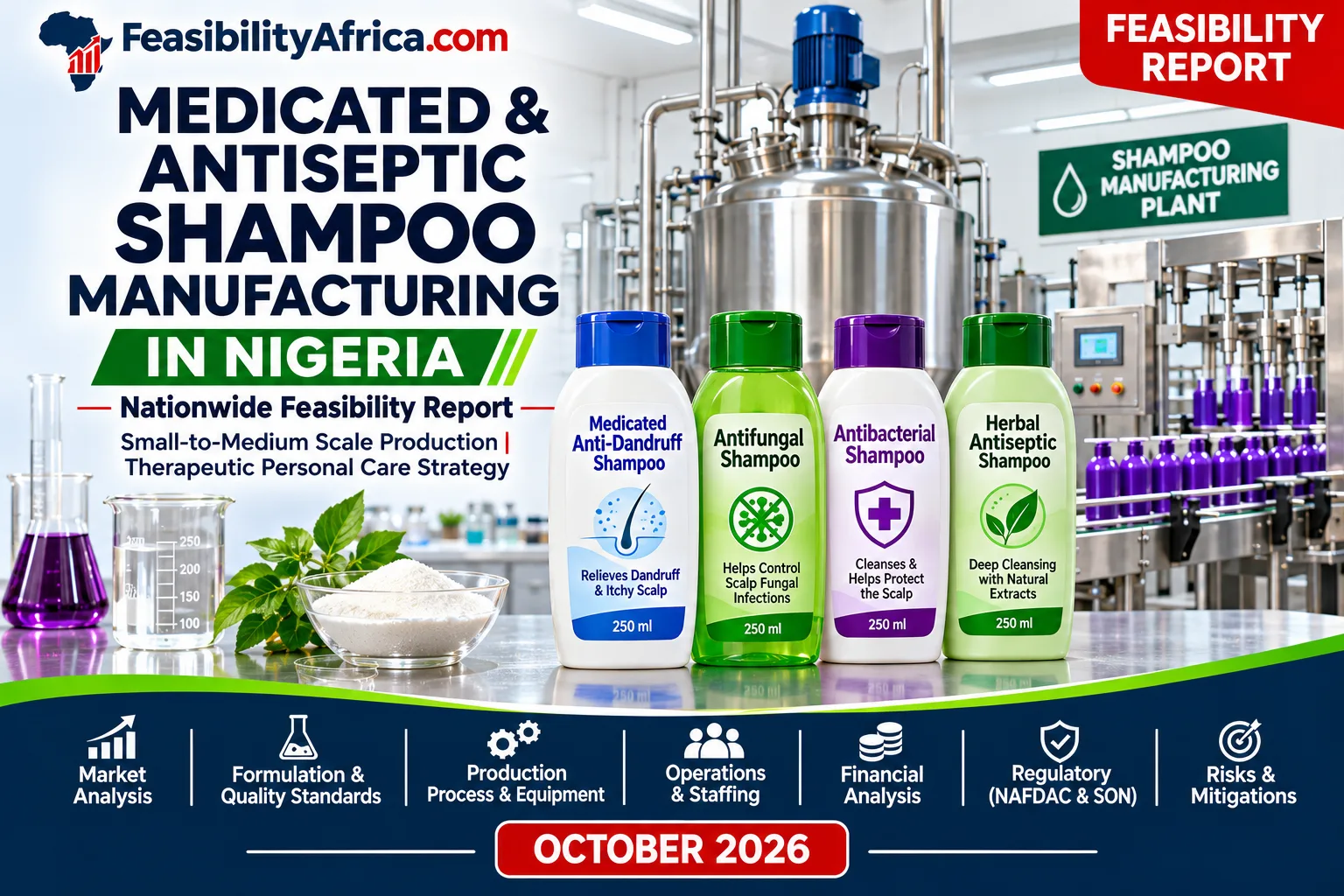
Medicated Shampoo Manufacturing in Nigeria: Exploring Opportunities in the Therapeutic Hair-Care Market
Nigeria's growing hair-care market presents opportunities for entrepreneurs interested in local shampoo manufacturing. Discover how medicated and antiseptic shampoos are formulated and produced, the ingredients and equipment required, the importance of NAFDAC compliance, potential customers, distribution strategies and the challenges of building a trusted personal-care brand.
By FeasibilityAfrica Research Team · · 14 min read
Introduction: Beyond Ordinary Shampoo
Hair care is an important part of personal hygiene and personal grooming. Across Nigeria, consumers purchase shampoos for routine hair washing, scalp care and the management of common scalp concerns such as dandruff, itching and flaking.
Yet the shampoo market is not limited to ordinary cleansing products. A specialised segment focuses on medicated and antiseptic formulations designed for particular scalp-care needs.
Products in this category occupy an interesting position between everyday personal care and therapeutic products. Consumers often look for formulations they perceive as more effective, while pharmacists, salons and other professional outlets can influence purchasing decisions.
For entrepreneurs and manufacturers, this creates an opportunity to develop locally produced products that combine consistent quality, appropriate formulation, regulatory compliance and competitive pricing.
However, medicated shampoo manufacturing is considerably more demanding than mixing ingredients and filling bottles. It is a formulation-driven manufacturing business in which product quality, safety, regulatory approval and consumer confidence are essential.
Understanding the Medicated and Antiseptic Shampoo Market
Ordinary shampoo is primarily designed to remove dirt, oil and product residue from hair and the scalp.
Medicated and specialised antiseptic shampoos, on the other hand, are formulated around particular scalp-care applications. Depending on their formulation and regulatory classification, they may contain specific active ingredients intended for defined purposes.
The Nigerian market includes several product categories.
Anti-dandruff shampoo
Anti-dandruff products address visible flaking and associated scalp discomfort.
They are familiar to consumers and provide a potential entry point for a new manufacturer seeking to establish a specialised hair-care brand.
Antifungal shampoo
These products are formulated with appropriate active ingredients for particular fungal-related scalp conditions.
They require careful formulation, quality control and regulatory assessment. Manufacturers must ensure that the product's composition and claims are supported by the applicable regulatory requirements.
Antibacterial scalp-care products
This category focuses on specialised scalp hygiene and products with antibacterial positioning.
The intended use, ingredients and claims must be carefully defined rather than assuming that every antiseptic formulation can make broad therapeutic claims.
Herbal antiseptic shampoo
Herbal-positioned products may incorporate ingredients such as neem, tea tree oil and aloe vera.
These products can appeal to consumers interested in plant-derived ingredients and locally relevant personal-care brands.
However, the use of natural ingredients does not automatically establish safety or effectiveness. Their quality, concentration, stability and compatibility with the complete formulation must be assessed.
Why Local Shampoo Manufacturing Presents an Opportunity
Nigeria's shampoo market offers several potential opportunities for manufacturers who can establish credible products and distribution.
The October 2026 feasibility report cites an estimated Nigerian shampoo market value of US$189.93 million in 2024, with a forecast of US$303.57 million by 2033.
It also identifies the medicated segment as the largest product category by market share in 2024.
These figures suggest an established market with potential for further growth. They should, however, be treated as market research estimates rather than guaranteed sales opportunities for a new manufacturer.
1. The price gap between imported and locally manufactured products
Imported medicated shampoos can be expensive for Nigerian consumers.
The report's October 2026 retail price comparisons include Nizoral products listed at approximately ₦27,500–₦39,800 and Selsun products at around ₦14,500–₦16,000, depending on the product and size.
Exchange-rate movements, importation costs and distribution expenses can influence the final retail price.
A credible Nigerian manufacturer may be able to compete by developing quality products at more accessible prices.
The opportunity is not simply to produce the cheapest shampoo. It is to provide a dependable alternative that consumers and professional retailers can trust.
2. Growing consumer attention to scalp care
Consumers increasingly distinguish between ordinary hair washing and specialised scalp care.
People experiencing dandruff, itching and other scalp concerns may seek products specifically positioned for their needs.
This creates room for brands with clearly differentiated formulations, appropriate labelling and reliable product quality.
3. Opportunities in pharmacies and salons
Medicated and specialised shampoo products are not necessarily sold through the same channels as ordinary household toiletries.
Pharmacies, patent medicine stores, hair salons, barbershops, supermarkets and beauty supply shops can all play important roles.
A manufacturer that develops relationships with these outlets can build brand credibility and access customers who are actively looking for specialised hair-care products.
What Goes into Shampoo Manufacturing?
The formulation of shampoo involves combining several ingredient categories to produce a stable, safe and effective finished product.
The precise ingredients depend on the intended product, formulation technology and regulatory classification.
Water
Water is the principal component of many liquid shampoo formulations.
The feasibility report estimates that treated water accounts for approximately 70–80% of the product.
Its quality is therefore critical. Untreated or contaminated water can compromise the finished product.
Manufacturers need an appropriate water-treatment system, such as reverse osmosis or deionisation, alongside routine water-quality monitoring.
Surfactants
Surfactants provide the cleansing and lathering properties of shampoo.
The report identifies Sodium Laureth Sulfate (SLES) and Cocamidopropyl Betaine (CAPB) among the relevant ingredients.
The choice and combination of surfactants influence cleansing performance, foam, texture and the overall characteristics of the formulation.
Active ingredients
Active ingredients distinguish specialised medicated products from ordinary cleansing shampoos.
The report identifies ketoconazole and zinc pyrithione among the ingredient categories used in its proposed product range.
These ingredients require particular attention to sourcing, quality documentation, concentration, compatibility and regulatory requirements.
Preservatives
Because liquid shampoo contains substantial quantities of water, microbial stability is an important consideration.
Preservatives help protect products against microbial contamination during storage and use.
The report identifies ingredients such as phenoxyethanol and sodium benzoate among possible preservative categories.
The appropriate preservative system must be selected and validated for the specific formulation.
Thickeners, fragrances and colourants
Thickeners help establish the desired consistency and viscosity.
Fragrances and colourants contribute to the product's appearance and sensory experience.
These ingredients must be compatible with the formulation and should not compromise product stability or safety.
Packaging materials
Packaging is more than a branding decision. It protects the product and supports storage, transportation and consumer use.
Common packaging components include:
- PET bottles.
- Caps and closures.
- Printed labels.
- Tamper-evident seals where appropriate.
- Cartons for transportation and distribution.
Packaging must be compatible with the product and sufficiently durable to withstand handling and distribution.
How Is Shampoo Manufactured?
Commercial shampoo manufacturing follows a controlled sequence of formulation, mixing, testing and packaging operations.
A typical production process involves the following stages.
1. Water treatment
Water is passed through an appropriate treatment system to achieve the required quality.
2. Preparation of the cleansing base
The treated water is processed with selected surfactants under controlled mixing and temperature conditions.
3. Addition of active ingredients
The appropriate active ingredients are introduced according to the formulation's specified order of addition, temperature and mixing requirements.
4. Thickening and pH adjustment
The formulation is adjusted to achieve the required viscosity and pH.
The feasibility report identifies a target pH range of 4.5–6.0 for its proposed product specifications.
5. Addition of fragrance and colour
These components are introduced at suitable stages to preserve their characteristics and achieve uniform distribution.
6. Quality-control testing
The batch is checked for appearance, pH, viscosity and microbial compliance before release.
7. Filling and capping
The approved product is transferred into bottles using suitable filling equipment. Containers are capped and checked for leakage and closure integrity.
8. Labelling and packaging
Each product receives the required label and batch information before being packed into cartons for storage and distribution.
The process requires documented procedures and trained personnel. Commercial manufacturing should not be treated as an informal household mixing activity.
Equipment Required for a Shampoo Manufacturing Plant
A small-to-medium-scale manufacturing operation requires a combination of production, water-treatment, filling and quality-control equipment.
Depending on the selected production capacity, the equipment may include:
- Reverse-osmosis water-treatment system.
- Stainless-steel mixing tanks.
- Agitators and heating systems.
- High-shear emulsifier.
- Semi-automatic liquid filling machine.
- Capping machine.
- Labelling machine.
- Batch coding and expiry-date printer.
- pH meter.
- Viscometer.
- Laboratory balance and glassware.
- Generator and supporting utilities.
The feasibility report evaluates a semi-automated production arrangement and provides illustrative equipment costs.
One important recommendation is to purchase equipment from suppliers who can provide installation, operator training, spare parts and after-sales support.
A cheaper machine without reliable technical support can become an expensive operational problem.
Quality Control: The Foundation of a Trusted Brand
For a medicated shampoo manufacturer, quality control is central to the business model.
Consumers may initially try a new brand because of its price or availability, but repeat purchases depend on their confidence in the product.
A manufacturer must be able to produce consistent batches that meet established specifications.
Important quality parameters include:
Appearance: The finished product should have a uniform appearance and colour consistent with its approved specification.
pH: The product must remain within its defined pH range.
Viscosity: The shampoo should have a consistent and appropriate texture.
Active ingredient concentration: The amount of each declared active ingredient must meet the approved specification.
Microbial quality: The product must comply with applicable microbiological limits.
Packaging integrity: Bottles should not leak, caps should remain secure and labels should withstand normal handling.
The manufacturer should maintain batch records, supplier documentation, testing records and traceability systems.
These procedures help identify problems, investigate complaints and maintain consistency as production volumes increase.
NAFDAC Registration: A Critical Requirement
Regulatory compliance is one of the most important aspects of medicated and antiseptic shampoo manufacturing in Nigeria.
Manufacturers must establish the correct product classification and comply with the applicable National Agency for Food and Drug Administration and Control (NAFDAC) requirements.
The feasibility report emphasises the importance of company documentation, product dossiers, label review, product testing and factory inspection.
The facility must be prepared for Good Manufacturing Practice (GMP) requirements.
This includes appropriate production areas, water quality, equipment, hygiene procedures, pest control and documentation.
Why registration should come before commercial sales
A manufacturer should not assume that a product can be sold commercially simply because a formulation has been developed or a factory has been established.
The report advises that commercial sales should not begin before the required NAFDAC registration has been issued.
It estimates a practical registration planning period of approximately 6–9 months, although actual timelines depend on the application and regulatory process.
The pre-approval period should be used for formulation development, facility preparation, staff training, trial production, quality systems and customer research.
Therapeutic claims also require particular care. A manufacturer must not make unsupported claims about treating or curing diseases.
Who Are the Potential Customers?
The commercial opportunity extends beyond individual consumers.
A manufacturer can develop a distribution strategy around several customer groups.
Pharmacies and patent medicine stores
These outlets are important because consumers often seek specialised products through professional or medicinal retail channels.
A credible, properly registered product with clear labelling and supporting documentation can be more attractive to these retailers.
Hair salons and barbershops
Hair professionals interact directly with consumers and can influence product selection.
Professional-use packs, product demonstrations and training can help establish relationships with salons and barbershops.
Supermarkets and beauty supply stores
These outlets provide visibility and access to consumers who purchase personal-care products during routine shopping.
Appropriate packaging, pricing and reliable product availability are important.
Regional distributors
As sales grow, distributors can help the manufacturer reach additional states and geographic markets.
A new manufacturer should first establish a dependable local sales base before expanding too quickly into nationwide distribution.
Building a Competitive Shampoo Brand
A successful shampoo manufacturing business needs more than production capacity.
It must establish a clear market position and communicate why consumers should trust its products.
The feasibility report recommends positioning the proposed brand as a credible local alternative to expensive imported medicated shampoos.
Three elements are particularly important.
Medical credibility: Product information, active ingredients, registration details and claims must be accurate and appropriately presented.
Local relevance: Product variants, packaging, pricing and marketing should reflect the needs and purchasing power of Nigerian consumers.
Affordability without compromising quality: Competitive pricing can attract customers, but the product must maintain the quality standards required to earn repeat purchases.
A manufacturer should avoid competing solely on price. A race to the bottom can make it difficult to maintain adequate margins, invest in quality and support distributors.
Marketing Strategies for a New Shampoo Manufacturer
Launching a new personal-care brand requires deliberate market development.
The report identifies several promotional strategies that can help a manufacturer build awareness and distribution.
Free sampling
Small trial packs can introduce the product to consumers through pharmacies, salons and promotional events.
Sampling is particularly useful when a brand has not yet established consumer recognition.
Salon partnerships
Professional relationships can help build product awareness and encourage recommendations from hair-care practitioners.
Pharmacy detailing
A sales representative can introduce the product to pharmacy operators, explain its positioning and provide the necessary product information.
Digital marketing
Social media content can educate consumers about scalp care, introduce product variants and create awareness of the brand.
Influencer partnerships may also help reach relevant audiences.
Marketing communications must remain consistent with the approved product claims and regulatory requirements.
Point-of-sale materials
Shelf displays, posters, leaflets and other materials can improve product visibility at the point of purchase.
The Financial Realities of Shampoo Manufacturing
The commercial potential of shampoo manufacturing should not obscure the financial demands of establishing a production facility.
The business requires investment in machinery, water treatment, production infrastructure, raw materials, packaging, regulatory processes, staffing, utilities and distribution.
The feasibility report estimates the following capital requirements for its illustrative business model:
- Recommended total capital planning figure: ₦20–₦28 million.
- Minimum liquid capital threshold for a lean launch: ₦15 million.
- Detailed full-scale capital requirement: approximately ₦25.7–₦40 million, including working capital.
- Illustrative equipment cost: ₦11.2–₦19.8 million.
These figures are planning estimates, not supplier quotations. Investors should validate them against current machinery prices, facility costs and raw material quotations.
Raw materials and packaging
The cost of surfactants, active ingredients, preservatives, fragrances and packaging materials has a significant effect on production economics.
Many specialised inputs are import-linked, even when purchased from local distributors.
Exchange-rate movements can therefore affect the manufacturer's cost structure.
Electricity and diesel
Production involves mixing, heating, water treatment and packaging operations.
Unreliable electricity can increase dependence on generators, making diesel consumption a major operating expense.
Manufacturers should monitor energy use and assess practical opportunities for reducing generator dependence.
Working capital
A manufacturing business must finance raw materials, packaging, salaries, utilities, marketing and distribution while waiting for customers to pay.
Pharmacies and supermarkets may request credit terms.
For a new business, uncontrolled credit sales can create a serious cash-flow problem even when sales volumes appear strong.
The report recommends cash-on-delivery arrangements for new customers and gradual extension of credit only to reliable accounts.
Why the First Year Can Be Difficult
A common mistake among new manufacturers is to assume that installing machinery automatically creates a profitable business.
In reality, a new shampoo brand must first establish product quality, obtain regulatory approval, build customer confidence and develop distribution relationships.
The feasibility report's illustrative financial model shows a loss-making first year, followed by approximately break-even performance in Year 2 and stronger profitability in Year 3 as production utilisation and sales increase.
It identifies production utilisation, raw material costs, diesel prices and selling prices as particularly important variables.
This means that the business requires sufficient capital to survive the early period rather than relying on immediate profits.
The report also estimates a detailed base-case payback period of 18–24 months. This is a projection based on its assumptions, not a guaranteed outcome.
Common Risks and How Manufacturers Can Manage Them
Regulatory delays: Start facility preparation and documentation early. Engage experienced regulatory professionals and do not begin commercial sales before approval.
Raw material price increases: Develop relationships with multiple suppliers, maintain appropriate safety stock and review pricing regularly.
Quality failures: Test incoming materials, validate formulations and establish documented batch-release procedures.
Slow customer adoption: Invest in sampling, pharmacy relationships, salon partnerships and targeted marketing.
Credit defaults: Begin with cash sales and introduce limited credit only after assessing customer payment history.
Equipment breakdown: Purchase from reputable suppliers, maintain critical spare parts and implement preventive maintenance.
Counterfeit competition: Build brand recognition, use appropriate packaging security features and maintain strong regulatory compliance.
These risks are manageable only when they are incorporated into the operating plan from the beginning.
Is Shampoo Manufacturing the Right Investment?
Medicated and antiseptic shampoo manufacturing may appeal to entrepreneurs who want to enter Nigeria's personal-care and consumer-products industry.
It offers the possibility of building a locally recognised brand, developing relationships with pharmacies and salons, and expanding into additional product categories over time.
However, the business is best suited to investors who have:
- Sufficient capital for equipment and working capital.
- Access to competent formulation and production professionals.
- A willingness to manage quality and regulatory requirements.
- The patience to build a brand over several years.
- A practical distribution and customer-acquisition strategy.
It may not be suitable for passive investors who expect immediate returns or entrepreneurs who cannot finance the regulatory and pre-revenue period.
Conclusion: The Opportunity Is in Quality, Trust and Distribution
Nigeria's shampoo market provides opportunities for manufacturers capable of combining reliable production with effective branding and distribution.
The medicated and antiseptic segment is particularly interesting because consumers are looking for specialised scalp-care products, while imported alternatives can be expensive.
A locally manufactured product can compete by offering an appropriate formulation, consistent quality, regulatory compliance and competitive pricing.
But the real challenge is not simply producing shampoo. It is building a trusted brand that pharmacies, salons, distributors and consumers are willing to support.
For prospective investors, the right approach is to understand the market, validate the formulation, secure the necessary approvals, invest in quality-control systems and maintain adequate working capital.
Considering a medicated or antiseptic shampoo manufacturing business in Nigeria?
The Medicated & Antiseptic Shampoo Manufacturing Feasibility Report in Nigeria (October 2026) provides a detailed assessment of the opportunity, including market analysis, product categories, raw material procurement, production processes, equipment requirements, regulatory procedures, staffing, marketing, financial projections and risk management.
It is designed to help entrepreneurs and investors evaluate the requirements of establishing a small-to-medium-scale shampoo manufacturing operation before committing capital.
Get the complete 34-page feasibility report from FeasibilityAfrica.com and make a more informed investment decision.
Enjoyed this? Get the next one free
Every new article, straight to you. Free. Choose email, WhatsApp — or both.
Email newsletter
New articles in your inbox. Unsubscribe anytime.
WhatsApp newsletter
Get new articles directly on WhatsApp. No spam, just new ideas.
Related articles
Manufacturing
Starting a Garri Processing Business: A Step-by-Step Guide
Machinery, raw material sourcing and why processed cassava beats raw cassava on margin.
Manufacturing
Bottled Water Manufacturing in Nigeria: How to Build a Competitive Business in the Packaged Drinking Water Market
Nigeria's demand for safe, conveniently packaged drinking water creates opportunities for regional manufacturers with reliable production and distribution. Discover how bottled water is produced, the machinery and regulatory approvals required, how to build a distributor network, and the financial and operational challenges investors must understand before setting up a plant.
Manufacturing
Margarine Manufacturing in Nigeria: Exploring Opportunities in the Table and Baking Margarine Market
Nigeria's margarine industry offers opportunities for food manufacturers supplying households, bakeries and commercial food businesses. Discover how table and baking margarine are made, the vegetable oils and specialised equipment involved, the importance of cold-chain management, and the challenges of building a competitive local margarine brand.