
High Quality Cassava Flour Processing in Nigeria: Turning Cassava into a Valuable Industrial Food Ingredient
Nigeria produces enormous quantities of cassava, yet converting this versatile crop into high-value industrial food ingredients remains a significant opportunity. Discover how High Quality Cassava Flour (HQCF) is produced, its applications in the food industry, potential customers, processing challenges and what investors should understand before entering the market.
By FeasibilityAfrica Research Team · · 12 min read
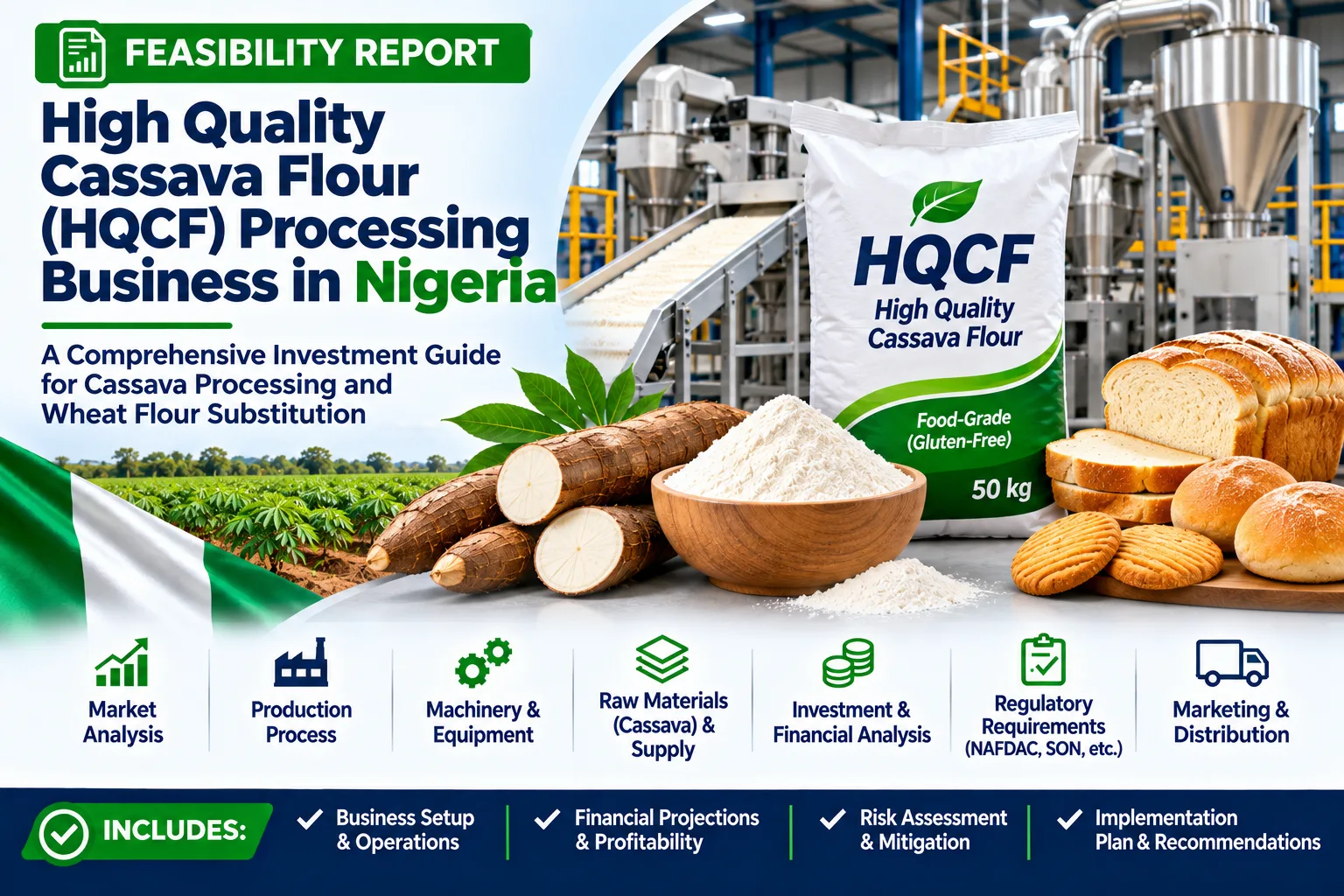
Nigeria is one of the world's major cassava-producing countries. Across many farming communities, cassava is cultivated by smallholder farmers and commercial growers, processed into traditional foods and sold in local markets.
But there is another side to the cassava industry that deserves greater attention: its potential as an industrial raw material.
Beyond garri, fufu and other familiar cassava products, the crop can be processed into High Quality Cassava Flour (HQCF), a specialised food ingredient with applications in bakeries, flour blending and other food manufacturing operations.
This creates an interesting opportunity at the intersection of agriculture and manufacturing. Instead of selling only fresh cassava roots or traditional processed products, entrepreneurs can explore supplying a more specialised ingredient to businesses that require consistent quality, reliable volumes and food-grade production standards.
However, HQCF processing is not simply about drying cassava and grinding it into flour. It is a technically demanding business in which raw material handling, processing technology, product specifications, energy costs and customer relationships all matter.
What Is High Quality Cassava Flour?
High Quality Cassava Flour is a food-grade, unfermented flour produced from fresh cassava roots.
Unlike garri and some traditional cassava products, HQCF is processed to produce a fine, white flour with controlled moisture content and other quality characteristics suitable for industrial food applications.
Its value lies partly in its ability to serve as an ingredient in products traditionally made with wheat flour.
Depending on the formulation and intended application, HQCF can be used as a partial substitute for wheat flour in:
- Bread
- Biscuits
- Cakes
- Snacks
- Other baked and processed foods
It is important to understand that HQCF is not automatically a one-for-one replacement for wheat flour in every recipe. Its functional properties differ, and manufacturers must determine suitable inclusion levels through product development and testing.
For bakeries and food manufacturers, the real question is whether HQCF can deliver acceptable product quality while helping manage ingredient costs.
That is where reliable processing and technical collaboration between flour suppliers and food manufacturers become important.
Why Nigeria's Cassava Industry Presents an Industrial Opportunity
Cassava is already deeply established in Nigeria's agricultural economy. It is cultivated across several geopolitical zones and supports millions of farmers, traders, transporters and processors.
Yet agricultural production alone does not guarantee industrial value creation.
Fresh cassava roots are perishable. They require timely harvesting, transportation and processing. Where processing capacity is inadequate, farmers may struggle to find dependable buyers, while processors may face difficulties securing consistent raw material supplies.
Industrial cassava processing can help connect agricultural production with more formal manufacturing markets.
HQCF is one possible route.
A well-organised processing operation can create commercial relationships with farmers and cooperatives, provide an outlet for fresh cassava roots and supply food manufacturers that need a consistent industrial ingredient.
This is particularly relevant in a country where the food industry has a continuing need to manage the cost and availability of key ingredients.
The opportunity is therefore not just about producing flour. It is about building a dependable link between cassava farmers and industrial food buyers.
The Wheat Flour Substitution Opportunity
One of the most discussed applications of HQCF is its use as a partial substitute for wheat flour in bread production.
Bread is a widely consumed food in Nigeria, and bakeries purchase significant quantities of flour as part of their regular production operations.
When the cost of wheat flour rises, bakers have an incentive to investigate alternative ingredients that may reduce production costs without making their products unacceptable to consumers.
HQCF offers one possible option.
The Nigerian government's cassava flour substitution policy has also drawn attention to the use of cassava flour in bread production, including a stated 20% inclusion target. However, policy targets should not be mistaken for guaranteed commercial demand. Actual adoption depends on implementation, ingredient availability, product performance, pricing and the willingness of bakeries to adjust their formulations.
For a prospective HQCF manufacturer, this distinction is crucial.
A large potential market does not automatically translate into confirmed orders. Before investing in a processing plant, an entrepreneur needs to establish whether specific bakeries, flour blenders and food manufacturers are willing to buy the product at a price that supports sustainable production.
Who Needs High Quality Cassava Flour?
HQCF has several potential customer categories.
1. Commercial bakeries
Large and medium-sized bakeries are potential buyers because they purchase flour regularly and may have the technical capacity to test alternative flour blends.
They are likely to be interested in consistency, reliable supply, product performance and the commercial implications of incorporating HQCF into their recipes.
2. Small and medium-scale bakeries
Smaller bakeries may also provide market opportunities, particularly where they can access HQCF through distributors or flour merchants.
However, adoption may require practical demonstrations, affordable packaging sizes and guidance on how to use the flour in existing recipes.
3. Flour millers and blenders
Flour blending companies may purchase HQCF as an ingredient for producing customised flour blends.
This customer category can be especially important because an established blender may have the technical infrastructure and distribution network to incorporate HQCF into products supplied to bakeries and other food businesses.
4. Food manufacturers
Businesses producing biscuits, cakes, snacks and other processed foods may explore HQCF as an ingredient where its functional characteristics are suitable.
Different applications require different product specifications, so manufacturers must work with suppliers to establish the appropriate flour quality.
5. Institutional and specialised food markets
Depending on the product specification, certification and applicable market requirements, additional opportunities may exist in institutional food supply and specialised food processing.
For an investor, the important lesson is to identify actual buyers rather than assume that every potential application represents an immediately accessible market.
How Is HQCF Produced?
HQCF processing involves a sequence of operations designed to transform fresh cassava roots into clean, dry, finely milled flour.
Although plant configurations differ, the general process includes the following stages.
1. Reception and sorting
Fresh cassava roots are received at the processing facility and inspected. Damaged, rotten or unsuitable roots should be separated from acceptable raw material.
2. Washing and peeling
The roots are washed to remove soil and other contaminants. Their outer layers are removed to prepare the material for further processing.
3. Grating
The peeled cassava is reduced into smaller particles through grating. This prepares the material for moisture removal and subsequent processing.
4. Dewatering
Excess water is removed from the grated cassava. Effective dewatering helps reduce the burden on the drying system.
5. Drying
The material is dried to achieve the required moisture level. This is one of the most important stages because drying conditions influence product quality, processing efficiency and energy consumption.
6. Milling and sieving
The dried material is milled into flour and passed through sieving equipment to achieve the desired particle size and uniformity.
7. Packaging and storage
The finished flour is packed in suitable food-grade packaging and stored under conditions that protect it from moisture, contamination and deterioration.
Each stage requires appropriate equipment, operating procedures and quality checks. A weakness in one stage can affect the quality of the final product.
Why Drying Technology Matters So Much
Among the different stages of HQCF production, drying deserves particular attention.
Fresh cassava contains substantial moisture. Converting it into stable flour requires effective moisture removal without compromising the product's quality.
Two broad drying approaches are often considered in processing operations: tray drying and flash drying.
Tray dryers use heated air to dry material arranged on trays. They may be considered for certain smaller-scale operations, but drying efficiency, product consistency and operating costs must be evaluated carefully.
Flash dryers use a different approach, rapidly drying suitably prepared material through a stream of hot air. They are commonly considered in industrial processing because of their ability to handle material continuously and reduce drying time.
The choice of drying technology can influence:
- Product consistency.
- Moisture control.
- Production capacity.
- Energy consumption.
- Labour requirements.
- Overall processing economics.
A prospective investor should not select a dryer based only on its purchase price. The more important question is how the technology performs under the intended operating conditions and what it costs to produce a kilogram of acceptable HQCF.
Quality Control: The Foundation of a Reliable HQCF Brand
Industrial food buyers cannot afford to work with suppliers whose products vary significantly from one delivery to another.
A bakery or flour blender needs to know that the HQCF it receives will meet agreed specifications and perform consistently during production.
Important quality parameters include:
Moisture content: Excess moisture can affect storage stability and increase the risk of deterioration.
Hydrogen cyanide (HCN): Cassava naturally contains cyanogenic compounds. Appropriate processing and testing are essential to ensure the finished food product meets applicable safety requirements.
Colour: A uniform white appearance is an important characteristic of food-grade HQCF.
Particle size: Milling and sieving determine the fineness and uniformity of the flour.
Microbiological quality: Hygiene throughout processing, packaging and storage helps protect the product from contamination.
Packaging and traceability: Proper packaging and production records support product protection, quality assurance and accountability.
For a manufacturer targeting formal food industry customers, quality control should be built into the operation from the beginning rather than introduced only after production has started.
The Cassava Supply Chain: An Advantage That Requires Careful Management
One of the most attractive aspects of HQCF processing is the opportunity to source raw materials from local farmers.
Cassava is cultivated in many parts of Nigeria, and processing plants can develop relationships with farmers, cooperatives and produce aggregators.
However, fresh cassava roots present a major logistical challenge: they deteriorate relatively quickly after harvesting.
This means that a processing plant cannot treat cassava procurement in the same way it might treat the purchase of a shelf-stable commodity.
A successful operation needs to coordinate harvesting, transportation and factory processing.
Some practical considerations include:
- Establishing relationships with farmers and cooperatives.
- Identifying cassava-producing communities close to the factory.
- Planning harvesting schedules around production requirements.
- Maintaining reliable transportation arrangements.
- Avoiding excessive delays between harvesting and processing.
- Monitoring the quality of incoming roots.
The location of the factory is therefore closely connected to the raw material strategy.
A plant situated far from dependable cassava supply may face higher transportation costs, delays and raw material quality problems.
Can Cassava Processing Create Additional Revenue Opportunities?
Cassava processing can generate more than one product or output.
For example, cassava peels are produced during processing. Rather than treating all processing residues as waste, operators can investigate suitable uses for them.
Cassava peels may be sold fresh or processed further for use in animal feed, subject to appropriate handling and processing requirements.
This creates an opportunity to improve resource utilisation and potentially generate additional income.
However, by-product revenue should be treated as supplementary until actual buyers, processing requirements and selling prices have been established.
The main business case should be built around the reliable production and sale of the principal product.
Regulatory Requirements and Food Safety
HQCF is intended for human food applications, so regulatory compliance is a fundamental part of establishing a credible processing business.
Entrepreneurs should understand the requirements of relevant Nigerian authorities, including the National Agency for Food and Drug Administration and Control (NAFDAC) and the Standards Organisation of Nigeria (SON).
Depending on the product and applicable standards, the business may need to address:
- Company registration and appropriate business documentation.
- Suitable factory premises and hygienic processing facilities.
- Food safety and good manufacturing practices.
- Product testing and documentation.
- Applicable NAFDAC registration requirements.
- Relevant SON standards and MANCAP certification.
- Environmental and waste-management obligations.
Regulatory requirements should be confirmed directly with the relevant authorities before production and commercial distribution.
Building a compliant facility from the beginning can reduce costly modifications and help establish confidence among institutional and industrial buyers.
The Challenges Investors Must Understand
HQCF processing has genuine industrial potential, but it also has challenges that should not be overlooked.
1. Finding buyers at commercially viable prices
The existence of bakeries and food manufacturers does not guarantee that they will purchase HQCF at a price that makes processing profitable.
Potential customers may require product samples, technical demonstrations, testing and supplier qualification before placing regular orders.
2. Energy costs
Drying is energy-intensive. Where a plant relies heavily on diesel-powered generators, energy expenses can significantly affect the cost of production.
Investors should evaluate available power options and the energy requirements of the proposed processing technology.
3. Raw material logistics
Cassava roots must be harvested and transported promptly. Poor coordination between farmers and the factory can lead to deterioration and production interruptions.
4. Inconsistent product quality
Poor drying, inadequate processing controls and weak hygiene practices can produce flour that fails to meet industrial buyer specifications.
5. Working capital constraints
The business may need to purchase cassava, pay workers, cover energy expenses and maintain operations before receiving payment from industrial customers.
Where buyers request credit, the processor must have sufficient financial capacity to manage the collection period.
6. Technology and maintenance
Processing equipment must be properly installed, operated and maintained. Equipment breakdowns can interrupt production and affect the ability to meet customer orders.
These challenges make it important to approach HQCF processing as a complete agro-industrial business rather than simply an agricultural extension activity.
What Makes an HQCF Processing Business Competitive?
A competitive HQCF manufacturer needs to combine agricultural supply management with industrial discipline.
The following areas deserve particular attention:
Reliable raw material supply: Build relationships with farmers and aggregators who can supply cassava roots consistently.
Appropriate processing technology: Select machinery that can produce the required quality at an operating cost the business can sustain.
Consistent product specifications: Develop quality-control procedures and test products before delivery.
Confirmed customer demand: Engage bakeries, flour blenders and food manufacturers before committing major capital.
Efficient energy management: Understand the cost of drying and investigate suitable energy alternatives.
Strong financial management: Monitor production costs, sales prices, customer payment terms and working capital requirements.
Regulatory compliance: Establish the necessary quality and food safety systems for the intended market.
Ultimately, the strongest competitive advantage may not be the ability to produce the cheapest flour. It may be the ability to supply the right quality consistently, at a commercially acceptable price, with dependable delivery.
Is HQCF Processing a Good Investment in Nigeria?
It can be an opportunity worth investigating, but it is not automatically profitable simply because cassava is widely cultivated.
The economics of HQCF processing depend on the relationship between raw material costs, processing yield, drying expenses, selling prices, production capacity and customer demand.
A particularly important consideration is the difference between producing HQCF at a low raw material cost and selling it at a price that covers the full cost of processing.
An investor who secures cheap cassava but faces high energy costs or cannot find buyers at viable prices may still struggle to operate profitably.
Before purchasing machinery, it is essential to validate buyer prices, obtain supplier quotations, assess the local cassava supply chain and understand the financial implications of the chosen processing technology.
A proper feasibility assessment can help reveal whether the proposed location, production capacity, equipment configuration and commercial strategy make sense.
Ready to Explore High Quality Cassava Flour Processing in Nigeria?
Nigeria's cassava industry offers opportunities to create greater value from an important agricultural crop. HQCF processing provides one route into the formal food manufacturing value chain, with potential customers in bakeries, flour blending and other food production businesses.
But turning this opportunity into a sustainable business requires careful investment planning and a realistic understanding of the market.
Our High Quality Cassava Flour (HQCF) Processing Business Feasibility Report in Nigeria (2026) provides a detailed assessment for entrepreneurs and investors considering entry into this sector.
It examines the processing business, raw material sourcing, production technology, machinery requirements, location strategy, regulatory considerations, marketing and distribution, financial assumptions, operating risks and conditions that must be met for commercial viability.
Do not assume that abundant cassava automatically means a profitable processing business. Understand the market, validate the numbers and plan your investment carefully.
Purchase the full HQCF Processing Feasibility Report from FeasibilityAfrica.com and take a more informed step towards evaluating this agro-industrial opportunity.
Enjoyed this? Get the next one free
Every new article, straight to you. Free. Choose email, WhatsApp — or both.
Email newsletter
New articles in your inbox. Unsubscribe anytime.
WhatsApp newsletter
Get new articles directly on WhatsApp. No spam, just new ideas.
Related articles
Manufacturing
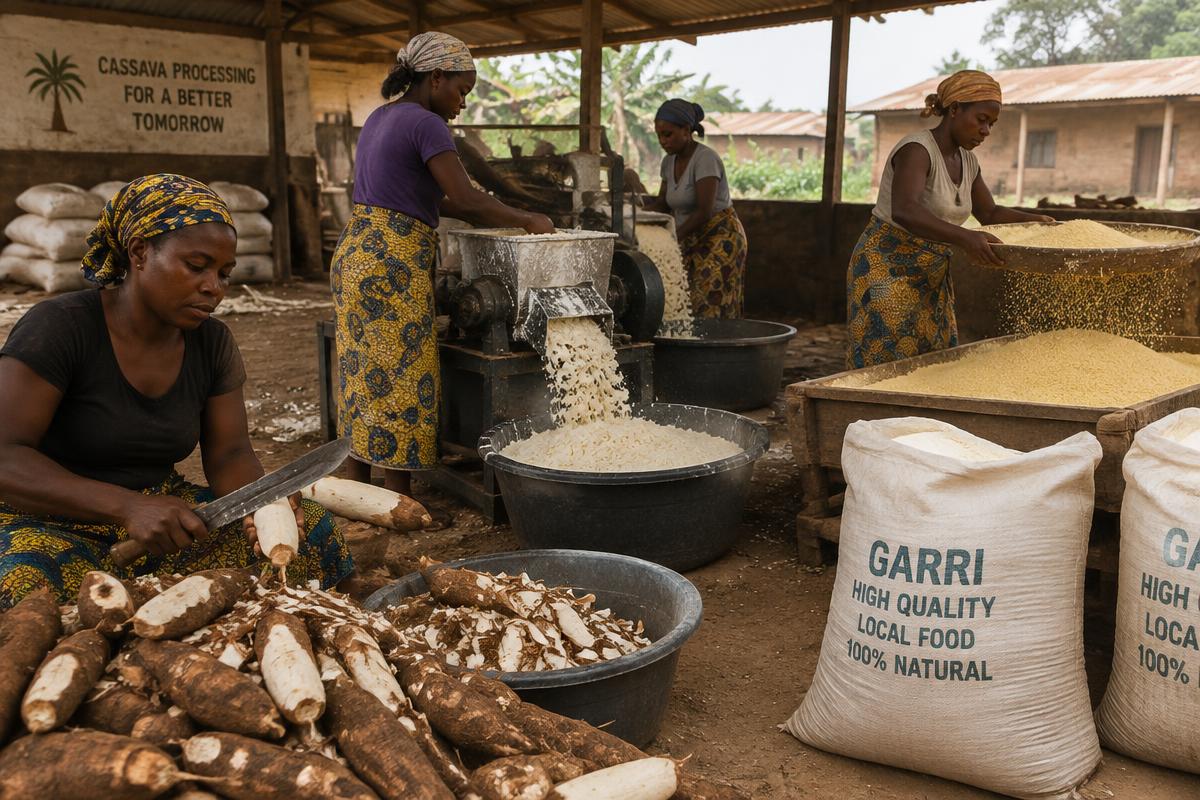
Starting a Garri Processing Business: A Step-by-Step Guide
Machinery, raw material sourcing and why processed cassava beats raw cassava on margin.
Manufacturing
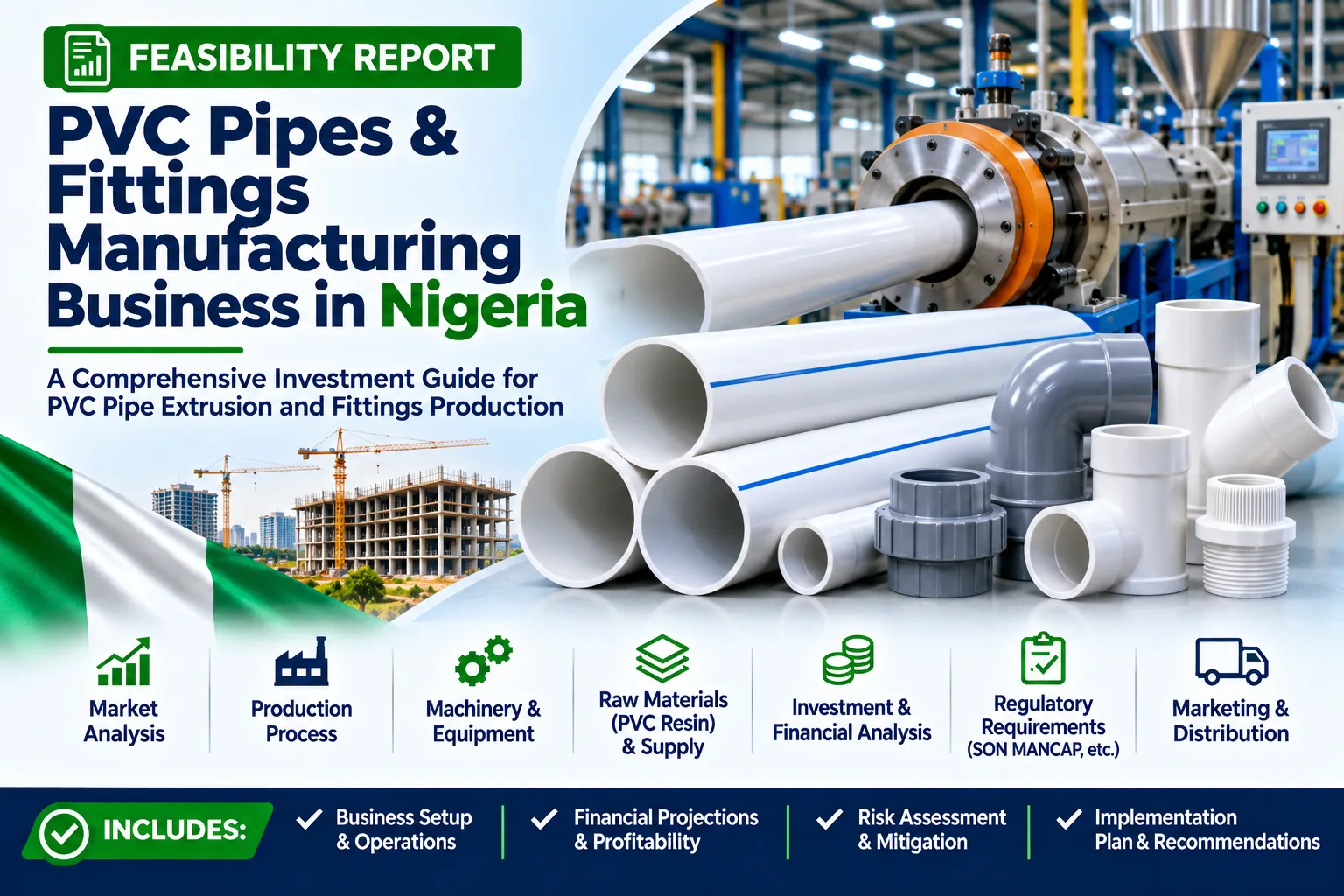
PVC Pipes and Fittings Manufacturing in Nigeria: Exploring Opportunities in the Construction and Infrastructure Market
Nigeria’s demand for reliable plumbing, water supply, drainage and electrical conduit products creates opportunities for local manufacturers. Discover how PVC pipes and fittings are produced, the customers who need them, the challenges manufacturers face and what it takes to build a competitive brand in this growing industrial market.

Manufacturing
Tissue Paper Manufacturing Business in Nigeria: How to Tap Into the Growing Hygiene Products Market
Discover the opportunities in Nigeria's tissue paper manufacturing industry. Learn how toilet rolls, serviettes and facial tissues are produced, who buys them, how to compete and what entrepreneurs should know before entering this everyday consumer products market.