
PVC Pipes and Fittings Manufacturing in Nigeria: Exploring Opportunities in the Construction and Infrastructure Market
Nigeria’s demand for reliable plumbing, water supply, drainage and electrical conduit products creates opportunities for local manufacturers. Discover how PVC pipes and fittings are produced, the customers who need them, the challenges manufacturers face and what it takes to build a competitive brand in this growing industrial market.
By FeasibilityAfrica Research Team · · 11 min read
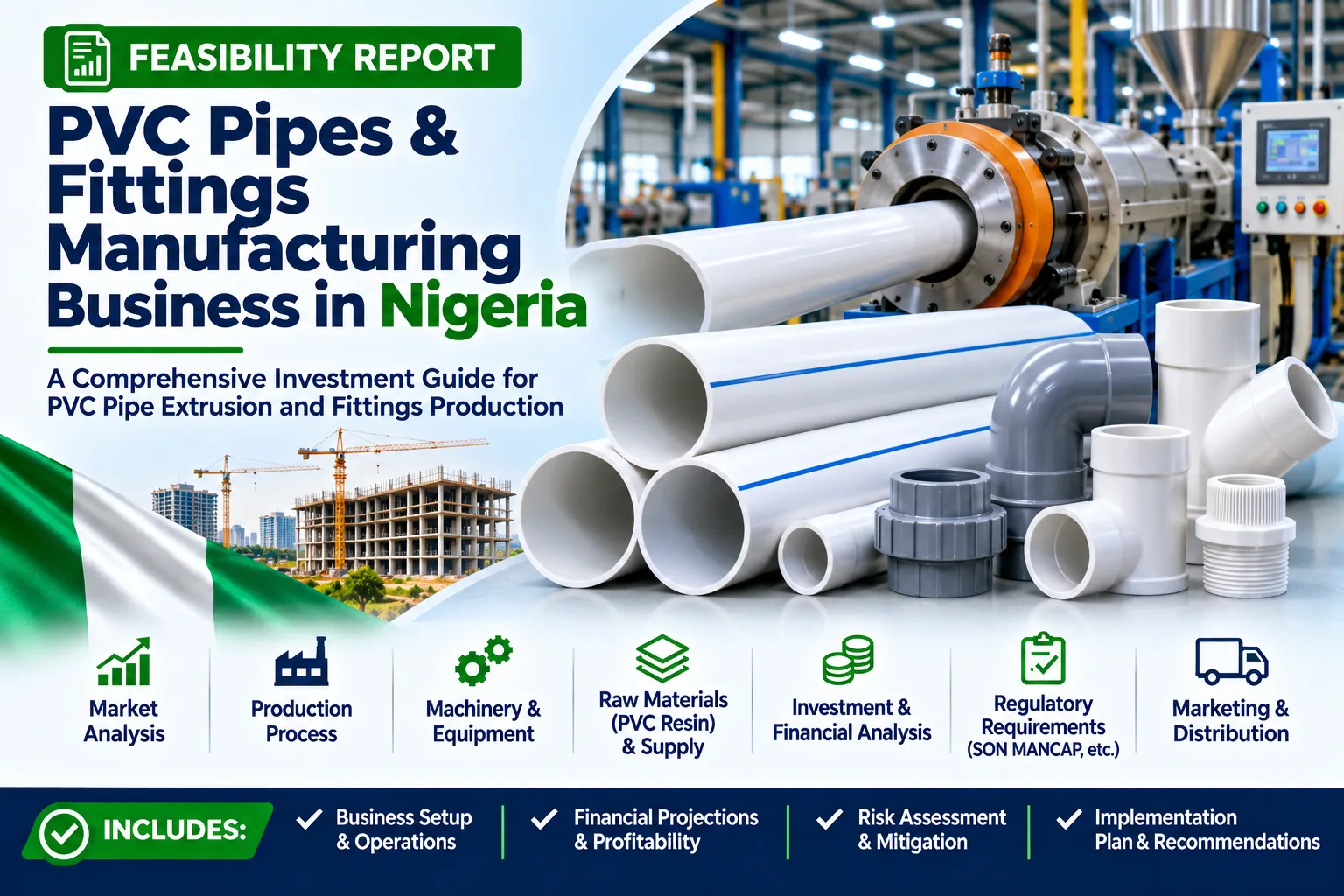
Imagine a new residential estate taking shape, a commercial building undergoing plumbing installation, or a community water project being developed. Beyond cement, roofing sheets, steel and other visible construction materials, there is another category of products that plays an essential role in almost every project: PVC pipes and fittings.
These products are used to transport water, manage wastewater, protect electrical cables and support irrigation systems. They are essential components of modern buildings and infrastructure, making them part of a market with demand from construction companies, plumbers, contractors, distributors, government projects and agricultural businesses.
For entrepreneurs and investors exploring manufacturing opportunities in Nigeria, PVC pipes and fittings production presents an interesting industrial proposition. However, the opportunity is not simply about acquiring machines and producing plastic pipes. Success depends on understanding the market, maintaining consistent product quality, managing raw material costs and building a distribution network that can move products efficiently.
Why PVC Pipes Are Important to Nigeria's Economy
PVC, or polyvinyl chloride, is one of the widely used materials in the construction and infrastructure industries. In its unplasticised form, commonly called uPVC, it is used to manufacture rigid pipes and fittings designed for different applications.
Its popularity comes from a combination of practical properties. PVC pipes are relatively lightweight, resistant to corrosion, easy to transport and install, and suitable for a variety of plumbing, drainage and electrical applications.
Unlike some traditional piping materials, PVC does not rust. This makes it useful in water distribution and drainage systems where long-term performance and maintenance costs matter.
As Nigerian communities expand, buildings are constructed and infrastructure projects are undertaken, the need for dependable piping products remains relevant.
The opportunity for local manufacturers lies in supplying products that meet the technical requirements of these applications while remaining competitively priced.
Understanding the Different Types of PVC Pipes and Fittings
A manufacturer entering this industry should understand that PVC pipes are not one uniform product. Different applications require different dimensions, specifications and performance characteristics.
1. Pressure pipes
Pressure pipes are designed to carry water under pressure. They are commonly used in plumbing installations, boreholes, water distribution networks and other water supply systems.
Their performance depends on factors such as wall thickness, material quality and pressure rating. A pipe intended for a particular pressure application must be manufactured to the appropriate specification.
2. Electrical conduit pipes
Electrical conduit pipes provide protective pathways for electrical cables in residential, commercial and industrial buildings.
They help protect wiring from physical damage and support organised electrical installations. Conduit products are commonly differentiated by their dimensions, colour and intended application.
3. Drainage and sewerage pipes
Drainage pipes are used to transport wastewater, stormwater and other forms of liquid waste.
They are important in residential buildings, commercial facilities, industrial premises and municipal drainage systems. Larger pipe diameters may be required for particular drainage and sewerage applications.
4. PVC fittings
Pipes rarely function independently. Plumbing and drainage installations require fittings that connect pipe sections and allow changes in direction or branching.
Common products include:
- Elbows
- Tees
- Couplings
- End caps
- Other connecting accessories
Fittings are commercially important because customers often prefer to obtain compatible pipes and accessories from the same supplier.
A manufacturer that offers a useful combination of pipes and fittings can serve customers more comprehensively than one that sells only a limited range of pipe products.
Who Buys PVC Pipes and Fittings in Nigeria?
The market is not restricted to large construction companies. There are several categories of customers that manufacturers can target.
Building material wholesalers and distributors: These businesses purchase products in volume and supply retailers, contractors and individual customers. They can become important partners for manufacturers seeking broad market coverage.
Plumbing contractors and installers: Plumbers and installation professionals influence the brands used in residential and commercial projects. Their confidence in product quality can influence repeat purchases and recommendations.
Construction companies and property developers: Residential estates, office buildings, shopping facilities and industrial developments require piping products at different stages of construction.
Government and infrastructure contractors: Water supply, sanitation, drainage and public infrastructure projects can create demand for pipes that meet specified technical requirements.
Agricultural businesses: Irrigation systems, including drip and sprinkler installations, use piping products to move and distribute water.
Electrical contractors: These customers require conduit pipes for protecting electrical cables in buildings and other installations.
Understanding these customer groups helps a manufacturer develop a more focused sales strategy instead of relying entirely on walk-in retail customers.
How Are PVC Pipes Manufactured?
PVC pipe manufacturing is an industrial process that requires specialised equipment, trained operators and careful quality control.
The process generally begins with the preparation of a formulation containing PVC resin and selected additives. These materials are measured and mixed to achieve the desired processing and product characteristics.
The prepared compound is then fed into an extrusion machine. Heat and mechanical action soften the material, which is forced through a specially designed die to form a continuous pipe.
The hot pipe passes through calibration and cooling equipment. This stage helps establish the required dimensions and shape. A haul-off unit controls the movement of the pipe, while a cutting system divides it into standard lengths.
Finished pipes undergo inspection and testing before packaging and storage.
Fittings follow a different production route. They are commonly manufactured through injection moulding, where prepared material is heated and injected into specially designed moulds. Once cooled, the fittings are removed, finished and inspected.
The two processes complement each other. Pipe extrusion produces continuous lengths of pipe, while injection moulding creates the accessories required to connect and complete piping installations.
Raw Materials: An Important Factor in Manufacturing Success
PVC resin is the principal raw material used in PVC pipe production. Other materials are incorporated into the formulation to influence processing characteristics, colour, stability and the physical properties of the finished product.
Depending on the product specification, these may include:
- Calcium carbonate
- Titanium dioxide
- Heat stabilisers
- Lubricants and processing aids
- Pigments and other additives
The quality and consistency of these materials matter. Variations in raw material quality or formulation can affect the finished product's dimensions, appearance, strength and performance.
One important consideration for Nigerian manufacturers is the supply of PVC resin. The industry is exposed to international resin prices, foreign exchange movements, import logistics and changes in shipping costs.
This creates a procurement challenge: a manufacturer may have sufficient production capacity but still struggle to maintain competitive prices if raw material costs rise unexpectedly.
Establishing dependable supplier relationships, obtaining competitive quotations and maintaining appropriate inventory are therefore important parts of the business.
Quality Is More Than Appearance
A PVC pipe may look attractive on a shop shelf but still fail to perform as expected when installed.
For this reason, serious manufacturers must pay attention to technical quality rather than relying on appearance or low prices alone.
Important quality considerations include:
- Correct outside diameter and dimensional tolerances.
- Consistent wall thickness.
- Appropriate pressure rating for the intended application.
- Resistance to impact and handling damage.
- Reliable joints and compatibility with fittings.
- Correct product markings and traceability.
For customers, the consequences of poor-quality pipes can be expensive. A failed pipe may result in water leakage, property damage, repairs, project delays and reputational problems for contractors.
Manufacturers that demonstrate consistent quality can build trust with distributors, plumbers, developers and project contractors.
In Nigeria, product certification and compliance with applicable standards are also important considerations. Manufacturers should engage the Standards Organisation of Nigeria (SON) to establish the relevant Nigerian Industrial Standards and certification requirements for their products. Additional requirements may apply to products intended for potable water systems.
Certification should not be treated as an administrative afterthought. It is part of building a credible manufacturing business.
The Competitive Landscape: Why Cheap Products Are Not Always the Best Strategy
The PVC pipes and fittings market contains different categories of competitors, including established manufacturers, smaller regional producers and imported products.
Some customers prioritise price, while others place greater emphasis on durability, certification, availability and the reliability of the supplier.
This creates an important strategic choice for a new manufacturer.
Competing solely on price can be dangerous, particularly when raw material and energy costs are volatile. A business that continually reduces prices without protecting product quality may find it difficult to maintain sustainable operations.
A stronger approach is to develop a clear market position built around:
Consistent quality: Customers should be confident that products purchased today will meet the same specifications as products purchased previously.
Reliable availability: Contractors and distributors need suppliers who can deliver the required sizes and quantities when needed.
Competitive pricing: Prices must be attractive enough to support distributors and retailers while allowing the manufacturer to cover production and operating costs.
Technical credibility: Product markings, test records, certification and responsive technical support help establish trust.
Strong relationships: Regular engagement with distributors, plumbers and contractors can create repeat business and provide valuable feedback about market requirements.
The Importance of Location and Distribution
Manufacturing PVC pipes is not simply a matter of locating a factory wherever land is affordable.
A suitable location should be evaluated in relation to raw material supply, access to customers, transportation infrastructure, industrial zoning, water availability, security and energy costs.
Because important raw materials may be imported, logistics from ports and major supply centres can have a significant effect on production costs.
At the same time, finished pipes are bulky products. Their transportation and storage require adequate space and careful planning.
A manufacturer serving customers across several states must consider how to move products efficiently without allowing distribution costs to erode its competitive advantage.
This is why a regional distribution strategy can be useful. A business may begin with one production facility and gradually appoint distributors or establish strategically located stock points as its customer base expands.
The objective should be to build market coverage in a financially disciplined manner rather than rushing into multiple production facilities before demand has been established.
Energy: A Major Operational Consideration
PVC extrusion and injection moulding require industrial machinery and dependable electricity.
Power interruptions, voltage fluctuations and equipment downtime can disrupt production, affect product consistency and increase operating costs.
Many Nigerian manufacturers rely on alternative power sources to maintain production. However, diesel generation can place significant pressure on operating expenses, particularly when energy prices rise.
Investors should therefore assess power availability and the cost of alternative energy before selecting a factory location or purchasing equipment.
Energy efficiency, preventive maintenance and proper production scheduling can also help reduce avoidable operating costs.
Common Challenges in PVC Manufacturing
Despite the opportunities, PVC pipes and fittings manufacturing is not a risk-free business.
Some of the major challenges include:
Foreign exchange exposure: Imported PVC resin and certain additives expose manufacturers to exchange-rate fluctuations.
Raw material price volatility: Changes in global resin prices can affect production costs and selling prices.
Power and energy costs: Industrial machinery requires dependable power, and alternative energy can be expensive.
Quality control: Poor formulation, incorrect processing conditions or inadequate testing can result in defective products.
Competition: Established brands and lower-priced producers can make market entry difficult.
Distribution and credit risk: Selling to distributors and contractors may involve requests for credit. Poor collection practices can create cash-flow problems even when sales appear strong.
Regulatory compliance: Manufacturers must understand applicable product standards, certification requirements and environmental obligations.
These challenges do not automatically make the industry unattractive. They show why proper planning, technical competence and disciplined management are essential.
Is PVC Pipes and Fittings Manufacturing Suitable for Every Investor?
Not necessarily.
This is an industrial manufacturing business, not a small trading operation that can be started with limited equipment and minimal technical supervision.
It requires substantial investment in machinery, factory infrastructure, power systems, raw materials, quality-control equipment, skilled personnel and working capital.
It also requires an operator who understands production management, procurement, distribution and customer relationships.
An investor who is interested in the sector but lacks manufacturing experience should consider the importance of recruiting experienced technical personnel and obtaining professional advice before committing capital.
The ability to produce pipes is only one part of the equation. The business must also be able to manufacture to specification, sell consistently, collect payments and replenish raw materials.
Turning the Opportunity into a Viable Manufacturing Business
Nigeria's construction, plumbing, water supply, drainage and agricultural sectors create several potential markets for PVC pipes and fittings.
However, identifying demand is different from proving that a particular factory will be profitable.
A serious investor must answer important questions:
- Which pipe categories and sizes should the factory produce first?
- What production capacity is appropriate for the target market?
- Which machinery configuration offers the right balance between output and investment?
- Where should the factory be located?
- How much working capital is required to sustain production?
- What are the realistic costs of raw materials, power, labour and logistics?
- What selling prices will distributors and contractors accept?
- How much product must be sold to cover operating costs?
- What regulatory approvals and product certifications are required?
- How long could it take to establish a reliable distribution network?
These questions should be answered before machinery is purchased or major capital is committed.
Want to Start a PVC Pipes and Fittings Manufacturing Business in Nigeria?
The opportunity is worth investigating, but successful entry requires more than an attractive market narrative. It requires a clear understanding of the investment requirements, production process, machinery, raw material supply, operating costs, market conditions and financial risks.
Our PVC Pipes and Fittings Manufacturing Business Feasibility Report in Nigeria (2026) is designed to help prospective investors and entrepreneurs evaluate the opportunity before making major investment decisions.
The report provides a structured assessment of the proposed manufacturing operation, including the production model, product range, equipment requirements, raw material procurement, location strategy, regulatory considerations, marketing and distribution, financial projections, risk analysis and implementation roadmap.
Do not invest blindly in industrial machinery. Understand the business before committing your capital.
Get the full feasibility report from FeasibilityAfrica.com and take a more informed step towards establishing a PVC pipes and fittings manufacturing business in Nigeria.
Enjoyed this? Get the next one free
Every new article, straight to you. Free. Choose email, WhatsApp — or both.
Email newsletter
New articles in your inbox. Unsubscribe anytime.
WhatsApp newsletter
Get new articles directly on WhatsApp. No spam, just new ideas.
Related articles
Manufacturing
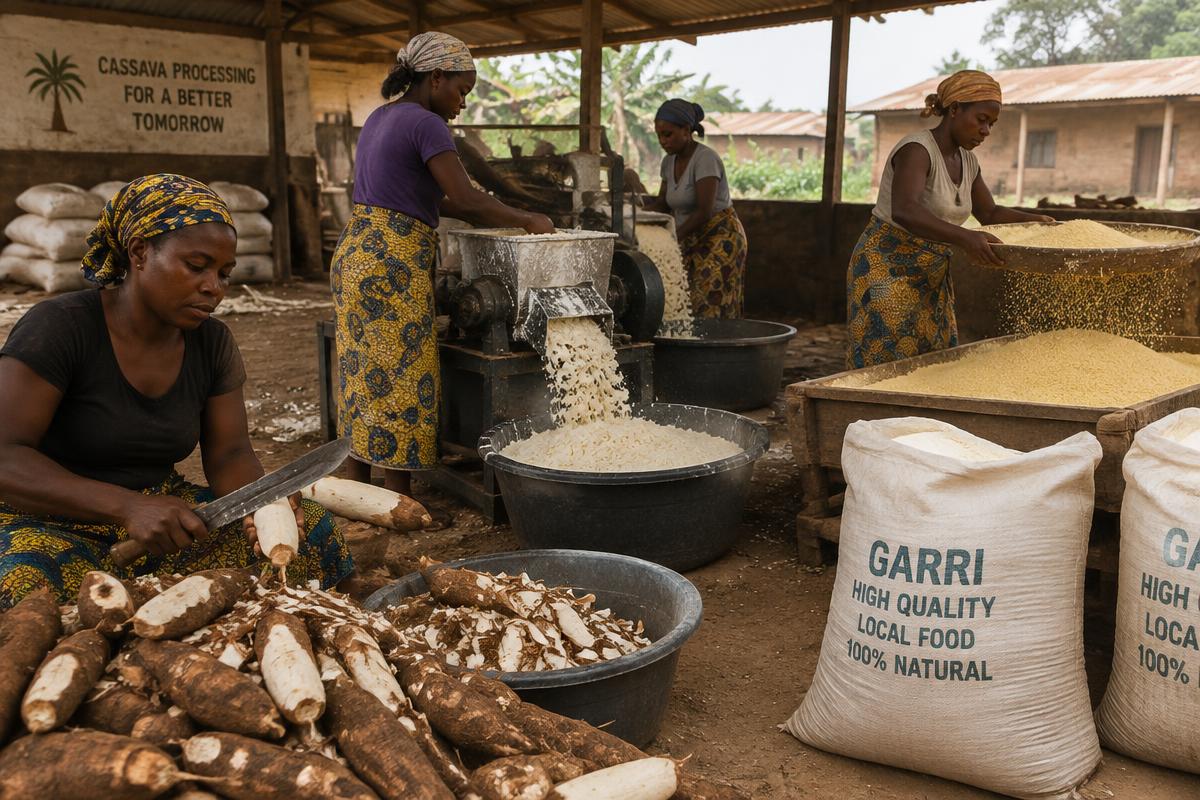
Starting a Garri Processing Business: A Step-by-Step Guide
Machinery, raw material sourcing and why processed cassava beats raw cassava on margin.
Manufacturing
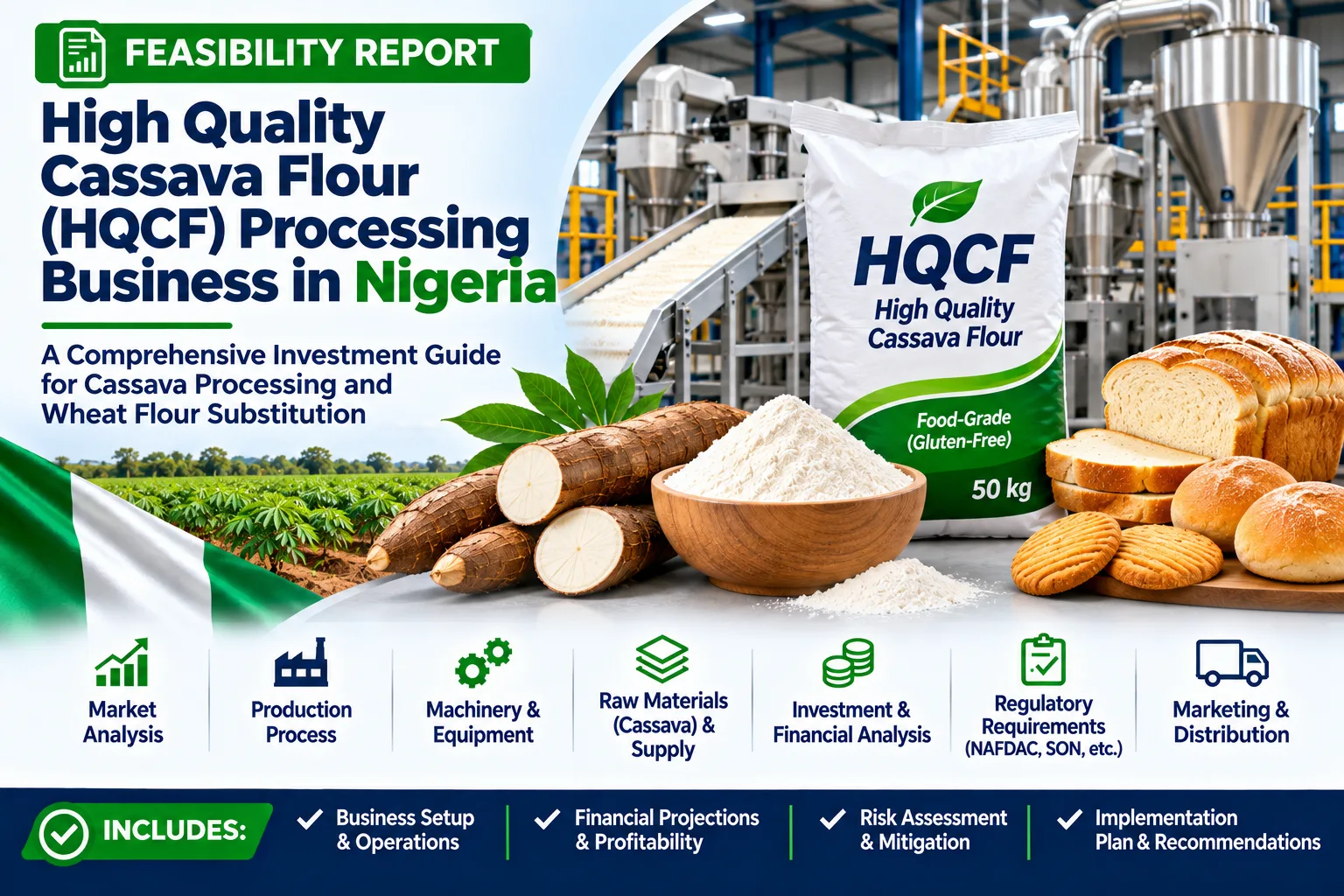
High Quality Cassava Flour Processing in Nigeria: Turning Cassava into a Valuable Industrial Food Ingredient
Nigeria produces enormous quantities of cassava, yet converting this versatile crop into high-value industrial food ingredients remains a significant opportunity. Discover how High Quality Cassava Flour (HQCF) is produced, its applications in the food industry, potential customers, processing challenges and what investors should understand before entering the market.
Manufacturing
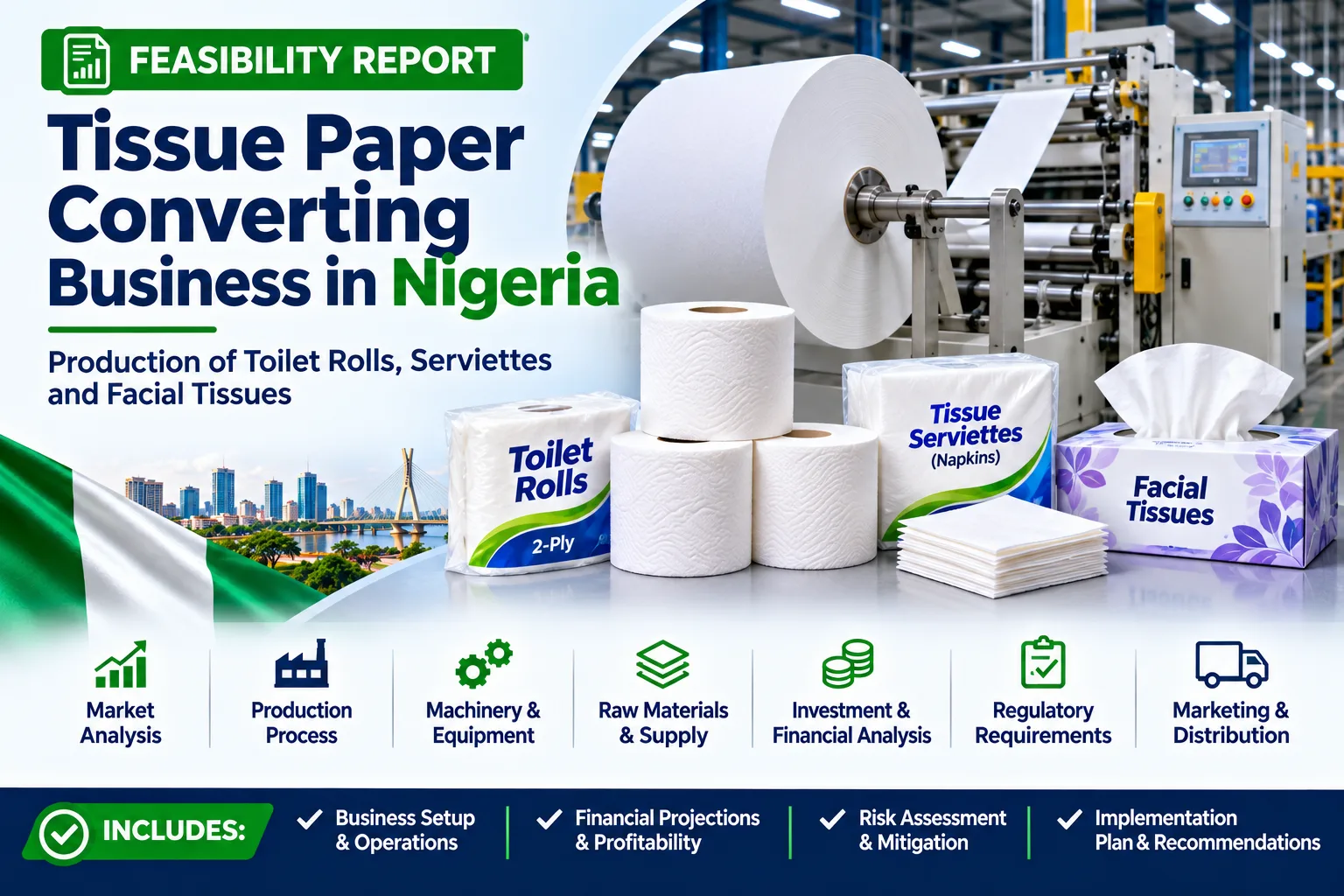
Tissue Paper Manufacturing Business in Nigeria: How to Tap Into the Growing Hygiene Products Market
Discover the opportunities in Nigeria's tissue paper manufacturing industry. Learn how toilet rolls, serviettes and facial tissues are produced, who buys them, how to compete and what entrepreneurs should know before entering this everyday consumer products market.