
Toothpaste Manufacturing Business in Nigeria: A Lucrative Opportunity for Entrepreneurs and Investors?
Thinking of starting a toothpaste manufacturing business in Nigeria? Discover the market opportunities, production process, raw materials, industry challenges and what it takes to build a competitive oral care brand in Nigeria.
By FeasibilityAfrica Research Team · · 11 min read
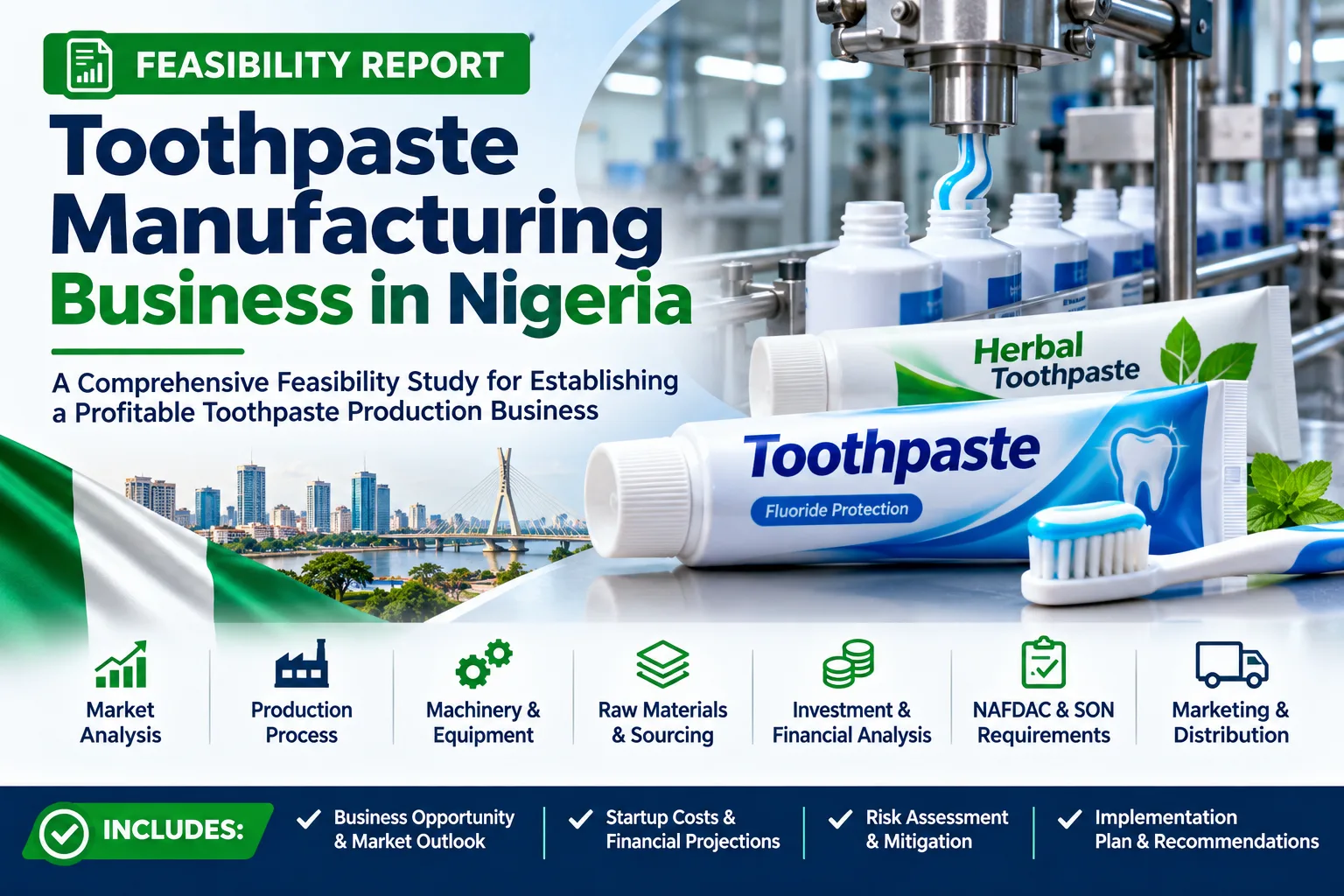
Imagine owning a brand of toothpaste that millions of Nigerians use every morning and night. Your product sits on supermarket shelves, in neighbourhood shops, pharmacies, hotels and homes across the country. Every day, consumers purchase it, use it and return to the market for another tube.
This is the nature of the toothpaste business: a consumer product built around a recurring everyday need.
Toothpaste is not a luxury product reserved for wealthy consumers. It is a household essential used by people across different income groups. Whether someone purchases a premium international brand or a more affordable alternative, the need for toothpaste remains.
For Nigerian entrepreneurs and investors, this creates an interesting manufacturing opportunity.
But there is a bigger question: Why should Nigeria continue to depend heavily on established international brands when local entrepreneurs can develop competitive toothpaste products and build successful Nigerian-owned oral care companies?
The opportunity is worth exploring.
1. Why Toothpaste Is an Interesting Manufacturing Business
Some manufacturing businesses depend heavily on fashion trends, seasonal demand or consumer preferences that can change quickly. Toothpaste is different.
It belongs to the fast-moving consumer goods (FMCG) industry, where products are purchased regularly and distributed through established retail channels.
Consider the everyday demand drivers:
- Every household needs oral hygiene products.
- Families purchase toothpaste repeatedly throughout the year.
- Hotels, schools, hospitals and other institutions require hygiene supplies.
- Consumers have different preferences concerning flavour, formulation, price and packaging.
- New brands can target specific consumer segments rather than compete for the entire market.
This recurring demand gives toothpaste manufacturers an opportunity to build repeat-purchase businesses.
The Nigerian market also has a wide range of consumers, from price-sensitive households looking for affordable products to customers willing to pay more for specialised oral care products.
The opportunity is therefore not necessarily to manufacture the most expensive toothpaste. It is to identify an underserved customer segment and deliver a product that meets its expectations.
2. The Nigerian Oral Care Market: Is There Room for Another Brand?
Walk into almost any supermarket or neighbourhood provision store in Nigeria and you will find several toothpaste brands competing for attention.
Some brands have been in the market for decades. Others target premium consumers, while some compete through affordability and promotional pricing.
This competitive environment might discourage a new investor. However, competition also demonstrates that a functioning consumer market already exists.
The important question is not whether Nigeria needs another toothpaste brand. It is whether a new manufacturer can offer consumers a compelling reason to try a different product.
There are several potential opportunities.
Affordable quality: Many consumers are price-conscious. A locally manufactured toothpaste offering dependable quality at an attractive price could appeal to households looking to manage their spending.
Herbal oral care: Interest in herbal and naturally positioned personal care products creates opportunities for properly formulated and compliant herbal toothpaste.
Family-oriented products: A brand can develop different product sizes and formulations for families, individual consumers and children, subject to applicable safety and regulatory requirements.
Institutional supply: Schools, hotels, hospitals and other organisations may provide opportunities for bulk supply arrangements.
Regional branding: A Nigerian-owned brand with strong local distribution can build customer recognition in particular states before expanding nationally.
The most important lesson is that a new manufacturer does not need to defeat established brands everywhere. It needs to establish a commercially sustainable position within the market.
3. What Exactly Goes Into Making Toothpaste?
Toothpaste manufacturing is a formulation-based industrial process.
The objective is to combine different ingredients in carefully controlled proportions to produce a stable, homogeneous paste that cleans teeth and meets the intended product specifications.
Some of the common ingredients include:
Abrasives: Ingredients such as calcium carbonate and hydrated silica help remove deposits and surface stains from teeth.
Humectants: Sorbitol and glycerin help retain moisture and prevent the toothpaste from drying out.
Fluoride compounds: Sodium fluoride and other approved fluoride sources may be used in formulations designed to help prevent tooth decay.
Surfactants: Sodium lauryl sulphate (SLS), where appropriate, helps create foam and assists in dispersing debris.
Thickeners and binders: These help maintain the desired consistency and prevent ingredient separation.
Flavouring agents: Mint and other approved flavours improve the consumer experience.
Preservatives and other additives: Appropriate ingredients help maintain product stability and safety.
Not every toothpaste contains exactly the same ingredients. Formulation depends on the intended product, target market, applicable standards and regulatory requirements.
A manufacturer must work with qualified formulation specialists to ensure that ingredients are safe, compatible and used at appropriate concentrations.
4. How Is Toothpaste Manufactured?
The manufacturing process is more interesting than many people imagine.
It involves a combination of chemical formulation, controlled mixing, homogenisation and automated packaging.
A typical production operation follows these stages:
Step 1: Raw material preparation
Ingredients are received, inspected, weighed and prepared according to the approved formulation.
Accurate weighing is particularly important because even small formulation errors can affect product quality.
Step 2: Preparation of liquid ingredients
Selected ingredients are dissolved or dispersed in purified water or other appropriate liquid components.
This helps ensure that the ingredients are distributed uniformly throughout the finished product.
Step 3: Mixing and homogenisation
The ingredients are introduced into a specialised mixing system.
A vacuum homogeniser is commonly used to combine the ingredients and produce a smooth, consistent toothpaste paste while minimising air bubbles.
Step 4: Quality checks
The batch is examined for important characteristics such as pH, viscosity, appearance and fluoride content where applicable.
Step 5: Storage and stabilisation
The toothpaste may be held in suitable storage tanks to allow the formulation to stabilise before filling.
Step 6: Filling and sealing
The finished paste is transferred into toothpaste tubes using a filling machine.
The tubes are sealed, coded and prepared for packaging.
Step 7: Packaging and distribution
The finished tubes are packed into cartons and prepared for delivery to distributors and retailers.
The process requires proper hygiene, equipment maintenance, trained personnel and consistent quality assurance.
5. What Types of Toothpaste Can a Nigerian Manufacturer Produce?
One advantage of toothpaste manufacturing is the opportunity to develop multiple product lines using related production infrastructure.
However, a new manufacturer should avoid launching too many products simultaneously.
A focused product strategy is generally easier to manage.
Some potential product categories include:
Standard fluoride toothpaste: A mass-market product designed for everyday oral hygiene.
Herbal toothpaste: A product formulated with approved herbal ingredients and positioned for consumers interested in herbal oral care.
Whitening toothpaste: A specialised formulation targeting consumers interested in improving the appearance of their teeth.
Sensitive teeth toothpaste: A specialised product designed for consumers experiencing tooth sensitivity. Its formulation and claims require appropriate technical and regulatory substantiation.
Children's toothpaste: Products developed with age-appropriate formulations, flavouring and packaging.
Family toothpaste: Affordable products positioned for regular household consumption.
A new brand could begin with a standard fluoride product and introduce additional variants after establishing sufficient market demand.
6. Where Is the Real Business Opportunity?
The toothpaste business is not just about producing paste and putting it into tubes.
The real commercial opportunity lies in building a recognisable consumer brand supported by a reliable manufacturing and distribution operation.
Think about the number of outlets that sell personal care products across Nigeria.
There are supermarkets, pharmacies, wholesalers, open markets, neighbourhood provision stores and online retailers.
A manufacturer that develops a dependable supply network can reach consumers through multiple channels.
There are also opportunities to serve institutional customers such as hotels, schools and healthcare organisations.
Another interesting possibility is private-label manufacturing, where a manufacturer produces toothpaste for another company's brand.
This allows manufacturers to explore business-to-business contracts in addition to building their own consumer brand.
However, private-label arrangements require proper contractual, quality-control and regulatory arrangements.
7. Can Locally Manufactured Toothpaste Compete With Imported Brands?
Yes, but competing successfully requires more than displaying a Nigerian flag on the packaging.
Consumers are interested in product performance, price, quality, availability and trust.
A locally manufactured toothpaste brand must demonstrate that it can deliver consistent quality.
There are several ways a new manufacturer can build a competitive advantage.
Competitive pricing: Local manufacturing can create opportunities to manage procurement and distribution costs, although it does not automatically guarantee lower production costs.
Reliable product quality: Consumers must receive the same quality every time they purchase the product.
Attractive packaging: Packaging influences how consumers perceive a brand and can improve shelf visibility.
Strong distribution: A product that is unavailable when customers need it will struggle to build repeat purchases.
Brand trust: Appropriate product registration, truthful product claims and consistent quality help establish credibility.
Customer understanding: A manufacturer that understands the purchasing behaviour of its target customers can develop more effective products and marketing campaigns.
A new manufacturer should compete strategically rather than attempting to match the advertising budgets of established multinationals.
8. What Does It Take to Establish a Toothpaste Manufacturing Factory?
This is where the business becomes a serious industrial investment.
A toothpaste factory requires more than a room, a mixer and a packaging machine.
You need a properly designed production facility, suitable machinery, water treatment, electrical infrastructure, quality-control arrangements and qualified personnel.
The principal equipment typically includes:
- Vacuum homogeniser mixer.
- Toothpaste tube filling and sealing machine.
- Stainless steel storage tanks.
- Water purification system.
- Industrial air compressor.
- Laboratory testing equipment.
- Weighing and measuring equipment.
- Backup power infrastructure.
- Packaging equipment.
The facility must also provide appropriate areas for raw material storage, production, quality control, packaging and finished goods.
The machinery configuration will depend on the production capacity, level of automation and intended product range.
For an investor, one particularly important decision is whether to begin with a semi-automatic production line or invest in a more automated configuration.
That decision affects the initial investment, labour requirements, output capacity, maintenance requirements and future expansion possibilities.
9. The Importance of Raw Material Sourcing
Raw material procurement can make or break a toothpaste manufacturing business.
Some ingredients are available locally, while others may depend on imported supply chains.
This creates both challenges and opportunities.
For example, Nigeria has local calcium carbonate resources, and domestic production of cassava-based sorbitol offers an opportunity to reduce dependence on imported supplies of this important toothpaste ingredient.
However, manufacturers must evaluate suppliers based on more than price.
Important considerations include:
- Product purity and quality specifications.
- Certificates of analysis.
- Consistency between batches.
- Supplier reliability.
- Delivery timelines.
- Minimum order quantities.
- Storage requirements.
- Payment terms.
Packaging materials also deserve particular attention. Laminated tubes, caps, cartons and labels must be compatible with the production process and suitable for the intended product.
A manufacturer that secures dependable raw material supply can better manage production planning and product consistency.
10. Regulatory Compliance: What Must You Know?
Toothpaste is a regulated consumer product. You cannot simply manufacture it and begin selling it commercially without satisfying applicable regulatory requirements.
In Nigeria, prospective manufacturers should pay particular attention to the following institutions.
Corporate Affairs Commission (CAC): The business must be properly registered.
National Agency for Food and Drug Administration and Control (NAFDAC): Applicable product registration, facility inspection, product documentation, testing and labelling requirements must be satisfied.
Standards Organisation of Nigeria (SON): Applicable standards and conformity assessment requirements, including MANCAP where relevant, must be addressed.
Environmental authorities: The factory must comply with applicable environmental, waste management and operating requirements.
The manufacturer must also ensure that product formulations, ingredients, manufacturing practices and advertising claims comply with applicable regulations.
It is advisable to engage qualified regulatory and technical professionals early in the project rather than treating compliance as an afterthought.
11. The Challenges Every New Toothpaste Manufacturer Should Anticipate
The market opportunity is attractive, but the business is not without challenges.
Established competitors: International and established local brands already enjoy strong distribution networks and consumer recognition.
Foreign exchange exposure: Several important ingredients and packaging materials may be imported, exposing manufacturers to exchange-rate movements.
Energy costs: Production equipment requires reliable electricity, and generator operation can increase manufacturing expenses.
Quality control: Poor formulation, contamination, inconsistent viscosity or inadequate packaging can damage consumer confidence.
Regulatory delays: Registration and facility approvals can affect the time required to begin commercial operations.
Distribution financing: Wholesalers and retailers may request credit, creating cash-flow pressures for new manufacturers.
Marketing expenditure: Building consumer awareness requires investment in branding, promotions, trade relationships and product visibility.
These challenges do not necessarily make the business unattractive. They simply mean that the investment must be approached with a proper commercial strategy.
12. The Biggest Mistake New Investors Make
One common mistake in manufacturing is assuming that because a product is used by millions of people, any new factory producing it will automatically make money.
This is not how manufacturing works.
A factory can have excellent machinery and still struggle because its production costs are too high.
A manufacturer can produce a good product and still fail because distributors are unwilling to stock it.
A business can generate impressive sales figures and still experience cash-flow problems because customers pay late.
Before establishing a toothpaste factory, investors must understand the relationship between production capacity, utilisation, raw material costs, packaging expenses, selling prices, distribution margins and working capital.
The goal is not simply to produce thousands of toothpaste tubes daily.
The goal is to sell them consistently at prices that generate sustainable returns.
That distinction separates a functioning factory from a commercially successful manufacturing business.
13. Is Toothpaste Manufacturing Worth Exploring?
For entrepreneurs interested in Nigeria's FMCG and personal care industries, toothpaste manufacturing deserves serious consideration.
It offers access to a recurring consumer market, opportunities for product differentiation and the possibility of building a Nigerian-owned brand with nationwide distribution.
However, the opportunity is best suited to investors who are prepared to combine manufacturing discipline with effective marketing, quality management and distributor development.
The most successful businesses will not necessarily be those with the biggest factories. They will be those that understand their customers, control their costs, maintain consistent quality and build dependable routes to market.
Thinking of Investing in Toothpaste Manufacturing?
An opportunity can look attractive on paper, but the real investment decision depends on the numbers, the machinery, the raw materials, the production economics and the market you intend to serve.
Before committing your capital, take the time to understand the business properly.
Our Toothpaste Manufacturing Business Feasibility Report in Nigeria (2026) is designed for entrepreneurs, investors and prospective manufacturers who want to investigate this opportunity in greater depth.
The professionally prepared study examines the commercial, technical, operational, regulatory and financial considerations involved in establishing a toothpaste manufacturing operation in Nigeria.
It provides a structured foundation for evaluating the investment, understanding the requirements and identifying the conditions necessary for a commercially viable operation.
Don't just imagine owning a toothpaste brand. Understand what it takes to manufacture, market and grow one.
Get your copy of the Toothpaste Manufacturing Business Feasibility Report in Nigeria today and take a more informed step towards your manufacturing investment.
Enjoyed this? Get the next one free
Every new article, straight to you. Free. Choose email, WhatsApp — or both.
Email newsletter
New articles in your inbox. Unsubscribe anytime.
WhatsApp newsletter
Get new articles directly on WhatsApp. No spam, just new ideas.
Related articles
Manufacturing
Starting a Garri Processing Business: A Step-by-Step Guide
Machinery, raw material sourcing and why processed cassava beats raw cassava on margin.
Manufacturing
High Quality Cassava Flour Processing in Nigeria: Turning Cassava into a Valuable Industrial Food Ingredient
Nigeria produces enormous quantities of cassava, yet converting this versatile crop into high-value industrial food ingredients remains a significant opportunity. Discover how High Quality Cassava Flour (HQCF) is produced, its applications in the food industry, potential customers, processing challenges and what investors should understand before entering the market.
Manufacturing
PVC Pipes and Fittings Manufacturing in Nigeria: Exploring Opportunities in the Construction and Infrastructure Market
Nigeria’s demand for reliable plumbing, water supply, drainage and electrical conduit products creates opportunities for local manufacturers. Discover how PVC pipes and fittings are produced, the customers who need them, the challenges manufacturers face and what it takes to build a competitive brand in this growing industrial market.