
Animal Feed Milling Business in Nigeria: Exploring Opportunities in the Poultry, Fish and Livestock Industries
Nigeria’s livestock and aquaculture industries depend on reliable supplies of affordable, nutritious animal feed. Discover the opportunities in commercial feed milling, the raw materials and production processes involved, the customers to serve and the challenges entrepreneurs must overcome to build a competitive feed manufacturing business.
By FeasibilityAfrica Research Team · · 12 min read
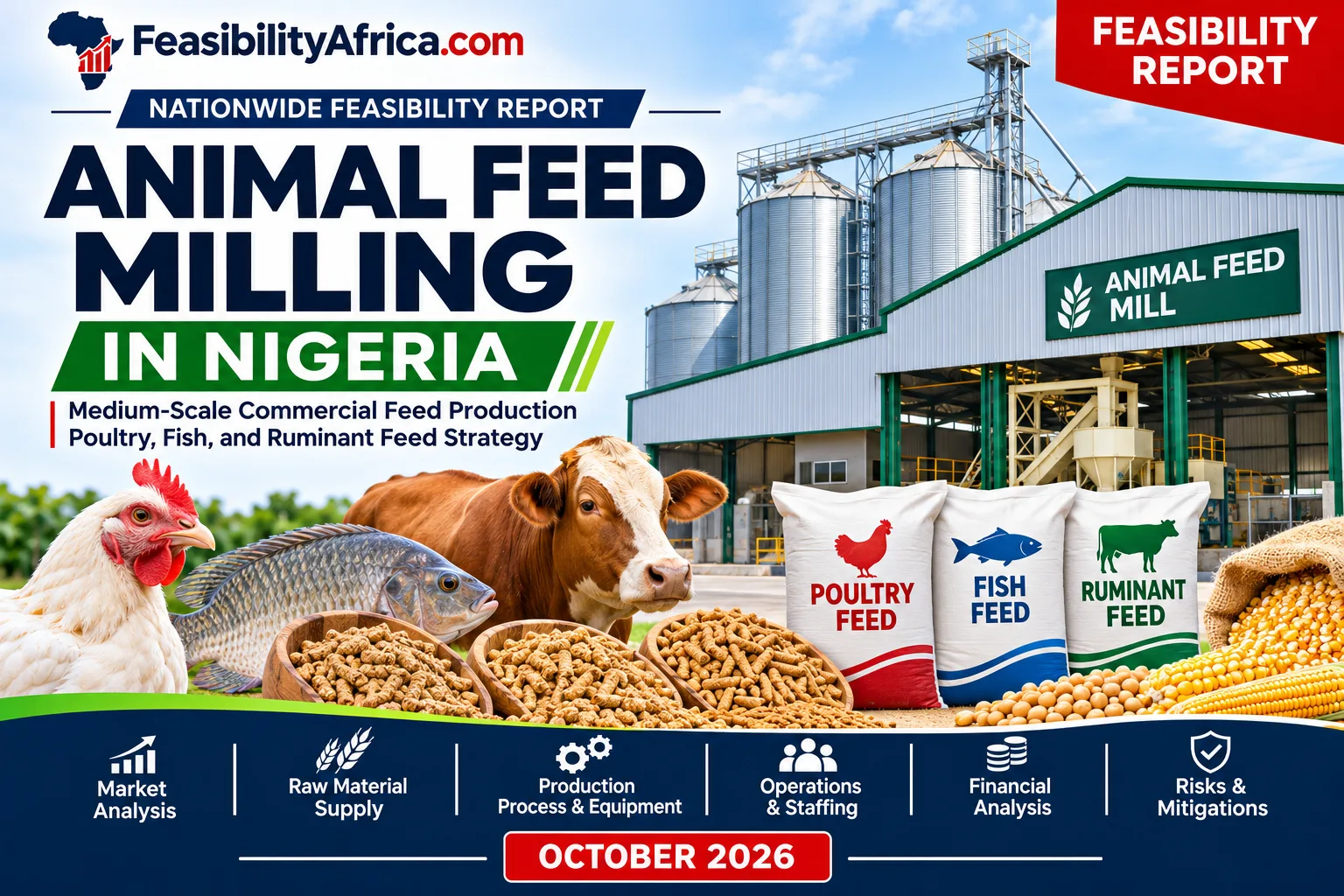
Introduction: The Business Behind Animal Protein Production
When consumers buy eggs, chicken, fish, beef or milk, they are purchasing the final products of a much larger agricultural value chain. Behind much of this production is one essential input: animal feed.
For poultry farmers, fish farmers and livestock producers, feed is not simply another farm expense. It is a major determinant of production cost, animal growth, productivity and profitability. The quality, availability and price of feed can influence whether a farm operates successfully or struggles to remain competitive.
This creates an important business opportunity for entrepreneurs interested in Nigeria's agribusiness and manufacturing sectors: commercial animal feed milling.
A feed mill converts agricultural raw materials and nutritional ingredients into formulated feeds designed for specific animal species and production stages. With the right equipment, technical knowledge, supply arrangements and customer relationships, an operator can serve a market that includes poultry farms, fish farms, livestock enterprises, agro-dealers and agricultural cooperatives.
However, establishing a successful feed mill requires considerably more than purchasing a grinding machine and mixing ingredients. It is a manufacturing business that depends on formulation accuracy, raw material management, quality assurance, production efficiency and reliable distribution.
Why Animal Feed Matters to Nigeria's Agricultural Economy
Nigeria's demand for animal-source foods creates demand for the inputs needed to produce them. Poultry farmers require feed throughout the production cycle. Fish farmers need appropriately formulated diets to support growth in aquaculture systems. Cattle, sheep and goat enterprises also require supplementary feeding, particularly in commercial fattening and intensive livestock operations.
Feed is especially important because it represents a substantial share of livestock production expenditure. Farmers are therefore sensitive to changes in feed prices, but they also understand that poor-quality feed can undermine animal performance and waste money.
This creates an interesting commercial position for a well-managed local manufacturer.
The opportunity is not necessarily to compete with established premium brands on brand recognition or to sell the cheapest feed in the market. It is to provide a dependable alternative: nutritionally appropriate products, consistent quality, competitive pricing and reliable availability.
For farmers, a supplier that delivers the right product consistently can become an important long-term business partner.
Understanding the Different Markets for Animal Feed
One of the first decisions an aspiring feed manufacturer must make is which customer segments to serve. Animal feed is not a single product category. Different animals have different nutritional requirements, and even animals of the same species require different formulations depending on their age and production stage.
1. Poultry feed
Poultry is an important market for commercial feed manufacturers. Products include:
- Broiler starter feed: Formulated for young broiler birds during their early growth stage.
- Broiler finisher feed: Designed for the later stage of broiler production.
- Layer mash: Formulated to support laying hens and egg production.
- Grower mash: Used during the development stage of replacement pullets.
- Layer concentrates: Products that farmers combine with other ingredients according to the manufacturer's instructions.
Poultry farmers are concerned with feed conversion, growth, egg production, consistency and the cost of feeding. A manufacturer must therefore understand the nutritional requirements of each product rather than simply produce a generic poultry mixture.
2. Fish feed
Aquaculture offers another specialised market. Catfish and tilapia farmers require feed suited to their production systems and the growth stages of their fish.
Fish feed may be produced in floating or sinking forms. Floating feed is particularly useful in many farming systems because farmers can observe feeding activity and monitor consumption. Sinking feed serves other feeding requirements and may provide a lower-cost option in suitable applications.
Fish feed production can involve additional technical requirements, including extrusion equipment, appropriate particle characteristics, water stability and carefully controlled protein levels.
A manufacturer interested in this market must recognise that fish feed is not simply poultry feed in pellet form. Its formulation and physical properties must be appropriate for aquatic feeding.
3. Ruminant feed
Cattle, goats and sheep also create demand for formulated feed, particularly in commercial fattening, dairy and intensive livestock operations.
Ruminant feed products can include supplementary feeds and formulated rations intended for particular production objectives. Customers may include feedlots, livestock farmers, dairy operations and commercial animal fattening enterprises.
Although this segment may have different volume and pricing characteristics from poultry feed, it can provide an additional market for manufacturers with suitable formulations and distribution arrangements.
The Raw Materials That Drive Feed Production
Animal feed manufacturing depends on the availability of agricultural commodities and specialised nutritional ingredients.
Some of the commonly used materials include:
- Maize: A major energy source in many poultry feed formulations.
- Soybean meal: An important source of protein.
- Groundnut cake: A regional protein ingredient that requires appropriate quality control.
- Wheat offal: Used as a source of fibre and energy.
- Fish meal: An animal-protein ingredient used in some formulations, particularly for fish feed.
- Limestone: A source of calcium.
- Bone meal: Can provide calcium and phosphorus, subject to quality requirements.
- Vitamin and mineral premixes: Help supply essential micronutrients.
- Salt and amino acids: Used in controlled quantities to support nutritional balance.
The proportions of these ingredients are not universal. They depend on the animal species, production stage, nutritional targets, ingredient quality and formulation strategy.
This is why successful feed production requires technical expertise. Incorrect formulation can result in nutritional deficiencies, poor animal performance, unnecessary production costs or potential health problems.
Why Raw Material Procurement Can Determine Profitability
For many feed mills, raw materials represent the largest component of production expenditure. This makes procurement strategy one of the most important determinants of commercial performance.
Maize and soybean prices can fluctuate significantly. Their availability and prices are influenced by harvest cycles, weather, transportation, market demand, storage conditions and wider economic developments.
A manufacturer that purchases ingredients only when production requires them may find that input costs rise during periods of limited supply.
Strategic purchasing can help reduce this exposure.
For example, the harvest period can provide an opportunity to purchase certain grains in larger quantities and store them for later use. However, this strategy requires adequate working capital, suitable storage facilities and proper inventory management.
Storage must protect ingredients from moisture, mould, pests, contamination and deterioration. Buying large quantities at a favourable price is not beneficial if poor storage damages the materials.
Manufacturers should also develop relationships with multiple suppliers instead of depending entirely on one source. Every delivery should be inspected and tested according to the ingredient's quality requirements.
A reliable procurement system is therefore not merely a purchasing function. It is part of the manufacturer's competitive advantage.
How Commercial Animal Feed Is Manufactured
The production process varies according to the product and equipment configuration, but commercial feed manufacturing generally follows a sequence of controlled operations.
Receiving and cleaning: Raw materials are weighed, inspected and cleaned to remove stones, metal and other unwanted materials.
Grinding: Ingredients are reduced to the required particle size. Particle size requirements can differ between poultry and fish feed applications.
Batching: Each ingredient is weighed according to the approved formulation. Accurate weighing is essential because formulation errors can affect the nutritional composition of the finished product.
Mixing: Ingredients are blended in a suitable mixer to achieve uniform distribution. A poorly mixed batch can result in inconsistent nutrient delivery.
Conditioning and pelleting: Where pelleted feed is produced, the mash may be conditioned with steam and passed through a pellet mill. The process requires appropriate control of temperature, moisture and equipment condition.
Cooling: Newly produced pellets are cooled to reduce moisture and bring them closer to ambient temperature.
Bagging and storage: Finished feed is weighed, packaged, labelled and stored under suitable conditions before dispatch.
Not every feed mill needs to begin with a fully integrated production line. A manufacturer can start with a more limited product range and equipment configuration, then expand as customer demand and technical capacity develop.
However, equipment selection should be based on the intended products, output requirements, quality expectations and future expansion plans.
Quality Assurance: The Foundation of a Sustainable Feed Brand
In animal feed manufacturing, quality is not an optional selling point. It is central to the product's value.
Farmers want feed that delivers consistent nutritional performance. If one batch produces satisfactory results while another performs poorly, customers may lose confidence in the brand.
A serious manufacturer therefore needs quality controls covering both incoming materials and finished products.
Important quality considerations include:
- Moisture content and storage stability.
- Crude protein and other nutritional specifications.
- Uniformity of ingredient mixing.
- Pellet durability where pelleted feed is produced.
- Aflatoxin and other contamination risks.
- Consistent appearance, texture and odour.
Groundnut cake and maize, for example, require attention to mould and aflatoxin risks. Materials that fail quality requirements should not be accepted simply because they are available at a low price.
Manufacturers should maintain batch records, document formulations, retain samples where appropriate and establish procedures for tracing products.
A feed brand built around consistency and technical credibility has a stronger foundation for retaining customers than one competing only through price discounts.
Choosing the Right Location for a Feed Mill
Location influences both the cost of production and the ability to reach customers.
A feed mill needs access to raw materials, livestock and aquaculture customers, transport infrastructure, suitable industrial premises and dependable utilities.
Locating close to grain-producing areas may reduce the cost of sourcing maize and other agricultural ingredients. However, a location with limited customer demand may increase the cost of distributing finished products.
Conversely, locating near large poultry or fish farming clusters can improve customer access but may increase the cost of transporting raw materials.
This is why location selection should consider both sides of the business: where ingredients come from and where finished feed will be sold.
A regional production hub supported by distributors and agro-dealers can be more practical than attempting to establish production facilities across several states from the beginning.
The manufacturer can first build a strong customer base within a manageable catchment area, then extend distribution as demand grows.
Power, Machinery and the Cost of Running a Feed Mill
Commercial feed milling is an energy-consuming manufacturing activity. Grinding, mixing, conveying and pelleting equipment require reliable power.
In Nigeria, dependence on diesel generators can significantly affect operating costs, particularly when production runs for several hours each day.
A prospective investor should therefore evaluate electricity availability, generator requirements, fuel consumption, maintenance costs and alternative energy arrangements before selecting a site.
The machinery package also needs to be selected carefully. Depending on the products and production scale, a commercial facility may require:
- Hammer mills.
- Horizontal mixers.
- Conveyors and bucket elevators.
- Weighing scales.
- Pellet mills and coolers, where required.
- Bagging and sealing equipment.
- Generators and electrical installations.
- Storage facilities.
- Laboratory and quality-control equipment.
The cheapest machinery is not necessarily the best investment. Equipment reliability, production capacity, spare-parts availability, technical support and after-sales service can be more important than the initial purchase price.
A machine that frequently breaks down can disrupt production, delay customer orders and damage the reputation of a new business.
Finding Customers and Building Distribution
A feed mill can have good machinery and technically sound formulations but still struggle if it cannot sell its output consistently.
Customer development should therefore begin before commercial production.
Potential customers include commercial poultry farms, smaller poultry operators, fish farms, livestock enterprises, agro-dealers, distributors and farmer cooperatives.
Direct engagement is particularly valuable in this market. Visiting farms, understanding their feeding practices, discussing their current suppliers and offering properly controlled product trials can help a new manufacturer build credibility.
Agro-dealers can also extend the brand's reach into locations where direct sales would be expensive or difficult to manage.
However, distribution margins must be considered when setting ex-factory prices. A product may appear profitable when sold directly but become unattractive to distributors if there is insufficient margin for them.
Credit management is equally important. Feed is a recurring purchase, and some customers may request payment terms. Extending credit without proper controls can create serious cash-flow problems, especially when the manufacturer must continue purchasing raw materials and paying staff.
A disciplined business should establish clear customer limits, payment terms and procedures for following up overdue accounts.
Regulatory Compliance and Responsible Manufacturing
Animal feed manufacturing requires attention to regulatory requirements, product quality and facility standards.
The report identifies the Nigerian Institute of Animal Science (NIAS), the National Agency for Food and Drug Administration and Control (NAFDAC), and the Standards Organisation of Nigeria (SON) among the important institutions in the regulatory process.
Requirements may include premises registration, product registration, factory inspection, product testing and applicable conformity assessment procedures.
Manufacturers must also consider environmental, local business-premises and fire-safety requirements.
Regulatory processes take time and should be incorporated into the project schedule. A business should not assume that it can begin commercial sales immediately after installing its machinery.
Entrepreneurs should obtain current requirements and professional guidance directly from the relevant authorities before committing capital or commencing operations.
The Challenges Investors Must Understand
The animal feed business offers opportunities, but it also presents operational and financial risks.
Raw material price volatility: Increases in maize, soybean meal and other ingredients can quickly reduce margins.
Quality inconsistency: Poor ingredients, incorrect formulations or inadequate mixing can affect animal performance and damage customer confidence.
Power costs: Diesel consumption can become a significant operating expense.
Working-capital pressure: Manufacturers need money for raw materials, packaging, wages, transportation and other expenses while waiting for customer payments.
Customer credit risk: Late payments and defaults can interrupt production and procurement.
Equipment breakdown: Machinery failure can cause production delays and additional maintenance costs.
Regulatory delays: Product and premises approvals can affect the timing of commercial launch.
These challenges make management discipline essential. A feed mill is not simply a machine-based investment that can be left unattended. Procurement, quality control, production planning, customer relationships and cash flow require active supervision.
Is Animal Feed Milling a Business Worth Exploring?
Animal feed milling may appeal to entrepreneurs who understand manufacturing, agribusiness or livestock production and who can develop reliable relationships with suppliers and customers.
It can also create opportunities to add value to agricultural commodities, support livestock producers and participate in the wider food production value chain.
Nevertheless, the size of the market alone does not guarantee the success of a new feed mill. A manufacturer must establish that it can source ingredients at competitive prices, produce feed to consistent specifications, reach enough customers and operate with sufficient working capital.
The most sensible approach is to validate local demand, obtain machinery quotations, confirm supplier arrangements and develop realistic financial projections before making an investment decision.
Starting with a focused range of products may also be more manageable than attempting to manufacture every type of poultry, fish and ruminant feed immediately.
Take the Next Step: Evaluate the Investment Before You Commit
Setting up an animal feed mill involves interconnected decisions about machinery, factory facilities, raw material procurement, formulations, staffing, regulation, distribution and finance.
Making these decisions without a structured feasibility assessment can expose an investor to avoidable costs and operational risks.
The Animal Feed Milling Business Feasibility Report in Nigeria (2026) provides a detailed assessment of the commercial opportunity and the practical requirements for establishing a medium-scale feed manufacturing operation.
The 31-page report examines the Nigerian market, regional location considerations, product range, raw material supply, production processes, machinery and equipment, staffing, regulatory requirements, marketing and distribution, capital expenditure, operating expenses, revenue projections, break-even analysis, risk mitigation and implementation planning.
It is designed to help entrepreneurs, investors and agribusiness operators assess the opportunity before committing resources.
Ready to evaluate the animal feed milling opportunity? Purchase the full Animal Feed Milling Business Feasibility Report in Nigeria (2026) from FeasibilityAfrica.com and take a more informed step towards your investment decision.
Enjoyed this? Get the next one free
Every new article, straight to you. Free. Choose email, WhatsApp — or both.
Email newsletter
New articles in your inbox. Unsubscribe anytime.
WhatsApp newsletter
Get new articles directly on WhatsApp. No spam, just new ideas.
Related articles
Agri-Business
Egg Powder Production in Nigeria: Turning Surplus Eggs into Valuable Industrial Food Ingredients
Nigeria produces large quantities of eggs, yet food manufacturers still rely on imported egg powder for many industrial applications. Discover how surplus eggs can be converted into shelf-stable ingredients for bakeries, noodle manufacturers and confectioneries, the technology required, and the commercial challenges investors must overcome to build a viable local production business.
Agri-Business
Tomato Paste Manufacturing in Nigeria: Exploring the Opportunity in Local Food Processing and Import Substitution
Nigeria produces substantial quantities of tomatoes, yet local processing has struggled to meet the country's demand for tomato paste. Discover the business opportunities in industrial tomato processing, how fresh tomatoes are transformed into concentrated paste, the importance of seasonal sourcing and energy management, and what investors should consider before entering this challenging but strategically important food manufacturing sector.
Manufacturing
Toothpaste Manufacturing Business in Nigeria: A Lucrative Opportunity for Entrepreneurs and Investors?
Thinking of starting a toothpaste manufacturing business in Nigeria? Discover the market opportunities, production process, raw materials, industry challenges and what it takes to build a competitive oral care brand in Nigeria.