
Tomato Paste Manufacturing in Nigeria: Exploring the Opportunity in Local Food Processing and Import Substitution
Nigeria produces substantial quantities of tomatoes, yet local processing has struggled to meet the country's demand for tomato paste. Discover the business opportunities in industrial tomato processing, how fresh tomatoes are transformed into concentrated paste, the importance of seasonal sourcing and energy management, and what investors should consider before entering this challenging but strategically important food manufacturing sector.
By FeasibilityAfrica Research Team · · 15 min read
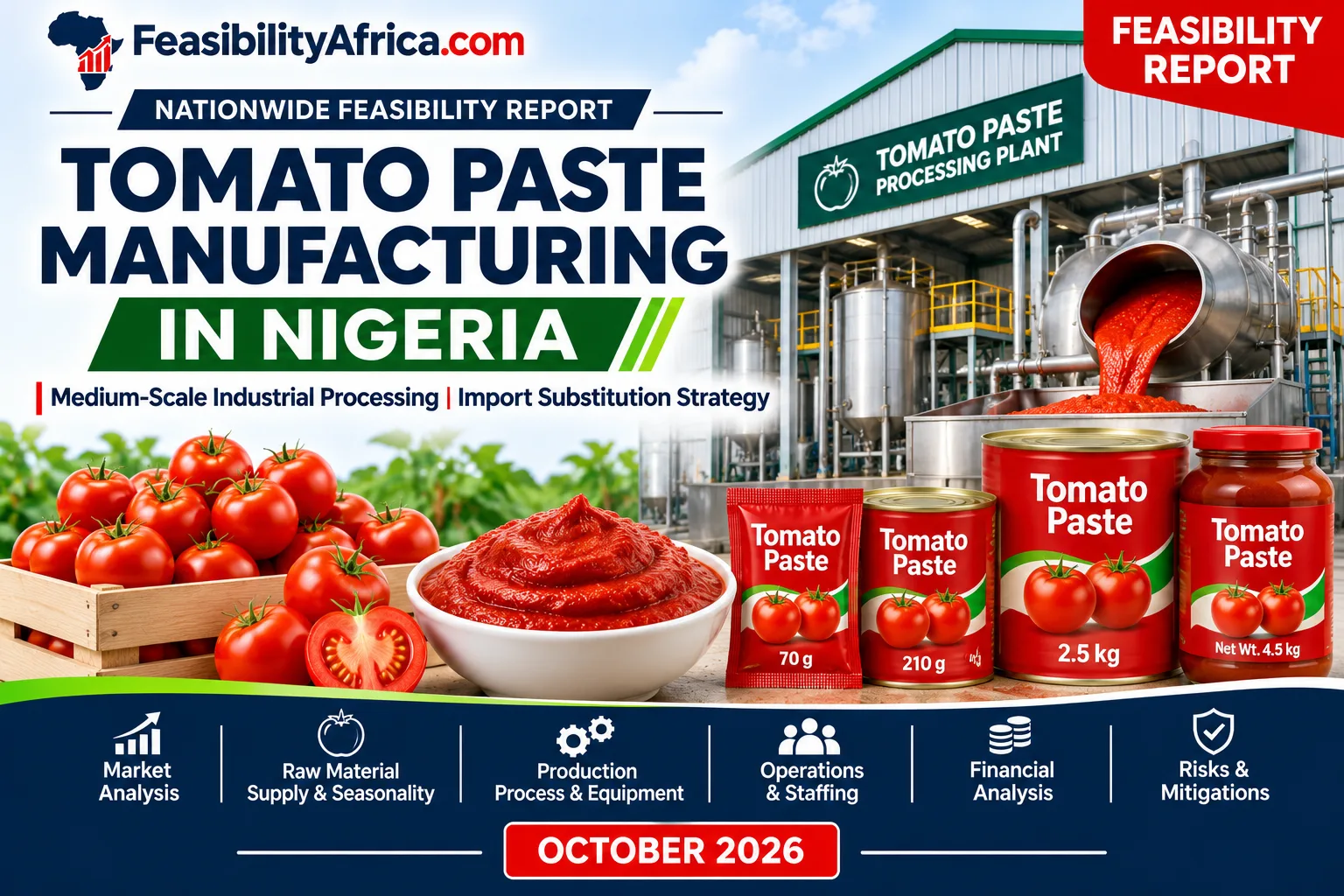
Introduction: Can Nigeria Turn Its Tomatoes into a Bigger Industrial Opportunity?
Tomato is one of the most familiar ingredients in Nigerian households. From everyday stews and soups to restaurant meals and packaged food products, tomato paste has become an essential item in the country's food market.
Yet there is a striking contradiction in this value chain: Nigeria produces large quantities of fresh tomatoes but still depends heavily on imported tomato paste.
This gap between agricultural production and industrial processing presents an opportunity for food manufacturers, agribusiness entrepreneurs and investors.
Tomato paste manufacturing involves converting fresh tomatoes into a concentrated, shelf-stable product that can be packaged for households, restaurants, caterers and food manufacturers. It connects agricultural production with industrial manufacturing, packaging, distribution and retail.
The opportunity, however, is more complicated than simply buying tomatoes cheaply and processing them. Tomato paste manufacturing is a capital-intensive, seasonal and energy-sensitive business. Its success depends on the ability to secure sufficient raw materials during the harvest period, operate processing equipment efficiently, maintain product quality and distribute finished products competitively.
For investors considering this sector, understanding the entire value chain is essential.
Nigeria's Tomato Production and the Processing Gap
Nigeria is a major tomato-producing country. The crop is cultivated across several states, particularly in northern agricultural regions where climatic conditions and farming systems support substantial production.
Despite this agricultural base, a significant proportion of fresh tomatoes is consumed without industrial processing. Some is sold in open markets, while some is lost because of inadequate storage, transportation difficulties, poor handling and limited processing capacity.
Fresh tomatoes are highly perishable. Unlike grains, they cannot be stored for extended periods under ordinary conditions without deterioration. When farmers harvest large quantities during peak production periods, market supply can exceed immediate demand, resulting in substantial post-harvest losses.
Industrial processing provides one possible solution.
Instead of selling every tomato immediately after harvest, processors can convert suitable fresh tomatoes into concentrated paste. The product can then be stored and packaged for sale over a longer period.
This creates value at several levels:
- Farmers gain another potential market for their produce.
- Aggregators and transport operators participate in the supply chain.
- Manufacturers create value through processing and packaging.
- Distributors and retailers gain access to locally manufactured products.
- Consumers can access processed tomato products throughout the year.
The commercial opportunity is therefore connected not only to the tomato market but also to the broader development of Nigeria's agricultural processing industry.
Why Local Tomato Paste Manufacturing Deserves Attention
Nigeria's reliance on imported tomato paste creates an opportunity for domestic manufacturers capable of producing consistent, competitively priced products.
Imported products often benefit from established brands, large-scale manufacturing, distribution networks and recognised quality standards. A local manufacturer must therefore offer more than a Nigerian-made label.
It must deliver a product that consumers trust and distributors can sell confidently.
A strong domestic brand could compete through:
- Consistent product quality and cooking performance.
- Reliable availability throughout the year.
- Competitive pricing and efficient distribution.
- Attractive packaging suited to different customer groups.
- Transparent product labelling and regulatory compliance.
- Strong relationships with wholesalers and retailers.
However, import substitution is not automatic. Imported brands may have production-scale advantages, while informal or smuggled products can compete through unusually low prices.
A new manufacturer must identify customers who value quality, hygiene, consistency and dependable supply rather than attempting to win every customer through price reductions.
Understanding the Tomato Paste Product Market
Tomato paste is not sold in only one packaging format. Different customers have different consumption patterns, purchasing power and product requirements.
1. Small retail sachets
Small sachets serve consumers who prefer affordable, single-use or small-quantity purchases.
They can support high-volume distribution through neighbourhood shops, open markets and small retailers. However, manufacturers must carefully manage packaging costs, production efficiency and selling prices because the product may have relatively limited margin per unit.
2. Household tins
Household tins serve consumers who purchase larger quantities for regular cooking.
The 210g format is one example of a household product size identified in the feasibility report. Such products can be distributed through supermarkets, wholesalers and traditional retail outlets.
Brand recognition, packaging integrity and consistent quality are particularly important in this segment.
3. Food-service packs
Restaurants, caterers, hotels and food vendors often require larger quantities of tomato paste.
Larger tins, such as 2.5kg and 4.5kg formats, can serve these customers. Their purchasing decisions may place greater emphasis on consistency, convenience, product performance and dependable supply.
Food-service customers can offer manufacturers an opportunity to develop business-to-business relationships and diversify beyond household retail sales.
4. Industrial customers
Food manufacturers producing sauces, seasonings and other processed foods may require tomato paste in larger volumes with specific quality specifications.
This segment can become relevant as a manufacturer develops its production capacity, quality systems and ability to meet bulk supply requirements.
How Fresh Tomatoes Become Industrial Tomato Paste
Industrial tomato paste manufacturing is a specialised food-processing operation. It involves several stages designed to extract tomato pulp, remove excess water, achieve the desired concentration and produce a safe, shelf-stable product.
The process generally includes the following operations.
1. Receiving and weighing
Fresh tomatoes arrive at the processing facility and are weighed. Incoming loads are inspected to assess their condition and suitability for processing.
2. Sorting
Damaged, rotten, green or contaminated tomatoes are removed. This is an important quality-control stage because poor-quality raw materials can affect the finished product.
3. Washing
The tomatoes are washed to remove dirt and other unwanted materials. Water quality and appropriate sanitation procedures are important.
4. Crushing and pulping
The tomatoes are broken down, and the pulp is separated from skins and seeds using suitable processing equipment.
5. Pre-heating
The pulp is heated under controlled conditions to support processing and reduce enzyme activity and spoilage risks.
6. Evaporation
This is one of the most important stages. Water is removed from the tomato pulp to increase its concentration.
Industrial evaporators are used to achieve the desired soluble-solids level. The feasibility report identifies 28–30° Brix as the target specification for double-concentrated tomato paste.
7. Sterilisation
The concentrated paste undergoes controlled heat treatment to achieve the required microbiological safety and product stability.
8. Filling and packaging
The paste is filled into suitable retail or food-service packaging. Depending on the production system, packaging may include sachets, tins or aseptic containers.
9. Cooling, labelling and storage
Finished products are cooled where required, labelled, coded, packed into cartons and stored under appropriate conditions before distribution.
Each stage requires appropriate equipment, operating procedures and quality controls. A failure in one part of the process can affect the quality, safety and commercial value of the final product.
The Most Important Raw Material: Fresh Tomatoes
Unlike many manufacturing businesses that can purchase relatively stable raw materials throughout the year, tomato paste manufacturers must deal with a highly seasonal agricultural commodity.
Tomatoes are available in larger quantities during particular harvest periods. Prices can change dramatically as supply conditions shift.
During peak harvest, fresh tomatoes may be available at relatively favourable prices. During periods of scarcity, prices can rise sharply, making fresh processing significantly more expensive.
This creates a fundamental challenge: the factory must process enough tomatoes during the harvest window to support sales throughout the rest of the year.
A manufacturer that depends entirely on purchasing fresh tomatoes whenever production is required may struggle to maintain competitive costs.
Building a dependable tomato supply network
A serious processor needs a procurement strategy before investing in machinery.
This can involve:
- Building direct relationships with tomato farmers.
- Working with cooperatives and agricultural groups.
- Establishing aggregation centres close to farming communities.
- Appointing local agents to coordinate collection.
- Agreeing on quality specifications and purchasing arrangements.
- Planning transportation and receiving schedules around harvest periods.
The feasibility report places particular emphasis on establishing relationships with at least 20 farmers or three major aggregators before the first production season.
The objective is to reduce uncertainty about the availability, quality and cost of tomatoes.
Why immediate payment matters
Farmers and aggregators may require immediate payment, especially during busy harvest periods.
A processor that has machinery but insufficient cash to purchase raw tomatoes may lose the opportunity to operate when raw materials are most available.
This makes working capital particularly important.
The ability to mobilise cash quickly can be as important as the factory's installed processing capacity.
The Role of Concentrate Storage in Year-Round Production
One of the most important features of the industrial tomato paste business is the distinction between primary processing and packaging.
During the harvest period, the factory can operate its processing line at high capacity, converting fresh tomatoes into concentrated paste.
The concentrate can then be stored in appropriate aseptic packaging, such as bags held in drums or boxes.
During the off-season, the business can focus more heavily on filling and packaging stored concentrate into retail and food-service formats.
This approach helps reduce dependence on expensive fresh tomatoes during periods of limited supply.
It also allows a manufacturer to maintain a presence in the market beyond the main harvest season.
However, concentrate storage requires appropriate processing, aseptic handling, packaging integrity and inventory management. It is not simply a matter of keeping unfinished paste in ordinary containers.
Why Energy Efficiency Can Make or Break the Business
Tomato paste manufacturing is an energy-intensive industrial activity.
The evaporation stage requires substantial thermal energy to remove water from tomato pulp. Other equipment, including pumps, conveyors, filling machines and supporting utilities, also requires electricity.
In Nigeria, unreliable grid electricity can force manufacturers to depend on generators and other energy sources.
This creates a serious operating-cost challenge.
Diesel expenditure can consume a substantial portion of the potential operating margin, particularly when the plant processes large volumes during an intensive harvest season.
Consequently, energy planning should begin during the project design stage.
A manufacturer should evaluate:
- Natural gas availability at the proposed location.
- Boiler and generator fuel requirements.
- Evaporator efficiency.
- Electricity demand across the production line.
- Equipment maintenance requirements.
- Opportunities to reduce energy consumption.
The choice of processing technology can have long-term consequences for profitability. A more efficient evaporator may require a higher initial investment but can reduce operating expenditure over time.
For investors, energy efficiency should be treated as a core investment consideration rather than an afterthought.
Selecting the Right Location for a Tomato Processing Factory
A tomato processing plant should be located with raw material supply in mind.
Fresh tomatoes are heavy, perishable and expensive to transport over long distances. Delays between harvesting and processing can increase spoilage and reduce the quantity of usable raw materials.
This makes proximity to farming clusters an important location factor.
Northern Nigeria offers several potential locations because of its tomato-producing areas and established agricultural trading networks.
The feasibility report identifies Kaduna and Kano as particularly relevant locations for primary processing, while Plateau State is discussed as a potential secondary production or aggregation location.
The report also highlights an important distinction between processing locations and distribution locations.
For example, Lagos has a large consumer market but limited commercial tomato production compared with the northern tomato belt. It may therefore be more suitable for packaging, warehousing or distribution than for primary processing.
A manufacturer should assess the following before selecting a site:
- Distance to reliable tomato-producing communities.
- Availability of farmers and aggregators.
- Road access and transportation costs.
- Availability and quality of water.
- Energy infrastructure.
- Factory land and construction costs.
- Security and community relationships.
- Access to distributors and target markets.
A strategically located plant can reduce raw material logistics costs and improve the reliability of production.
Machinery and Infrastructure Requirements
Industrial tomato paste production requires specialised processing machinery.
Depending on the production capacity and packaging strategy, a plant may require:
- Tomato washing and sorting equipment.
- Crushers and pulpers.
- Pre-heating equipment.
- Industrial evaporators.
- Boilers and supporting accessories.
- Sterilisation equipment.
- Filling and sealing machines.
- Packaging and labelling equipment.
- Generators and electrical installations.
- Water treatment facilities.
- Effluent treatment systems.
- Storage and material-handling equipment.
The evaporator is particularly important because it performs the concentration operation that transforms tomato pulp into paste.
Equipment selection should consider processing capacity, energy efficiency, reliability, food-contact materials, maintenance requirements, availability of spare parts and after-sales support.
Purchasing machinery solely because it has the lowest quoted price can expose a manufacturer to extended downtime and expensive repairs.
For a seasonal business, equipment reliability is especially important. A breakdown during the short harvest window can mean losing raw materials and production opportunities that cannot easily be recovered later in the year.
Packaging, Branding and Consumer Confidence
The quality of the product is important, but packaging also influences consumer confidence and market acceptance.
Tomato paste is a familiar product category with established brands competing for shelf space.
A new manufacturer must create a product identity that communicates quality, hygiene, reliability and value.
Packaging must protect the paste against contamination, oxygen exposure, leakage and physical damage during storage and transportation.
Sachets require suitable multilayer packaging materials, while tins need food-grade internal coatings and secure seals.
The label should provide the required product information, including applicable registration details, batch identification, manufacturing and expiry dates, and nutritional information.
Brand positioning can also help differentiate a locally manufactured product.
A business may emphasise the use of fresh Nigerian tomatoes, local agricultural value addition and dependable product quality. However, such claims must be supported by the actual sourcing and manufacturing process.
The objective is to create a brand that consumers and distributors can trust.
Regulatory Requirements for Tomato Paste Manufacturing
Tomato paste is a processed food product, so regulatory compliance is a central part of establishing the business.
The feasibility report identifies several important institutions and compliance areas:
Corporate Affairs Commission (CAC): Registration of the business entity.
National Agency for Food and Drug Administration and Control (NAFDAC): Product registration, inspection and relevant food-safety requirements.
Standards Organisation of Nigeria (SON): Applicable standards and MANCAP certification requirements.
Environmental authorities: Environmental permits, wastewater management and other applicable environmental obligations.
One particularly important infrastructure requirement is an effluent treatment plant.
Tomato processing generates wastewater containing organic material from washing, cleaning and other production activities. Appropriate treatment and disposal systems must be incorporated into the factory design.
Regulatory approval should be planned early. A manufacturer should not assume that the factory can begin commercial sales immediately after machinery installation.
The business needs to allow time for facility preparation, inspections, testing, documentation and product approvals.
Finding Buyers and Building a Distribution Network
A tomato paste manufacturer must develop a route to market before production begins.
Potential customers include wholesalers, regional distributors, retailers, supermarkets, restaurants, caterers, hotels, food-service suppliers and industrial food manufacturers.
A practical approach is to begin with a focused geographic market.
For example, a factory located in Kaduna or Kano could initially build relationships with distributors and wholesalers serving the North-West and North-Central regions.
As production becomes more stable, the business can extend distribution into larger consumption centres such as Abuja and Lagos.
The manufacturer should also develop different sales strategies for different product formats.
Small sachets may depend on extensive retail distribution, while food-service packs can be sold through direct relationships with restaurants, caterers and institutional buyers.
Credit management is another important issue.
Large distributors and institutional customers may request payment terms. While credit can help secure sales, excessive credit exposure can create serious cash-flow problems for a business that already has seasonal raw material requirements.
New distributors should generally be approached with cautious payment arrangements, with credit extended only after a reliable trading history has been established.
The Major Challenges Investors Must Consider
Despite the market opportunity, tomato paste manufacturing is not an easy business to operate.
Several challenges can determine whether a factory becomes commercially successful.
1. Seasonal raw material supply
The factory needs access to sufficient quantities of suitable tomatoes during the harvest window. Supply shortages can lead to idle machinery and lost production.
2. Tomato price volatility
Prices can rise sharply outside the main harvest season. Poor procurement planning can make the cost of production uncompetitive.
3. High energy expenditure
Evaporation, steam generation and electricity consumption create substantial operating costs. Dependence on diesel can weaken margins.
4. Competition from imported products
Established brands have distribution networks and consumer recognition. Smuggled or substandard products may also compete through low prices.
5. Working-capital requirements
The manufacturer needs cash to purchase tomatoes during the harvest period and finance operations while concentrate is stored and packaged.
6. Machinery downtime
A processing-line breakdown during peak harvest can result in lost raw materials and production opportunities.
7. Regulatory delays
Food-processing facilities must satisfy applicable regulatory requirements before commercial sales. Delays can affect the project launch schedule.
These challenges demonstrate why tomato paste manufacturing requires experienced management and careful planning.
Opportunities Beyond Tomato Paste
A tomato processing facility may eventually explore additional products and activities that use its existing infrastructure or by-products.
The feasibility report identifies several possible expansion opportunities.
Tomato puree and passata
These products involve different concentration levels and processing specifications. They may provide opportunities to serve customers seeking alternatives to double-concentrated tomato paste.
Tomato sauce and ketchup
A manufacturer may consider producing value-added tomato products using paste as a key ingredient. This would require additional formulation, mixing and filling capabilities.
Other fruit processing
Processing other fruits, such as mango, guava and pineapple, may help utilise selected equipment and facilities during periods when fresh tomatoes are unavailable.
However, each product requires its own market assessment, processing requirements and financial evaluation.
Tomato pomace utilisation
Tomato skins and seeds generated during processing can be considered for by-product utilisation. The report identifies potential sales to livestock farmers or further processing into animal feed.
Such opportunities may improve resource efficiency, but their commercial value should be evaluated against collection, handling, processing and transportation costs.
Is Tomato Paste Manufacturing the Right Investment?
Tomato paste manufacturing may appeal to entrepreneurs and investors with experience in food processing, agricultural supply chains and industrial operations.
It can create value by linking farmers to manufacturers, reducing dependence on imported processed food products and developing local manufacturing capacity.
However, it is not an ideal business for an investor seeking passive income or quick returns.
A successful operator needs to manage the business actively, particularly during the harvest season. The ability to purchase tomatoes at competitive prices, maintain efficient processing operations, control energy expenditure and build a reliable distribution network is central to the investment case.
The most important lesson is that abundant tomatoes do not automatically guarantee profitable tomato paste manufacturing.
A factory must be designed around the realities of the agricultural supply chain, seasonal production, energy costs and market competition.
Investors should validate raw material supply, confirm equipment quotations, assess local energy options, interview distributors and prepare realistic financial projections before committing capital.
Take the Next Step: Study the Opportunity Before Investing
Establishing a tomato paste manufacturing plant involves major decisions about location, processing capacity, machinery, raw material sourcing, seasonal inventory, energy infrastructure, regulatory compliance, packaging, distribution and working capital.
These decisions are interconnected. A mistake in raw material planning, equipment selection or operating-cost assumptions can affect the entire investment.
The Tomato Paste Manufacturing Business Feasibility Report in Nigeria (2026) provides a structured assessment of this industrial opportunity.
The 30-page report examines the Nigerian tomato market, nationwide location strategy, product formats, raw material seasonality, production processes, machinery and equipment, staffing, regulatory requirements, marketing and distribution, capital expenditure, working capital, operating costs, financial projections, risk mitigation and implementation planning.
Importantly, the report assesses the conditions under which the business may become viable rather than presenting tomato paste manufacturing as a guaranteed investment opportunity.
Interested in establishing a tomato paste manufacturing business in Nigeria? Purchase the full Tomato Paste Manufacturing Business Feasibility Report (2026) from FeasibilityAfrica.com and evaluate the opportunity with a clearer understanding of its requirements, risks and commercial realities.
Enjoyed this? Get the next one free
Every new article, straight to you. Free. Choose email, WhatsApp — or both.
Email newsletter
New articles in your inbox. Unsubscribe anytime.
WhatsApp newsletter
Get new articles directly on WhatsApp. No spam, just new ideas.
Related articles
Agri-Business
Egg Powder Production in Nigeria: Turning Surplus Eggs into Valuable Industrial Food Ingredients
Nigeria produces large quantities of eggs, yet food manufacturers still rely on imported egg powder for many industrial applications. Discover how surplus eggs can be converted into shelf-stable ingredients for bakeries, noodle manufacturers and confectioneries, the technology required, and the commercial challenges investors must overcome to build a viable local production business.
Agri-Business
Animal Feed Milling Business in Nigeria: Exploring Opportunities in the Poultry, Fish and Livestock Industries
Nigeria’s livestock and aquaculture industries depend on reliable supplies of affordable, nutritious animal feed. Discover the opportunities in commercial feed milling, the raw materials and production processes involved, the customers to serve and the challenges entrepreneurs must overcome to build a competitive feed manufacturing business.

Manufacturing
Toothpaste Manufacturing Business in Nigeria: A Lucrative Opportunity for Entrepreneurs and Investors?
Thinking of starting a toothpaste manufacturing business in Nigeria? Discover the market opportunities, production process, raw materials, industry challenges and what it takes to build a competitive oral care brand in Nigeria.