
Egg Powder Production in Nigeria: Turning Surplus Eggs into Valuable Industrial Food Ingredients
Nigeria produces large quantities of eggs, yet food manufacturers still rely on imported egg powder for many industrial applications. Discover how surplus eggs can be converted into shelf-stable ingredients for bakeries, noodle manufacturers and confectioneries, the technology required, and the commercial challenges investors must overcome to build a viable local production business.
By FeasibilityAfrica Research Team · · 17 min read
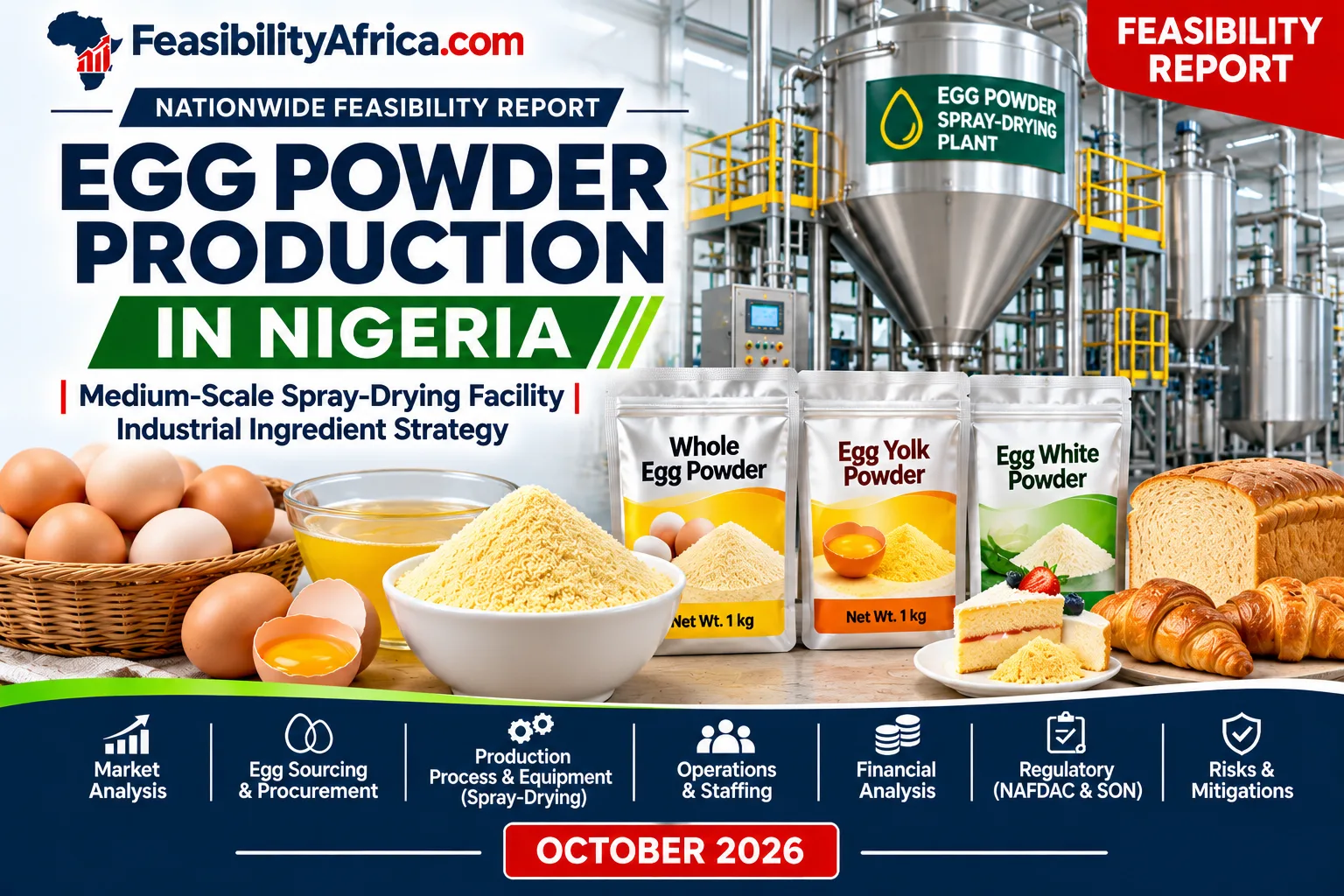
Introduction: An Opportunity Beyond the Fresh Egg Market
Eggs are an important source of protein and a widely used ingredient in Nigeria's food industry. They are consumed directly by households and used extensively by bakeries, confectioneries, restaurants and food manufacturers.
Yet fresh eggs have a major commercial limitation: they are perishable.
They require careful handling, storage and transportation. Their quality can deteriorate, and seasonal changes in supply can create periods when poultry farmers struggle to sell their output at profitable prices.
Now consider a different way of using this agricultural resource.
Instead of selling every egg as a fresh product, it can be processed into egg powder: a shelf-stable ingredient that can be stored, transported and supplied to industrial customers in measured quantities.
This is the idea behind commercial egg powder production.
For investors, it creates a potential connection between Nigeria's poultry industry and its food-manufacturing sector. However, the opportunity is more technically demanding and financially sensitive than it may initially appear.
The key question is not simply whether Nigeria produces enough eggs. It is whether a manufacturer can obtain eggs at a competitive cost, process them safely and efficiently, and sell the resulting powder to customers at a price that supports profitable operations.
What Is Egg Powder?
Egg powder is produced by removing most of the moisture from liquid eggs through an industrial drying process.
The result is a concentrated, dry ingredient that can be packaged for storage and use in food manufacturing.
Depending on the production process and product specification, manufacturers can produce three main categories:
Whole egg powder
Whole egg powder is made from liquid eggs containing both yolk and egg white.
It is the proposed manufacturer's primary product in the first year of operation in the October 2026 feasibility report.
Its potential applications include:
- Industrial bakeries.
- Pasta and noodle manufacturing.
- Biscuits and confectionery.
- Sauces and food preparations.
Egg yolk powder
Egg yolk powder is produced by separating the yolk before drying.
It has applications in products that require the functional properties of egg yolk, including mayonnaise, salad dressings, ice cream and premium bakery products.
The report proposes introducing it from Year 2, after the whole egg powder operation has become established.
Egg white powder
Egg white powder, also known as albumen powder, is produced from separated egg whites.
It is used in applications such as meringues, confectionery, meat processing and certain protein-oriented products.
It is a more specialised product and requires its own handling and drying parameters.
The report considers it a potential Year 2–3 expansion product.
Why Egg Powder Production Deserves Attention in Nigeria
Nigeria has a substantial poultry industry and produces significant quantities of eggs.
The October 2026 feasibility report cites an estimated annual production of approximately 15.8–16 billion eggs.
However, high production volume does not automatically translate into a stable and profitable market for poultry farmers.
Seasonal oversupply can occur, particularly between February and May. During these periods, farmers may face pressure to sell eggs below their production cost.
Processing can help create another route to market for suitable surplus eggs.
At the other end of the value chain, industrial food manufacturers need dependable supplies of functional egg ingredients.
Egg powder can help bridge these two sides of the market.
Reducing dependence on fresh eggs in industrial production
For food manufacturers, using powdered eggs can offer several practical advantages.
It can reduce the labour involved in cracking and handling large numbers of eggs. It also removes the need to manage shells and can make ingredient measurement more consistent.
Because the product is dry, it can be stored and transported more conveniently than fresh shell eggs, provided that suitable packaging and storage conditions are maintained.
A potential outlet for surplus and grade-B eggs
Egg powder production may create a market for eggs that are not suitable for ordinary retail presentation but remain acceptable for processing after proper inspection.
This does not mean that rotten, leaking or contaminated eggs can be used.
Food safety remains fundamental. Every incoming batch must be inspected, and unacceptable eggs must be rejected.
An opportunity for local industrial ingredients
The feasibility report identifies imported egg powder from markets including Europe, South Africa and India.
A Nigerian manufacturer may compete through local availability, naira-denominated pricing, shorter delivery times and technical support.
However, local production does not automatically mean lower production costs. The economics of egg procurement and energy consumption must be carefully evaluated.
Who Buys Egg Powder?
Egg powder is primarily an industrial ingredient, not a conventional household consumer product.
Understanding the target customers is therefore central to the business model.
1. Industrial bakeries
Bakeries use eggs in bread, cakes, pastries and other products.
Egg powder can reduce the handling and labour associated with fresh eggs and provide a more convenient ingredient for controlled production processes.
2. Noodle and pasta manufacturers
Manufacturers of instant noodles and pasta may use egg ingredients to support product formulation, texture and protein enrichment.
These businesses can be important potential buyers because they operate production lines that require consistent ingredient specifications.
3. Confectionery and biscuit manufacturers
Biscuits, cookies, sweets and other confectionery products use eggs for functional purposes, including texture and emulsification.
Egg powder can provide a convenient ingredient for manufacturers seeking consistent formulation and easier storage.
4. Sauce and dressing manufacturers
Egg yolk powder has applications in mayonnaise, salad creams and other emulsified products.
This creates a potential market for a manufacturer that eventually expands beyond whole egg powder.
5. Hotels, catering companies and institutions
Large food-service operators may value bulk ingredient supply, predictable storage and reduced egg-cracking labour.
This segment can provide additional opportunities, although customer requirements and purchasing volumes will vary.
6. Pharmaceutical and nutraceutical manufacturers
Egg white powder contains concentrated protein and has specialised applications in certain protein-oriented products and formulations.
This is a more specialised market that may require additional customer qualification and product specifications.
The Production Process: From Shell Eggs to Powder
Commercial egg powder manufacturing is a specialised food-processing operation.
It requires food-grade machinery, strict hygiene controls, pasteurisation, spray drying and laboratory testing.
The typical process involves several stages.
1. Egg receiving and inspection
Fresh eggs arrive from contracted poultry farms.
The quality-control team checks the incoming eggs for dirt, contamination, cracks, leakage and signs of spoilage.
Sampling and candling may be used to assess internal egg quality.
The objective is to prevent unsuitable raw materials from entering the production process.
2. Washing and sanitising
Acceptable eggs pass through a washing and sanitising system.
The process removes surface dirt and reduces contamination risks.
Water quality, temperature and sanitiser concentration must be controlled.
3. Breaking and separation
Mechanical egg-breaking equipment opens the eggs and separates the contents from the shells.
For whole egg powder, the liquid contents can be retained together.
Where yolk and white powders are to be produced, separation is required.
Shell fragments, membranes and other unwanted material must be removed.
4. Filtration
The liquid egg passes through filtration equipment to remove remaining shell fragments, chalazae and other particles.
This protects downstream equipment and supports product consistency.
5. Pasteurisation
The liquid egg is heat-treated under controlled conditions to reduce pathogenic microorganisms, including Salmonella.
The report describes a process temperature of approximately 60–65°C, with the holding time specified by the validated process.
Temperature and holding time are critical control points.
6. Spray drying
This is the defining stage of egg powder production.
The pasteurised liquid egg is atomised into fine droplets inside a spray dryer. Hot air removes the moisture, leaving dry particles that are collected as powder.
The report gives illustrative inlet air temperatures of approximately 180°C and outlet temperatures of approximately 60–80°C.
Actual operating conditions must be validated for the selected equipment, product and food-safety requirements.
7. Cooling and sieving
The powder is cooled to ambient temperature under controlled conditions.
It is then sieved to break soft lumps and achieve a more uniform particle size.
Moisture exposure must be minimised because egg powder can absorb moisture from the surrounding environment.
8. Packaging
The finished powder is filled into moisture-barrier packaging in a controlled environment.
The report identifies multi-layer kraft paper bags with a food-grade polyethylene inner liner for industrial packaging, while foil-laminated pouches may be suitable for smaller packs.
Packages must be properly sealed to protect the powder against moisture, light and oxygen.
9. Storage and dispatch
Finished products are stored in a cool, dry warehouse.
A first-in, first-out inventory system helps manage stock rotation and product traceability.
Machinery Required for Egg Powder Manufacturing
A commercial egg powder plant requires specialised equipment.
The feasibility report identifies the following major machinery and infrastructure:
- Egg washing and breaking line.
- Liquid egg filtration equipment.
- Pasteuriser with holding tubes.
- Food-grade spray dryer.
- Powder cooling and sieving equipment.
- Industrial packaging and sealing machine.
- Air compressor.
- Boiler, where required by the selected process.
- Water-treatment system.
- Laboratory and quality-control equipment.
- Generator and electrical infrastructure.
- Cold storage and suitable raw material handling facilities.
The report estimates total equipment costs of approximately ₦110 million–₦182 million, depending on capacity, supplier specifications and installation requirements.
It also notes that imported machinery quotations must be assessed on a landed-and-installed basis. Freight, customs, commissioning and technical support can materially increase the final cost.
The spray dryer and egg-breaking line are particularly important investment decisions.
A low purchase price is not necessarily a good deal if the equipment cannot achieve the required output, product quality or reliability.
Production Capacity and Egg-to-Powder Yield
One of the most important technical considerations is the number of eggs required to produce one kilogram of whole egg powder.
The report uses an illustrative yield of approximately 70 eggs per kilogram.
Its proposed medium-scale plant has a capacity of 5,000 eggs per eight-hour shift.
At full utilisation, this translates to approximately 71kg of powder per day, or about 21,400kg annually over 300 operating days.
However, actual yield can vary.
The report examines a range of 60–80 eggs per kilogram. A change in yield directly affects the quantity of raw eggs required, output, raw material cost and profitability.
Investors should therefore conduct a small-scale drying trial using locally sourced eggs before committing to major equipment purchases.
A machinery supplier's advertised capacity is not a substitute for a production-yield test using the intended raw material.
Raw Material Procurement: The Most Important Business Decision
The strongest competitive advantage in egg powder manufacturing may not be the machinery. It may be access to affordable, suitable eggs.
The business requires a deliberate procurement network rather than dependence on daily spot-market purchases.
The report recommends establishing supply relationships with at least five layer farms within approximately 150km of the proposed facility.
A broader target of 5–7 contracted farms is suggested in its procurement strategy.
Contracted farm supply
Supply agreements can help secure regular quantities and establish a pricing formula.
The objective is to obtain suitable eggs at a price that supports the economics of processing.
Seasonal surplus procurement
The report identifies February–May as a period when egg gluts may create opportunities to purchase surplus eggs at discounted prices.
A manufacturer that has the capacity and working capital to buy during these periods may improve its average raw material cost.
Grade-B egg sourcing
Some eggs may be unsuitable for ordinary retail presentation but acceptable for processing after inspection.
These can provide a lower-cost source of raw material.
However, cracked eggs must be handled carefully, and rotten, leaking or contaminated eggs must be rejected.
Cold storage and supply buffers
The report recommends maintaining a buffer equivalent to approximately 2–3 weeks of egg inventory in a cold room to help manage supply interruptions.
The required storage capacity and holding conditions must be validated against the plant's actual procurement and processing schedule.
Backup suppliers
The plant should maintain alternative suppliers outside its primary farm cluster.
This reduces dependence on a small number of farms and provides additional resilience.
Where Should an Egg Powder Plant Be Located?
Location affects raw material procurement, energy costs, customer access and distribution.
A plant should ideally be situated close to poultry farms while remaining accessible to industrial food manufacturers.
The report evaluates several regional options.
South-West: Oyo, Ogun and the Lagos fringe offer substantial poultry activity, food-processing customers and logistics access. The report identifies the Ibadan corridor in Oyo State as an attractive production location.
North-Central: Kwara and Nasarawa offer central distribution advantages and potentially lower land costs. However, egg collection logistics may require additional investment.
North-West: Kaduna and Kano offer access to large populations, poultry activity and potential industrial customers. The report identifies this region as suitable for northern supply, while noting security and long-distance distribution considerations.
South-East: Enugu and Anambra have established trade and food-processing networks. The report considers them more suitable for commercial presence and distribution than primary production.
South-South: Edo and Delta can support secondary distribution, although egg supply may be less concentrated.
The report's recommended base case is a South-West or North-Central location, subject to farm mapping and verification of supply commitments.
For an investor, the final decision should be based on actual egg availability, delivered raw material cost, power reliability, land and facility costs, road access and confirmed customer demand.
Power Supply: A Major Operating Challenge
Spray drying is energy-intensive.
Unlike some food-processing activities, a spray-drying cycle cannot tolerate an unexpected power interruption without potentially damaging the product and disrupting operations.
The report therefore treats generator power as a primary production input.
Its illustrative power requirements include:
- Generator capacity: 100–150 KVA.
- Generator consumption: approximately 20–30 litres per hour at load.
- Diesel benchmark: ₦1,840 per litre in late October 2026.
- Industrial electricity benchmark: ₦225/kWh for Band A.
Using a 125 KVA generator at 25 litres per hour for 10 hours daily, the report estimates diesel expenditure of approximately ₦46,000 per production day, or ₦13.8 million over 300 production days.
This estimate excludes maintenance and other associated costs.
The plant must also consider automatic changeover, power conditioning for control systems, reliable water supply and adequate storage infrastructure.
A solar or hybrid system may support selected non-production loads, but the report does not treat it as a replacement for the plant's primary power requirements.
Quality Control, Food Safety and Product Standards
Egg powder is an industrial food ingredient. Buyers need confidence that every batch meets the required specifications.
The report identifies several quality targets for whole egg powder:
- Moisture content: not more than 5%.
- Protein: at least 43% on a dry basis.
- Fat: at least 40%.
- Uniform, free-flowing appearance.
- Negative Salmonella result.
- Controlled microbiological parameters.
- Suitable pH and ash levels.
It also identifies a potential sealed-product shelf life of 12–24 months under cool, dry storage conditions.
These are report specifications and targets; the actual product must be validated through testing and applicable regulatory standards.
A proper quality-control system should cover incoming eggs, processing temperatures, pasteurisation, drying conditions, finished-product moisture, microbiological testing, packaging integrity and batch traceability.
Regulatory Requirements in Nigeria
A commercial egg powder manufacturer must plan for regulatory compliance before commencing sales.
The report identifies the following key requirements.
Corporate Affairs Commission
The manufacturing business should be incorporated as an appropriate Nigerian business entity.
NAFDAC
The National Agency for Food and Drug Administration and Control is central to processed-food registration and facility compliance.
The report identifies factory inspection, Good Manufacturing Practice requirements, product testing, label approval and product registration.
It estimates a practical planning period of approximately 4–6 months, although the overall regulatory roadmap allows 6–9 months for the relevant approvals.
Standards Organisation of Nigeria
The report identifies SON's Mandatory Conformity Assessment Programme (MANCAP) as a relevant certification requirement.
Environmental and local approvals
The facility may also require environmental approvals, waste-management permits, local business-premises permits and fire-safety certification.
The report provides an illustrative total regulatory budget of approximately ₦1.18 million. Actual requirements, fees and timelines must be confirmed with the relevant agencies and qualified advisers.
Commercial labels should not be printed and products should not be sold before the required NAFDAC registration is obtained.
Understanding the Financial Challenge
Egg powder production may appear attractive because Nigeria has a large poultry sector and industrial buyers require egg ingredients.
But the raw material economics present a serious challenge.
The report's most important financial finding is that buying eggs at ordinary market prices and selling whole egg powder at import-parity prices does not produce a viable business.
The eggs-to-powder cost problem
The report cites an average 2026 egg price of approximately ₦5,500–₦6,100 per crate of 30 eggs.
At a yield of about 70 eggs per kilogram of powder, the raw material alone would cost approximately ₦12,800–₦14,200 per kilogram.
The report compares this with an illustrative imported whole egg powder price of approximately US$6.41 per kilogram, equivalent to roughly ₦8,650 at its assumed exchange rate.
This means a local producer purchasing eggs at average prices cannot compete with imports on cost alone.
The importance of the sourcing strategy
The report identifies four possible commercial pathways:
Discounted surplus sourcing: Buy suitable eggs during glut periods or through supply agreements with farms at prices below normal market levels.
Premium pricing: Sell to customers willing to pay more for reliable local supply, naira pricing, shorter lead times and technical support.
Specialty products: Introduce egg yolk and egg white powders to serve customers with specialised requirements and potentially higher-value applications.
Contract processing: Process eggs supplied by farms or aggregators in exchange for a processing fee, reducing the manufacturer's exposure to raw material price fluctuations.
The report's central recommendation is to validate at least one of these pathways before committing capital.
Ideally, the business should combine discounted sourcing with premium customer pricing.
Capital requirements
The report's detailed financial model estimates a total capital requirement of approximately ₦163 million–₦262 million for its proposed medium-scale facility.
It also considers a leaner option using a smaller 3,000-eggs-per-day line, used or refurbished equipment and a leased facility, with an illustrative capital requirement of ₦90 million–₦120 million.
These figures are planning estimates, not supplier quotations. Investors should obtain written machinery, installation, facility and working-capital estimates before making commitments.
Why the base case is loss-making
The report's detailed Year 1–3 financial model projects losses under its base assumptions.
It identifies diesel as a particularly significant cost and shows that the business cannot reach break-even at the assumed base prices and utilisation.
Its break-even analysis indicates that, at a selling price of ₦11,000/kg, eggs would need to cost approximately ₦3,200–₦3,500 per crate. Alternatively, at an egg purchase price of ₦4,200 per crate, the selling price would need to rise to approximately ₦16,000–₦18,000/kg.
These are illustrative break-even conditions from the report, not guaranteed market prices.
The report also models a more attractive combination of discounted egg procurement at ₦3,000 per crate and premium selling prices of ₦15,000/kg.
A contract-processing model, in which the farm or aggregator bears the cost of the eggs, is another possible route.
This is why a business plan based only on national egg production figures or claims about import dependence would be inadequate.
Risks Investors Must Consider
Several risks can undermine the performance of an egg powder plant.
Egg price risk: If suitable eggs cannot be obtained at the assumed discount, production costs can exceed the selling price.
Yield risk: A lower-than-expected powder yield increases raw material consumption per kilogram of finished product.
Energy costs: Diesel and electricity expenses can consume a large proportion of operating revenue.
Customer adoption: Industrial buyers may be reluctant to switch from established imported suppliers without testing and qualification.
Regulatory delays: Failure to complete the required approvals can delay commercial launch.
Equipment breakdown: Spray dryers and egg-breaking machinery require specialised maintenance and spare parts.
Product quality failures: Excessive moisture, contamination or inadequate packaging can damage product quality and customer confidence.
The report recommends securing egg supply and customer demand before ordering equipment. It also recommends testing the yield with local eggs, hiring experienced technical personnel and building relationships with industrial buyers before launch.
Sustainability and Expansion Opportunities
Egg powder production can also create opportunities to use by-products.
The report identifies eggshells as a potential source of calcium-rich material after appropriate cleaning, drying and processing.
It also identifies possible uses for reverse-osmosis reject water and recyclable packaging waste.
Once the core whole egg powder business is established, expansion options include:
- Egg yolk powder production.
- Egg white powder production.
- Additional production shifts.
- Contract processing for farms and aggregators.
- Regional sales offices and distribution arrangements.
The report recommends introducing new product lines only when the raw material supply, customer demand and production economics justify the additional investment.
Is Egg Powder Production the Right Investment?
Egg powder production is not simply a matter of buying eggs, installing a spray dryer and selling the finished powder.
It is a specialised industrial ingredient business requiring strong procurement relationships, technical expertise, reliable energy, food-safety controls and confirmed industrial customers.
It may be attractive to poultry investors who can secure surplus eggs, food manufacturers with existing industrial customers, or entrepreneurs capable of establishing contract-processing arrangements with farms and aggregators.
However, it may be unsuitable for investors who intend to buy eggs at average market prices and sell the powder at import parity, or those expecting quick returns from a largely passive investment.
The report identifies a 5–7-year investment horizon under its more favourable scenario assumptions, while emphasising that the base case is not viable without changes to sourcing or pricing.
Conclusion: The Opportunity Is in the Economics, Not Just the Eggs
Nigeria's poultry industry provides a potential foundation for developing local egg powder production.
The opportunity lies in connecting surplus egg supply with industrial food manufacturers that need reliable, shelf-stable egg ingredients.
But the most important lesson is that abundant raw material does not automatically translate into profitable manufacturing.
A successful investor must secure eggs below ordinary market prices, establish customers willing to pay for reliable local supply, or structure a contract-processing arrangement that reduces exposure to egg procurement costs.
The October 2026 feasibility report therefore classifies the project as conditionally feasible, not automatically profitable.
Considering an investment in egg powder production in Nigeria?
The Egg Powder Production in Nigeria Feasibility Report (October 2026) provides a detailed assessment of the opportunity, covering market analysis, egg procurement, industrial customers, production technology, spray-drying machinery, location strategy, quality standards, regulatory requirements, staffing, capital expenditure, operating costs, financial scenarios and investment risks.
It is designed to help entrepreneurs and investors understand the real requirements of establishing an egg powder manufacturing operation before committing significant capital.
Get the complete 40-page feasibility report from FeasibilityAfrica.com and evaluate the opportunity with greater clarity and confidence.
Enjoyed this? Get the next one free
Every new article, straight to you. Free. Choose email, WhatsApp — or both.
Email newsletter
New articles in your inbox. Unsubscribe anytime.
WhatsApp newsletter
Get new articles directly on WhatsApp. No spam, just new ideas.
Related articles
Agri-Business
Tomato Paste Manufacturing in Nigeria: Exploring the Opportunity in Local Food Processing and Import Substitution
Nigeria produces substantial quantities of tomatoes, yet local processing has struggled to meet the country's demand for tomato paste. Discover the business opportunities in industrial tomato processing, how fresh tomatoes are transformed into concentrated paste, the importance of seasonal sourcing and energy management, and what investors should consider before entering this challenging but strategically important food manufacturing sector.

Agri-Business
Animal Feed Milling Business in Nigeria: Exploring Opportunities in the Poultry, Fish and Livestock Industries
Nigeria’s livestock and aquaculture industries depend on reliable supplies of affordable, nutritious animal feed. Discover the opportunities in commercial feed milling, the raw materials and production processes involved, the customers to serve and the challenges entrepreneurs must overcome to build a competitive feed manufacturing business.

Manufacturing
Toothpaste Manufacturing Business in Nigeria: A Lucrative Opportunity for Entrepreneurs and Investors?
Thinking of starting a toothpaste manufacturing business in Nigeria? Discover the market opportunities, production process, raw materials, industry challenges and what it takes to build a competitive oral care brand in Nigeria.