
Cattle Fattening Business in Nigeria: How to Build a Profitable Commercial Beef Production Enterprise
Discover the opportunities in Nigeria’s cattle fattening industry. Learn how commercial feedlots work, which cattle breeds are suitable, what animals eat, how to manage their health and where to find buyers. Explore the practical considerations for turning lean cattle into market-ready beef animals.
By FeasibilityAfrica Research Team · · 16 min read
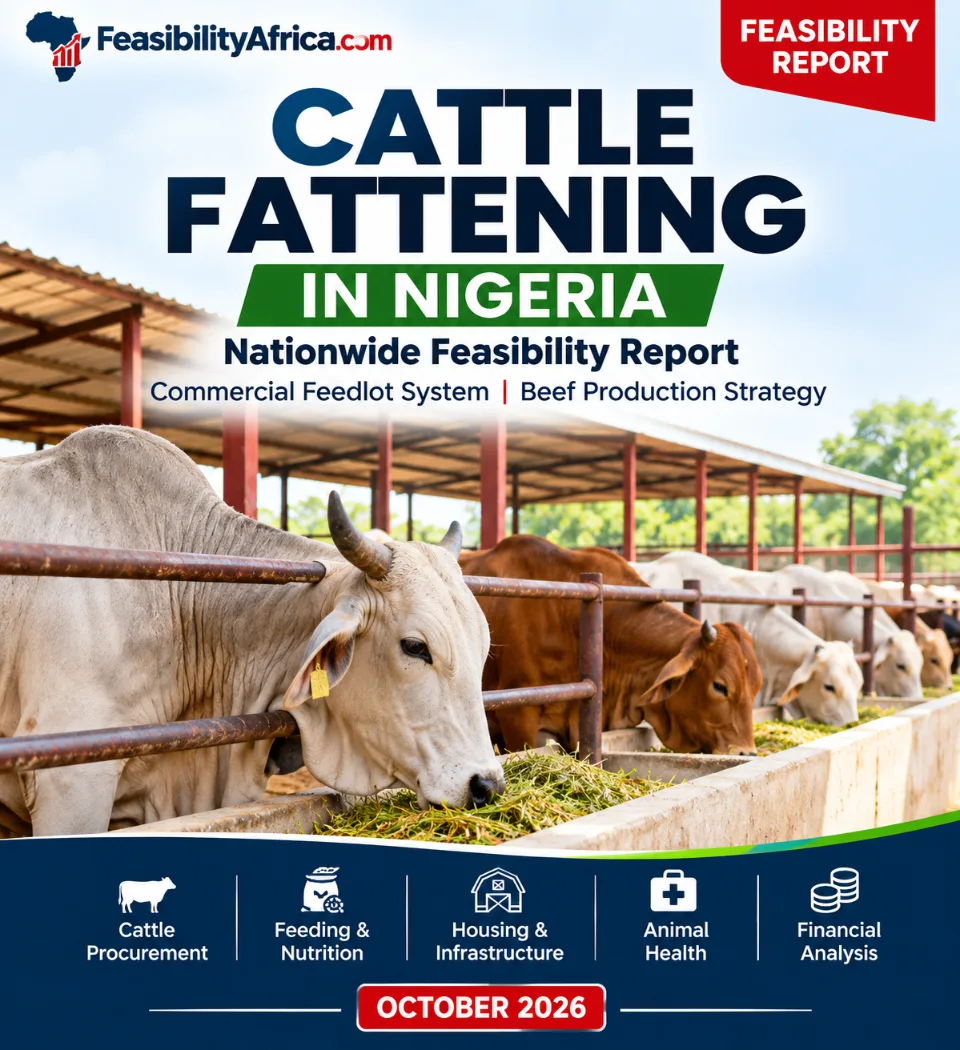
Beef is an important part of Nigeria's food economy. From neighbourhood meat shops and traditional markets to restaurants, hotels, event caterers and large abattoirs, demand for cattle and beef products creates a substantial commercial supply chain.
Yet much of the country's cattle production and marketing system remains traditional. Animals are often raised under extensive grazing systems and transported over long distances before reaching major consumption centres. This creates opportunities for businesses that can improve the condition, weight, consistency and market readiness of cattle.
One business model attracting attention is commercial cattle fattening.
Unlike cattle breeding, which involves raising animals from birth, cattle fattening focuses on purchasing relatively lean but healthy animals, feeding them intensively for a defined period and selling them when they have gained weight and body condition.
It is a practical livestock enterprise that connects cattle markets, feed suppliers, veterinary services, livestock transporters, abattoirs and meat traders.
For entrepreneurs and investors, the attraction is clear: instead of waiting years to raise cattle, a well-managed feedlot can operate in production cycles, purchase animals, improve their market value and sell to established buyers.
However, cattle fattening is not simply a matter of buying bulls and feeding them until they become bigger. The business requires careful procurement, appropriate nutrition, disease prevention, daily supervision and a clear understanding of livestock market prices.
What Is Commercial Cattle Fattening?
Commercial cattle fattening is a livestock production system in which selected cattle are confined in a managed feeding environment and provided with a controlled diet to improve their body weight and condition.
The business generally begins with the purchase of lean, healthy feeder cattle. These animals are brought to a feedlot, where they undergo an adaptation period before receiving a progressively more energy-dense feeding programme.
Over the fattening period, the operator monitors their feed intake, health, weight gain and general condition.
When the animals reach the desired market weight and finish, they are sold to abattoirs, meat traders, wholesalers or other bulk buyers.
A commercial fattening operation is therefore different from:
- Cattle breeding: Producing calves and raising them over an extended period.
- Open grazing: Keeping cattle on pasture where they obtain much of their feed through grazing.
- Cattle trading: Buying and reselling animals without a structured fattening programme.
- Dairy farming: Keeping cattle primarily for milk production.
The feedlot model focuses on adding weight and improving the condition of existing animals within a relatively short production cycle.
Why Cattle Fattening Has Commercial Potential in Nigeria
Nigeria has a large beef market supported by population growth, urbanisation and the widespread consumption of animal protein.
Beef is consumed across different income groups and regions. It is sold through traditional markets, butcheries, restaurants, hotels, supermarkets and institutional food supply channels.
Despite this demand, the livestock supply chain faces challenges relating to animal condition, transportation, inconsistent supply and the fragmented nature of production.
A commercial feedlot can address some of these gaps by producing animals that are more uniform in weight and condition and can be supplied according to agreed schedules.
Consider the difference between two suppliers.
One sells animals that have travelled long distances, may have lost body condition and have uncertain weights. The other supplies healthy, properly conditioned cattle that have been weighed and are ready for slaughter.
For an abattoir operator or meat wholesaler, the second supplier may offer greater predictability.
This is the commercial proposition behind cattle fattening: adding value to an animal before it reaches the meat market.
Understanding the Feedlot Business Model
A feedlot operation follows a relatively straightforward commercial sequence:
1. Source feeder cattle: Purchase healthy, suitable bulls from reputable livestock markets, brokers or direct suppliers.
2. Transport and inspect: Move the animals to the facility using appropriate livestock transport arrangements and obtain the required movement documentation.
3. Quarantine and adapt: Keep new arrivals separate for an appropriate period, assess their health and gradually introduce them to the feeding programme.
4. Feed intensively: Provide a balanced ration containing energy sources, protein, roughage, minerals and clean water.
5. Monitor performance: Observe the animals daily, monitor feed consumption and assess weight gain and body condition.
6. Prepare for sale: Identify suitable buyers, agree on selling arrangements and arrange weighing and transportation.
7. Sell finished animals: Deliver the cattle to abattoirs, meat traders or other buyers at the agreed price.
The process can be repeated in successive cycles. With experience, operators can introduce staggered purchasing so that different groups of cattle reach market readiness at different times.
This can help create a more regular sales pattern than buying and selling all animals at once.
Which Cattle Breeds Are Suitable for Fattening in Nigeria?
Breed selection is an important consideration because cattle differ in body structure, adaptability, growth characteristics and market preference.
Some indigenous breeds commonly considered for commercial fattening include:
White Fulani (Bunaji)
White Fulani cattle are among the most commercially significant indigenous breeds in Nigeria.
They are widely distributed and are valued for their adaptability to different environmental conditions. They are commonly considered for beef production and commercial fattening.
Sokoto Gudali
Sokoto Gudali cattle are another important breed. They are recognised for their body structure and potential for meat production.
They may be considered as an alternative or complementary breed in a fattening operation, depending on availability, animal condition and buyer preference.
Red Bororo (Rahaji)
Red Bororo cattle are associated with traditional pastoral production systems. Their relatively large frames make them suitable for meat production, although availability and purchase economics should be assessed in the target market.
Breed selection alone does not determine profitability. The individual animal's health, age, frame size, starting weight and purchase price are equally important.
A healthy animal with good growth potential may be a better purchase than a larger but poorly conditioned or unhealthy animal.
How to Select the Right Cattle for Fattening
Purchasing the right animals is one of the most important decisions in the business.
A feedlot operator makes a significant financial commitment when purchasing feeder cattle. Buying unsuitable animals can result in poor weight gain, high veterinary expenses and disappointing returns.
Important selection considerations include:
Age: Relatively young adult bulls are often preferred because they may respond better to a structured fattening programme than older animals.
Body condition: The ideal feeder animal should be lean but healthy. An extremely emaciated animal may have underlying health problems and should not automatically be regarded as a bargain.
Body frame: Look for animals with a reasonably large frame and body structure capable of carrying additional muscle and condition.
General health: Check the eyes, coat, movement, breathing and general alertness. Coughing, diarrhoea, discharge, lameness and other signs of illness require attention.
Teeth and age assessment: Teeth can help estimate an animal's age and suitability.
Purchase price: The animal must be acquired at a price that leaves room for feed, veterinary care, transport, labour and other operating expenses.
It is advisable to involve an experienced veterinarian when purchasing cattle, particularly when buying from unfamiliar markets or suppliers.
The Importance of Cattle Procurement
Cattle procurement is not merely a purchasing activity. It is a major determinant of the financial performance of the entire feedlot.
Feeder cattle can be sourced through livestock markets, trusted brokers and direct relationships with cattle owners.
In Nigeria, livestock markets in the northern part of the country play an important role in supplying animals to other regions.
For a commercial operator, building reliable procurement relationships can provide access to suitable cattle and improve the ability to negotiate competitive prices.
However, buyers should avoid making purchasing decisions based solely on verbal assurances.
A disciplined procurement process should include:
- Identifying reputable suppliers and brokers.
- Inspecting animals before purchase.
- Having a veterinarian assess their health.
- Agreeing on the purchase price and transaction terms.
- Obtaining receipts or written evidence of ownership.
- Arranging suitable livestock transportation.
- Obtaining applicable veterinary movement permits.
A poor procurement decision can affect the profitability of an entire fattening cycle. This is why experienced operators treat cattle selection and purchasing as core management functions.
Feeding and Nutrition: The Engine of Weight Gain
Feed is one of the most important recurring expenses in a cattle fattening operation.
The objective is to provide a balanced ration that supports weight gain while maintaining the animal's digestive health.
A feedlot ration generally combines several categories of ingredients.
Energy sources
Energy ingredients support growth and weight gain. Examples include maize offal, wheat offal and other suitable locally available feed materials.
Protein sources
Protein supports muscle development and other body functions. Common feed ingredients include cottonseed cake, groundnut cake and soybean meal.
The quality and safety of individual ingredients should be assessed before use.
Roughage
Roughage is important for normal rumen function and digestive health. It may include hay, maize stover, groundnut haulms and suitable silage.
Minerals
Mineral supplements, salt and other appropriate mineral sources support digestion, bone development and general animal health.
Water
Clean water must be available consistently. Cattle consume substantial quantities of water, particularly under intensive feeding conditions.
Water availability should therefore be treated as an essential part of feedlot infrastructure rather than an optional convenience.
Why Feeding Should Be Introduced Gradually
One common mistake in cattle fattening is changing the animals' diet too quickly after arrival.
Cattle arriving from extensive grazing systems may not be accustomed to concentrated, energy-rich feed. An abrupt change can cause digestive problems and affect their performance.
A structured adaptation period allows the animals to adjust to the new environment and feeding system.
A typical feeding programme can be organised into three broad stages:
Adaptation stage: The animals are gradually introduced to the new ration, with appropriate attention to roughage and digestive adjustment.
Growing stage: The feeding programme is adjusted to support consistent weight gain.
Finishing stage: The ration is managed to improve the animals' final condition and prepare them for market.
The exact formulation and feeding quantities should be developed with a qualified animal nutritionist or veterinarian based on the animals' condition, available ingredients and production objectives.
Designing a Functional Cattle Feedlot
A successful feedlot does not necessarily require elaborate buildings, but it must provide a safe, hygienic and functional environment.
Important infrastructure includes:
Pens: Cattle should have sufficient space to move, rest and access feed and water without excessive competition.
Flooring: Properly compacted and well-drained floors help reduce mud, discomfort and foot-related problems.
Shelter: Roofing should provide adequate protection from intense sunlight and heavy rainfall.
Fencing: Strong fencing is necessary to contain animals and protect the facility.
Feed troughs: Troughs should allow animals to feed comfortably and reduce unnecessary competition.
Water troughs: Clean drinking water should be accessible throughout the day.
Drainage: The facility should be designed to prevent standing water and excessive mud around the pens.
Feed storage: Feed ingredients must be stored properly to protect them from moisture, contamination, pests and deterioration.
Manure management: Regular cleaning and appropriate manure storage or composting help maintain hygiene.
The feedlot should also have suitable access roads for livestock trucks, feed deliveries and the movement of finished cattle.
Animal Health, Disease Prevention and Biosecurity
A cattle fattening operation can lose significant value if disease is not detected and managed early.
Animals purchased from livestock markets may have been exposed to different environments and disease risks before arriving at the farm.
For this reason, biosecurity should begin before the first animal enters the main pens.
A sound health management programme should include:
- Quarantine for newly purchased animals.
- Veterinary examination on arrival.
- Appropriate deworming and vaccination.
- Daily observation for signs of illness.
- Prompt isolation of sick animals.
- Clean water and feeding equipment.
- Regular removal of manure.
- Restricted and controlled visitor access.
- Veterinary support for emergencies and routine health management.
Vaccination programmes should be developed with a qualified veterinarian according to local disease risks and official veterinary guidance.
A feedlot operator should never assume that an animal is healthy simply because it appears normal at the livestock market.
Early detection, professional veterinary support and consistent hygiene are essential to protecting the herd.
Daily Management: Why This Is Not a Passive Investment
One of the most overlooked aspects of cattle fattening is the amount of daily supervision it requires.
Animals need to be fed, watered, observed and monitored. Pens must be cleaned, feed stocks checked and security maintained.
A practical daily routine typically includes morning feeding, health inspection, pen cleaning, record-keeping, afternoon feeding and a final security and animal check.
The operator should maintain records covering:
- Number of animals purchased.
- Purchase prices and supplier details.
- Initial weights.
- Feed ingredients purchased.
- Daily or periodic feed consumption.
- Veterinary treatments and medication.
- Weight gain and body condition.
- Deaths or other losses.
- Selling prices and customer details.
These records make it easier to identify poor-performing animals, control expenses and evaluate the results of each production cycle.
Cattle are valuable assets, and theft or staff negligence can create serious financial losses. Proper fencing, night security, headcounts and regular supervision are therefore essential.
An investor who expects to fund the operation and leave it entirely to unsupervised workers may face considerable risks.
Where Should a Cattle Fattening Business Be Located?
Location has a direct effect on cattle procurement, feed costs, transportation expenses and access to buyers.
A suitable site should be evaluated using several criteria.
Access to feeder cattle: Proximity to established livestock markets and reliable cattle suppliers can reduce procurement and transportation costs.
Availability of feed ingredients: The business needs dependable supplies of maize offal, cottonseed cake, groundnut cake, roughage and other ingredients.
Access to buyers: Proximity to abattoirs, meat wholesalers and major consumption centres can reduce the cost of transporting finished animals.
Road infrastructure: Livestock trucks and feed suppliers must be able to reach the facility throughout the year.
Security: The site must be secure against theft and other threats.
Water supply: Reliable clean water is essential for animal health and daily operations.
Community acceptance: A feedlot can generate odour, flies and waste. Good community relations and appropriate waste management help prevent disputes.
Northern states such as Kaduna, Kano and Katsina offer access to cattle markets and feed ingredients, while North-Central locations may offer a useful balance between northern livestock supply and access to Abuja and other markets.
The best location ultimately depends on the intended customer base and the relative costs of sourcing, fattening and selling cattle.
Who Buys Finished Cattle?
A feedlot should not wait until the animals are ready for sale before looking for customers.
Buyer relationships should be established during the planning and early production stages.
Potential customers include:
Abattoir operators
Abattoirs are important buyers because they purchase live cattle for slaughter and meat distribution. They may value consistent weights, good body condition and reliable delivery schedules.
Meat traders and wholesalers
These businesses purchase cattle, slaughter or process them and supply meat to retailers, markets and other customers.
Hotels, restaurants and caterers
Some hospitality and catering businesses require dependable meat suppliers, particularly when serving large numbers of customers or organising events.
Festive and bulk buyers
Demand for cattle can increase around major festive periods, including Sallah and Christmas. Buyers may seek suitable animals in advance for slaughter and distribution.
Livestock markets
Traditional livestock markets can provide an alternative sales channel, particularly when the operator has surplus animals or needs access to a wider pool of buyers.
The best commercial strategy is to develop direct relationships with reliable buyers and understand their preferences before the first sale.
Timing Sales Around Market Demand
The price of cattle can vary with location, season, animal size, body condition and prevailing market conditions.
Festive periods can create opportunities for higher selling prices because demand for cattle often increases around major celebrations.
However, holding animals for a festive market is not automatically profitable.
Additional feeding costs, the risk of disease, market price movements and the time value of capital must all be considered.
A good operator plans production cycles around realistic market demand and maintains communication with buyers.
The goal is to sell animals when their market value justifies the cost of keeping them, rather than relying on assumptions about seasonal price increases.
Can Cattle Manure Become an Additional Source of Income?
Cattle fattening generates manure, which can be managed as a useful agricultural by-product.
After appropriate collection and composting, manure may be sold to vegetable farmers, nurseries, gardeners and other agricultural users.
It can also be used on the operator's own fodder plots or agricultural land.
This offers two potential benefits: reducing waste-management problems and recovering some value from materials generated during the fattening process.
Manure should not be treated as the main source of revenue, but effective utilisation can support the overall sustainability of the operation.
Common Challenges in Cattle Fattening
Although the business has commercial potential, operators must prepare for several risks.
High feeder cattle prices: Buying animals at excessive prices can eliminate the margin available after fattening.
Rising feed costs: Feed is a major operating expense, and price increases can affect the economics of the entire cycle.
Disease outbreaks: Inadequate quarantine, vaccination and veterinary supervision can result in serious losses.
Poor weight gain: Incorrect feeding, unsuitable animals, illness and poor management can prevent cattle from reaching their target weight.
Theft: Cattle are valuable assets, making security a critical operational requirement.
Market price fluctuations: The selling price may change between the time animals are purchased and the time they are ready for sale.
Working capital shortages: Operators must finance cattle purchases, feed, labour, veterinary care and other expenses throughout the production cycle.
Poor management: Inadequate supervision, inaccurate records and staff negligence can undermine an otherwise promising operation.
These risks make disciplined management more important than simply increasing the number of animals on the farm.
What Makes a Cattle Fattening Business Competitive?
A successful operator must be able to source suitable animals, feed them efficiently, maintain their health and sell them at a price that covers the full cost of production.
Some of the most important competitive advantages include:
Competitive cattle procurement: Reliable suppliers and good market intelligence help the business avoid overpaying for feeder animals.
Efficient feed management: Sourcing ingredients carefully, storing them properly and formulating suitable rations can improve cost control.
Animal health management: Strong biosecurity and veterinary supervision help reduce avoidable losses.
Accurate weighing: Selling cattle based on measured weight rather than guesswork improves transparency and protects the operator's commercial interests.
Established buyer relationships: Direct relationships with abattoirs and bulk buyers can improve market access and reduce dependence on intermediaries.
Daily management: Consistent supervision helps ensure that feeding, cleaning, security and health monitoring are properly performed.
Financial discipline: Every animal should be assessed in terms of its purchase cost, feeding expenses, health costs, expected selling price and contribution to the overall business.
The ability to repeat these practices across successive production cycles is what turns cattle fattening from an occasional livestock transaction into a commercial enterprise.
Is Cattle Fattening Suitable for New Investors?
Cattle fattening can be attractive to entrepreneurs who understand livestock markets and are prepared to manage a hands-on agricultural business.
It may also appeal to existing livestock traders, farmers, feed suppliers and agricultural entrepreneurs who can use their existing relationships to improve procurement and sales.
However, it is not a completely passive investment.
The business requires daily oversight, working capital, suitable infrastructure, reliable veterinary support and the ability to respond quickly when an animal becomes sick or fails to perform.
New investors should begin with a carefully assessed scale, gain practical experience and expand only after demonstrating that their procurement, feeding and sales systems work.
Before You Invest: Understand the Economics of Cattle Fattening
The most important financial question is not simply how much a finished bull can sell for.
It is how much value the business can add after accounting for every cost incurred during the fattening period.
Three variables are particularly important:
- The purchase price of feeder cattle: Buying at the right price creates the foundation for a viable margin.
- The cost of feeding: Feed expenses can consume a substantial portion of the potential revenue.
- The selling price of finished cattle: The final market price determines whether the weight gained translates into a worthwhile commercial return.
Other factors include mortality, veterinary expenses, labour, transportation, utilities, infrastructure and working capital.
An attractive selling price does not guarantee profit if the animal was purchased too expensively or the feeding programme was inefficient.
Investors should therefore assess the entire production cycle before committing capital.
Ready to Start a Cattle Fattening Business in Nigeria?
Nigeria's beef market offers opportunities for entrepreneurs who can supply healthy, well-conditioned cattle to abattoirs, meat traders and bulk buyers.
A properly managed feedlot can create value by improving the weight and condition of feeder cattle while building a more organised relationship between livestock producers and the meat market.
But success depends on much more than buying cattle and providing feed. It requires a clear procurement strategy, an appropriate feeding programme, reliable veterinary care, effective security, disciplined financial management and confirmed access to buyers.
Our Cattle Fattening Business Feasibility Report in Nigeria (2026) is designed to help prospective investors and entrepreneurs evaluate this opportunity before committing their capital.
The report examines the commercial feedlot model, suitable cattle breeds, procurement strategy, feeding and nutrition, housing and infrastructure, animal health, staffing, regulatory requirements, marketing and sales, financial projections, risk analysis and implementation considerations.
Do not invest in cattle fattening based on guesswork. Understand the animals, the feed costs, the market and the numbers before you begin.
Purchase the full Cattle Fattening Business Feasibility Report from FeasibilityAfrica.com and take a more informed step towards building a commercial cattle fattening enterprise in Nigeria.
Enjoyed this? Get the next one free
Every new article, straight to you. Free. Choose email, WhatsApp — or both.
Email newsletter
New articles in your inbox. Unsubscribe anytime.
WhatsApp newsletter
Get new articles directly on WhatsApp. No spam, just new ideas.
Related articles
Agriculture
Catfish Farming in Africa: Costs, Profits and How to Start
Pond options, fingerling sourcing and what one harvest cycle can earn you.
Agriculture
How to Start a Profitable Poultry Farm in Nigeria (2026 Guide)
Startup costs, breeds, feed strategy and how much you can realistically earn from 1,000 birds.
Agriculture
Goat Farming in Nigeria: Building a Profitable Commercial Livestock Business
Goat farming offers opportunities for Nigerian agribusiness entrepreneurs, but success requires more than purchasing animals and providing feed. Discover how commercial goat breeding and fattening work, the best breeds to consider, feeding strategies, housing and animal health requirements, market opportunities, and the financial realities of building a sustainable goat farm.