
Goat Farming in Nigeria: Building a Profitable Commercial Livestock Business
Goat farming offers opportunities for Nigerian agribusiness entrepreneurs, but success requires more than purchasing animals and providing feed. Discover how commercial goat breeding and fattening work, the best breeds to consider, feeding strategies, housing and animal health requirements, market opportunities, and the financial realities of building a sustainable goat farm.
By FeasibilityAfrica Research Team · · 16 min read
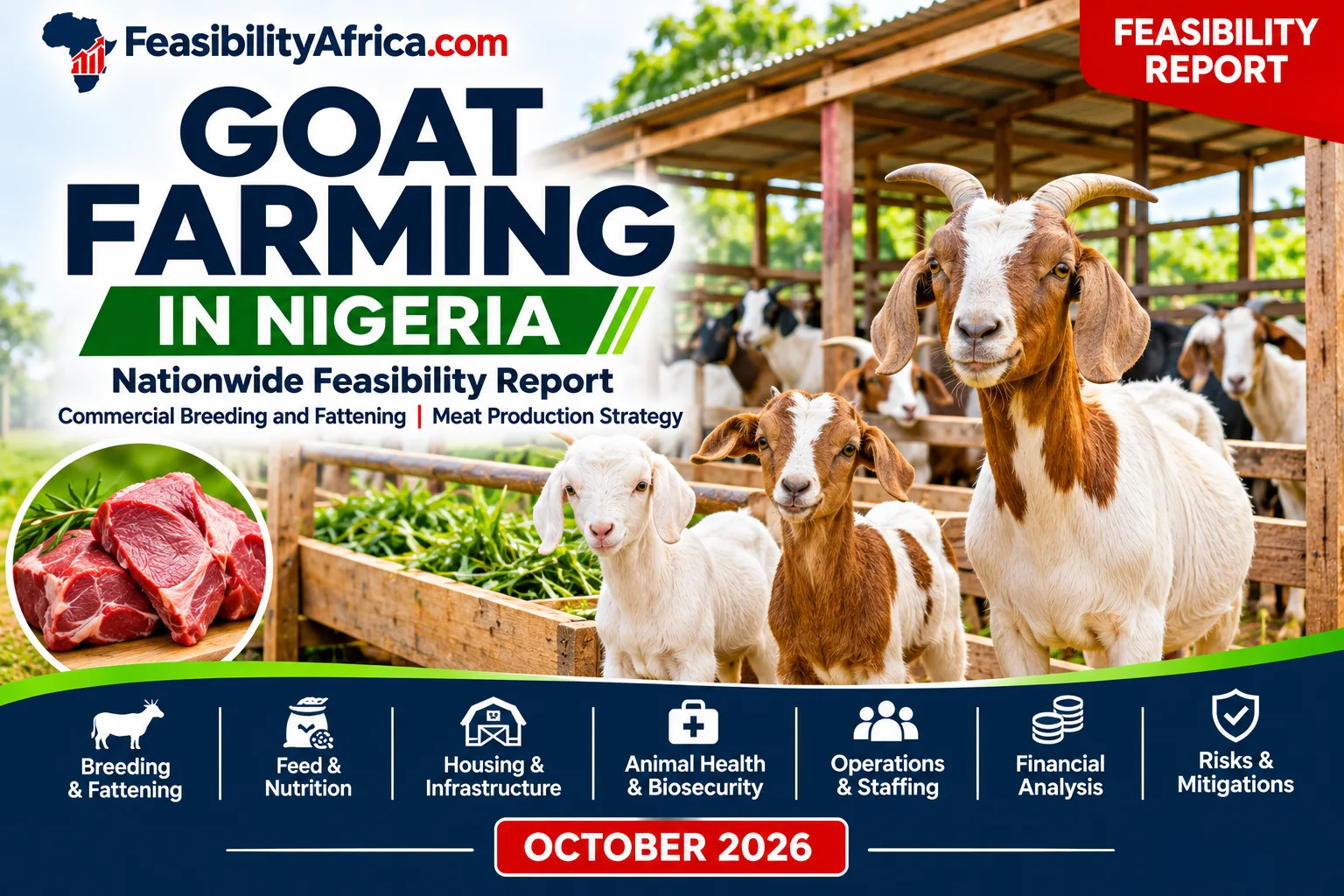
Introduction: An Agricultural Opportunity Hiding in Plain Sight
Goats are among the most familiar livestock animals in Nigeria. They are raised in rural communities, traded in livestock markets, consumed in households and restaurants, and purchased in large numbers during festive seasons.
Despite their widespread presence, much of Nigeria's goat production remains informal and fragmented. Many animals come from smallholder farmers, pastoralists and traditional livestock production systems.
This creates an opportunity for entrepreneurs who can approach goat farming as a structured commercial enterprise.
A well-managed goat farm can produce slaughter-ready animals, supply breeding stock to other farmers and generate additional income from manure. With appropriate management, it can also build a valuable livestock asset over time.
However, commercial goat farming is not simply about buying goats and allowing them to multiply. It requires proper breed selection, feeding, housing, veterinary care, reproduction management, security and access to reliable buyers.
For investors considering livestock production, understanding these fundamentals is essential before committing capital.
Why Goat Farming Attracts Agribusiness Investors
Goat farming has several characteristics that make it attractive as an agricultural enterprise.
1. An established meat market
Goat meat is consumed across Nigeria. It is sold through traditional markets, butcheries, restaurants, suya outlets and other food-service businesses.
Demand also increases around occasions such as Sallah, Christmas, weddings and other celebrations.
These different customer segments provide opportunities for farmers to sell animals throughout the year rather than depend entirely on one market.
2. Opportunities for breeding and fattening
A commercial goat farm can generate revenue through two complementary activities.
Breeding: Raising breeding animals, producing kids and retaining selected females to expand the herd.
Fattening: Raising young or growing goats to achieve marketable body weight before selling them for meat.
The combination allows the farmer to build a productive breeding herd while generating income from surplus male animals and selected stock.
3. Multiple revenue streams
Goat meat is the primary commercial product, but other opportunities exist.
These include:
- Sale of healthy breeding does.
- Sale of quality breeding bucks.
- Sale of composted manure.
- Potential integration with sheep production.
- Future meat processing and packaging.
These additional activities can diversify revenue, although the core goat enterprise should become stable before major expansion.
4. A business that builds livestock assets
Unlike a trading operation that depends entirely on buying and reselling animals, a breeding farm builds its own herd.
Female kids can be retained as replacement breeding stock, gradually increasing the productive capacity of the farm.
This biological growth is an important part of the commercial model.
It also explains why goat farming should be viewed as a medium- to long-term investment rather than a quick-income opportunity.
Understanding the Commercial Goat Farming Model
A properly organised goat farm begins with the acquisition of foundation breeding stock.
The farmer provides suitable housing, feed, water and veterinary care, introduces a controlled breeding programme and raises the resulting kids.
Male offspring can eventually be sold for meat, while selected females are retained to expand or improve the herd.
The feasibility report evaluates a small-to-medium-scale enterprise beginning with approximately 20–25 does and one or two bucks.
The recommended production system is semi-intensive. Animals are kept in raised-floor housing and receive supervised grazing or cut-and-carry fodder, supported by supplementary feeding.
This approach gives the farmer greater control over animal health, feeding and breeding than an unmanaged free-ranging system.
The objective is to develop a productive herd with consistent growth, controlled mortality and dependable market access.
Choosing the Right Goat Breeds
Breed selection is one of the most important early decisions.
A suitable breed should perform well under local climatic conditions, have good reproductive characteristics and produce animals that meet the requirements of the target meat market.
The feasibility report identifies three breeds or breed types worth considering.
Red Sokoto (Maradi)
<AsyncImage query="Red Sokoto Maradi goats Nigeria red brown goat herd" aspectRatio="16:9" width="100%"/>
The Red Sokoto goat is recommended as the primary foundation breed.
Its characteristics include:
- Adaptability to Nigerian climatic conditions.
- Good mothering ability.
- Hardiness.
- Desirable meat quality.
- Recognisable deep-red coat colour.
The report recommends starting with Red Sokoto breeding does and unrelated bucks sourced from reputable farms.
Boer crosses
<AsyncImage query="Boer cross meat goats white brown livestock farm" aspectRatio="16:9" width="100%"/>
Boer crosses can be considered where the objective is to improve growth performance and mature body weight.
They may be useful as terminal sires in a planned crossbreeding programme.
However, they generally require better feeding and management than the hardier local foundation breeds.
A farmer should not introduce them simply because they are larger. Their performance must justify the additional cost and management requirements.
West African Dwarf goats
<AsyncImage query="West African Dwarf goats small Nigerian indigenous goat herd" aspectRatio="16:9" width="100%"/>
West African Dwarf goats are known for their hardiness and ability to tolerate certain disease pressures, including trypanosomiasis.
Their smaller mature size may make them more appropriate for particular lower-price markets or carefully designed crossbreeding programmes.
Where should breeding stock be purchased?
The quality of foundation animals influences the productivity of the entire farm.
The report recommends purchasing breeding stock from established commercial farms where health history and genetics can be assessed.
Direct purchases from village or Fulani herds may also be considered, but they require experience in selecting healthy animals and strict quarantine.
Open livestock markets are not recommended for foundation stock because animals may be stressed or carrying infections.
Feeding and Nutrition: The Biggest Operating Cost
Feed management is arguably the most important operational challenge in commercial goat farming.
The feasibility report estimates that feed accounts for approximately 60–70% of total operating costs.
This means that a farm's ability to control feeding expenses can significantly influence its financial performance.
Goats require an appropriate balance of roughage, energy, protein, minerals and clean water.
A commercial farm should not rely entirely on expensive purchased concentrates.
Instead, it should develop a feeding strategy that combines locally available resources with supplementary feeds.
Own fodder production
Farmers can establish fodder plots using suitable grasses and tree legumes.
The report identifies:
- Napier grass.
- Leucaena.
- Gliricidia.
Growing fodder on the farm can reduce dependence on purchased feed and improve cost control.
A small area dedicated to fodder production can become particularly valuable during the dry season.
Concentrate feeds
Concentrates may include maize, soybean meal and groundnut cake.
They provide supplementary nutrients needed for growth, reproduction and other production requirements.
Bulk purchasing after harvest can help reduce costs compared with buying small quantities throughout the year.
Proper storage is important. Feed should be kept in dry, rodent-proof facilities to minimise spoilage and contamination.
Alternative feed sources
Commercial farms may also explore alternative feed ingredients where availability, nutritional quality and transportation costs make them practical.
The report identifies brewers' spent grain and rice bran as possible options.
Relationships with breweries and rice mills may help secure these materials.
However, alternative feeds should be incorporated into properly balanced diets rather than used indiscriminately.
Preparing for the dry season
Nigeria's seasonal feed pattern presents an important challenge.
The rainy season generally offers greater availability of green fodder, while the dry season creates shortages and increased feeding costs.
The report estimates that feed costs may rise by 30–50% during the dry season.
Farmers should therefore conserve fodder, store suitable feed ingredients and plan concentrate purchases ahead of the period of scarcity.
A farm that fails to prepare for the dry season may experience poor animal growth, reduced reproductive performance and higher operating expenses.
Housing: Creating the Right Environment for Healthy Goats
Goat housing must protect animals from excessive rain, heat, predators, theft and unsanitary conditions.
The feasibility report recommends a raised-floor open shed as a suitable housing arrangement for the proposed commercial system.
Important design considerations include:
Raised flooring: The floor should generally be 1–1.5 metres above ground level, with wooden slats spaced approximately 1–2 cm apart. This allows manure and urine to fall through, helping keep the animals dry.
Ventilation: Open sides with suitable wire mesh or netting help provide airflow while maintaining security.
Roofing: Corrugated iron sheets with sufficient overhang protect the animals from rainfall.
Separate pens: Bucks, does, kidding animals, weaners and sick or quarantined animals should have appropriate separate spaces.
Good housing reduces exposure to wet and dirty conditions and makes feeding, observation and routine management easier.
It also allows the farmer to identify sick animals and manage breeding activities more effectively.
Animal Health and Biosecurity
Disease management can determine whether a goat farm succeeds or suffers substantial losses.
A disease outbreak can affect reproduction, growth, mortality and the market value of animals.
For this reason, veterinary care should be integrated into the farm's operations from the beginning.
PPR vaccination
Peste des petits ruminants (PPR) is identified in the report as a major disease threat to goats.
The report recommends annual vaccination or the schedule advised by a qualified veterinarian.
Deworming
Internal parasites can reduce productivity without always producing obvious symptoms.
The report recommends deworming every three to four months, with rotation of drug classes under appropriate veterinary guidance.
Quarantine
Newly purchased goats should not be introduced immediately into the main herd.
The report recommends a quarantine period of at least 21–30 days.
This allows the farmer to observe the animals and manage potential disease risks before they come into contact with the existing herd.
Other routine interventions
A health programme should also include:
- Regular hoof inspection and trimming where necessary.
- Clean water and appropriate nutrition.
- Monitoring of pregnant and recently delivered does.
- Suitable kidding pens.
- Prompt isolation of sick animals.
- Proper veterinary records.
One of the most important recommendations is to identify a qualified veterinarian before purchasing the first animals.
Waiting until a disease outbreak occurs is an expensive way to establish a veterinary relationship.
Breeding Management and Herd Expansion
Breeding is the foundation of a commercial goat production enterprise.
The farmer must manage reproduction carefully to increase the herd without allowing uncontrolled mating or poor-quality breeding stock to undermine productivity.
The feasibility report uses illustrative assumptions of a 75% kidding rate in Year 1, increasing towards 80% by Year 3, with an average litter size of 1.5 kids per kidding doe.
It also uses a kid mortality assumption of 15%.
These are planning assumptions, not guaranteed biological outcomes. Actual performance depends on genetics, nutrition, health, housing and management.
Selecting replacement females
The best female kids should be retained to replace older or less productive breeding animals and expand the herd.
The report recommends retaining approximately 20–30% of female kids annually for internal herd expansion.
This reduces the need to purchase replacement animals repeatedly and helps improve herd genetics over time.
Managing breeding bucks
The farmer should maintain suitable buck-to-doe ratios and avoid uncontrolled inbreeding.
The report recommends starting with one or two unrelated bucks for the initial group of 20–25 does.
Breeding records should include mating dates, kidding dates, offspring numbers, mortality and animal identification.
Without records, it becomes difficult to assess the performance of individual breeding animals.
Who Buys Commercially Produced Goats?
A commercial goat farm should establish its sales relationships before animals reach market weight.
The feasibility report identifies several potential customer categories.
Meat traders
Livestock traders and meat-market sellers are the primary target customers during the early stages of the proposed business.
They purchase live goats for slaughter and resale.
Their main requirements include reliable availability, appropriate body weight and healthy animals.
Suya and pepper-soup businesses
These businesses need regular supplies of animals or carcasses.
They may become important customers as the farm develops a consistent production cycle.
Festive buyers
Sallah, Christmas, weddings and other celebrations create seasonal opportunities.
The report identifies festive demand as a potential route to higher selling prices.
Farmers may consider advance bookings and deposits before major festive periods, provided they can fulfil the agreed orders.
Bulk aggregators
Aggregators can help farmers move larger volumes into major city markets.
They become more useful as herd size and sales volumes increase.
Hotels and restaurants
These buyers may demand specific animal weights, consistent quality and dependable delivery arrangements.
They are potential premium-market customers as the farm develops.
Marketing a Commercial Goat Farm
A goat farm should not wait until animals are ready for sale before beginning its marketing activities.
Customer relationships take time to establish.
The report recommends a combination of farm-gate sales, trader relationships, festive advance bookings and breeding-stock sales.
Farm-gate sales
An organised farm with accessible roads, visible signage and properly managed pens can attract traders who prefer to purchase directly from the producer.
Building relationships with meat traders
Farmers should identify two or three major traders before the first animals are ready for sale.
This allows both sides to discuss expected volumes, animal weights and pricing arrangements.
Selling by weight
One practical recommendation in the report is simple: weigh, don't guess.
A hanging scale allows the farmer and buyer to agree on animal weight transparently.
This can reduce disputes and protect the farmer from undervaluing animals.
Managing payment
New buyers should generally pay cash on delivery.
For established bulk buyers, bank transfer should be confirmed before animals are loaded.
A farmer should avoid selling on credit simply to move stock quickly.
Understanding the Financial Requirements
Goat farming can look inexpensive compared with some other livestock businesses, but the total capital requirement is much greater than the cost of purchasing the first animals.
The investor must budget for housing, fencing, water, equipment, feed, labour, veterinary services, transportation and unexpected expenses.
The feasibility report provides the following illustrative figures for the proposed operation.
Initial capital expenditure
The report estimates initial capital expenditure at approximately ₦3.0 million–₦4.6 million.
This includes:
- Breeding stock.
- Raised-floor housing.
- Equipment and tools.
- Perimeter fencing.
- Fodder establishment.
- Water supply where required.
- Contingency.
Monthly operating expenses
The illustrative Year 1 monthly operating cost is estimated at approximately ₦185,000–₦320,000.
The main expense categories include concentrate feed, fodder, veterinary care, labour, security, utilities, transportation and miscellaneous repairs.
Actual costs will vary depending on location, herd size, feed availability and the level of owner involvement.
Recommended total capital
The report recommends total available capital of ₦12 million–₦15 million, including an 18–24 month operating buffer.
It identifies ₦8 million as the minimum liquid capital threshold for a lean small-scale launch.
This distinction is important: the cost of constructing a farm and purchasing animals is not the same as the amount needed to operate the business until it generates sufficient cash.
Why Goat Farming Is Not a Quick-Cash Business
One of the most important lessons in commercial goat farming is the difference between building an asset and generating immediate cash income.
A breeding farm needs time to establish its herd.
The first year is largely focused on acquiring animals, establishing infrastructure, managing reproduction and raising young stock.
During this period, many female kids should be retained rather than sold.
The feasibility report illustrates this progression:
Period
Herd development and sales strategy
Year 1
Begin with approximately 20 does; retain most females and sell selected cull males
Year 2
Grow towards 25–30 does; sell selected slaughter males
Year 3
Build towards 30–35 does; increase slaughter sales and begin breeding-stock sales
The report's illustrative revenue projections are ₦400,000–₦800,000 in Year 1, ₦1.2 million–₦1.8 million in Year 2 and ₦2.5 million–₦4 million in Year 3.
Its profit-and-loss model also shows cash losses in the first two years and a smaller projected loss in Year 3.
The report therefore describes the business as an asset-building enterprise, with cash profitability expected around Year 3–4 under its assumptions.
The investor must be prepared to finance the operation through this early period.
Selling breeding females prematurely to meet operating expenses can undermine the very herd expansion that makes the business attractive.
Location: Where Should You Establish a Goat Farm?
Location influences feed availability, market access, veterinary services, land costs, security and disease pressure.
The feasibility report assesses several Nigerian regions.
North-West Nigeria
Kaduna, Kano, Sokoto and Katsina have established livestock markets and strong feed-production potential.
The region is also associated with the Red Sokoto breed.
However, security conditions and logistics must be assessed carefully at the proposed site.
North-Central Nigeria
Kwara, Niger, Nasarawa and the Federal Capital Territory offer a central position for reaching markets across northern and southern Nigeria.
The region may provide access to Abuja demand and comparatively attractive land options in some areas.
South-West Nigeria
Oyo, Ogun and the Lagos fringe provide access to a large consumer market, abattoirs, restaurants and established commercial networks.
However, land costs, feed competition and disease pressure in some areas must be considered.
South-East and South-South Nigeria
The South-East has established trading networks and cultural demand for goats at social events.
The South-South provides access to Port Harcourt and other regional markets.
The report considers these regions more suitable for distribution and aggregation than as the primary production base in its illustrative national strategy.
Its recommended base-case locations are North-Central or South-West Nigeria, subject to local market validation, security assessment and veterinary review.
Common Challenges in Goat Farming
A successful goat farm requires more than good intentions. Investors should prepare for the following risks.
Disease outbreaks: PPR, enterotoxaemia and pneumonia can cause serious losses. Vaccination, quarantine, biosecurity and veterinary supervision are essential.
Theft: Goats are valuable and relatively easy to move. Fencing, night security, community relationships and regular headcounts are important.
Feed price increases: Feed is the largest operating expense. Own fodder production, bulk purchases and alternative feed sources can reduce exposure.
Kid mortality: Poor nutrition, inadequate kidding supervision and failure to ensure early colostrum intake can reduce the number of surviving kids.
Market price fluctuations: Farmers who need immediate cash may be forced to sell animals at unfavourable prices. Adequate working capital reduces this pressure.
Staff dishonesty or negligence: Daily feeding, health observation and animal counts require reliable personnel and supervision.
Land and community disputes: Secure land tenure and early engagement with local leaders help reduce operational disruption.
Expansion Opportunities for Established Goat Farms
Once the core breeding operation is stable, there are opportunities to expand into related activities.
Sheep integration
The farm can introduce a small number of pregnant ewes to diversify livestock production.
The report identifies sheep as a complementary opportunity, particularly because of their importance during Sallah.
Out-grower aggregation
An established farm can develop relationships with smallholder farmers, supply breeding stock and aggregate mature animals for larger buyers.
This can increase market volume without requiring an immediate expansion of the farm's own land.
Meat processing
Slaughtering, packaging and processing can potentially create additional value.
However, this requires additional capital, appropriate regulatory approvals, cold-chain facilities and butchery skills.
The report recommends considering this option only after the core farm is stable, generally around Year 4–5 or later.
Is Commercial Goat Farming Right for You?
Commercial goat farming may suit entrepreneurs who have access to secure land, sufficient capital, a reliable veterinary professional and the willingness to manage livestock daily.
It is particularly attractive to people interested in building a long-term agricultural asset rather than seeking immediate monthly income.
However, it may not be suitable for an investor who:
- Needs regular income from the farm within the first year.
- Cannot provide adequate working capital.
- Cannot supervise daily farm operations.
- Has no reliable source of feed.
- Has not established access to potential buyers.
- Is unwilling to implement vaccination and biosecurity programmes.
The feasibility report emphasises that absentee ownership rarely succeeds in this type of operation.
The owner's presence, or the appointment of an exceptionally reliable and experienced manager, is critical during the early stages.
Conclusion: Build the Herd, Control the Costs and Secure the Market
Nigeria's goat farming industry presents opportunities for entrepreneurs who can introduce better-managed and more reliable commercial production systems.
The business can combine meat production, breeding-stock sales and long-term herd development.
But its success depends on getting the fundamentals right: suitable genetics, affordable feeding, proper housing, disease prevention, reproductive management, security and dependable customers.
The first two years may test an investor's patience and financial reserves. A well-managed farm must have enough capital to survive the period before significant sales begin.
For anyone considering entering this sector, a detailed understanding of the investment requirements and operating model is essential.
Thinking of starting a commercial goat farming business in Nigeria?
The Goat Farming Business Feasibility Report in Nigeria (2026) provides a structured assessment of the opportunity, covering breed selection, breeding stock, feed and nutrition, housing, veterinary care, market access, financial projections, risk management and implementation planning.
It is designed to help aspiring livestock farmers, agribusiness entrepreneurs and investors evaluate the business before committing their capital.
Purchase the full 27-page Goat Farming Feasibility Report from FeasibilityAfrica.com and take a more informed approach to building your livestock investment.
Enjoyed this? Get the next one free
Every new article, straight to you. Free. Choose email, WhatsApp — or both.
Email newsletter
New articles in your inbox. Unsubscribe anytime.
WhatsApp newsletter
Get new articles directly on WhatsApp. No spam, just new ideas.
Related articles
Agriculture
Catfish Farming in Africa: Costs, Profits and How to Start
Pond options, fingerling sourcing and what one harvest cycle can earn you.
Agriculture
How to Start a Profitable Poultry Farm in Nigeria (2026 Guide)
Startup costs, breeds, feed strategy and how much you can realistically earn from 1,000 birds.
Agriculture
Cattle Fattening Business in Nigeria: How to Build a Profitable Commercial Beef Production Enterprise
Discover the opportunities in Nigeria’s cattle fattening industry. Learn how commercial feedlots work, which cattle breeds are suitable, what animals eat, how to manage their health and where to find buyers. Explore the practical considerations for turning lean cattle into market-ready beef animals.