
Palm Oil Processing Business in Nigeria: How to Establish a Profitable Palm Oil Mill
Nigeria's palm oil industry offers opportunities for entrepreneurs who can turn Fresh Fruit Bunches into quality crude palm oil and marketable by-products. Discover how a semi-mechanised palm oil mill operates, where to source palm fruits, the machinery involved, how to manage seasonal supply and what it takes to build a competitive processing business.
By FeasibilityAfrica Research Team · · 13 min read
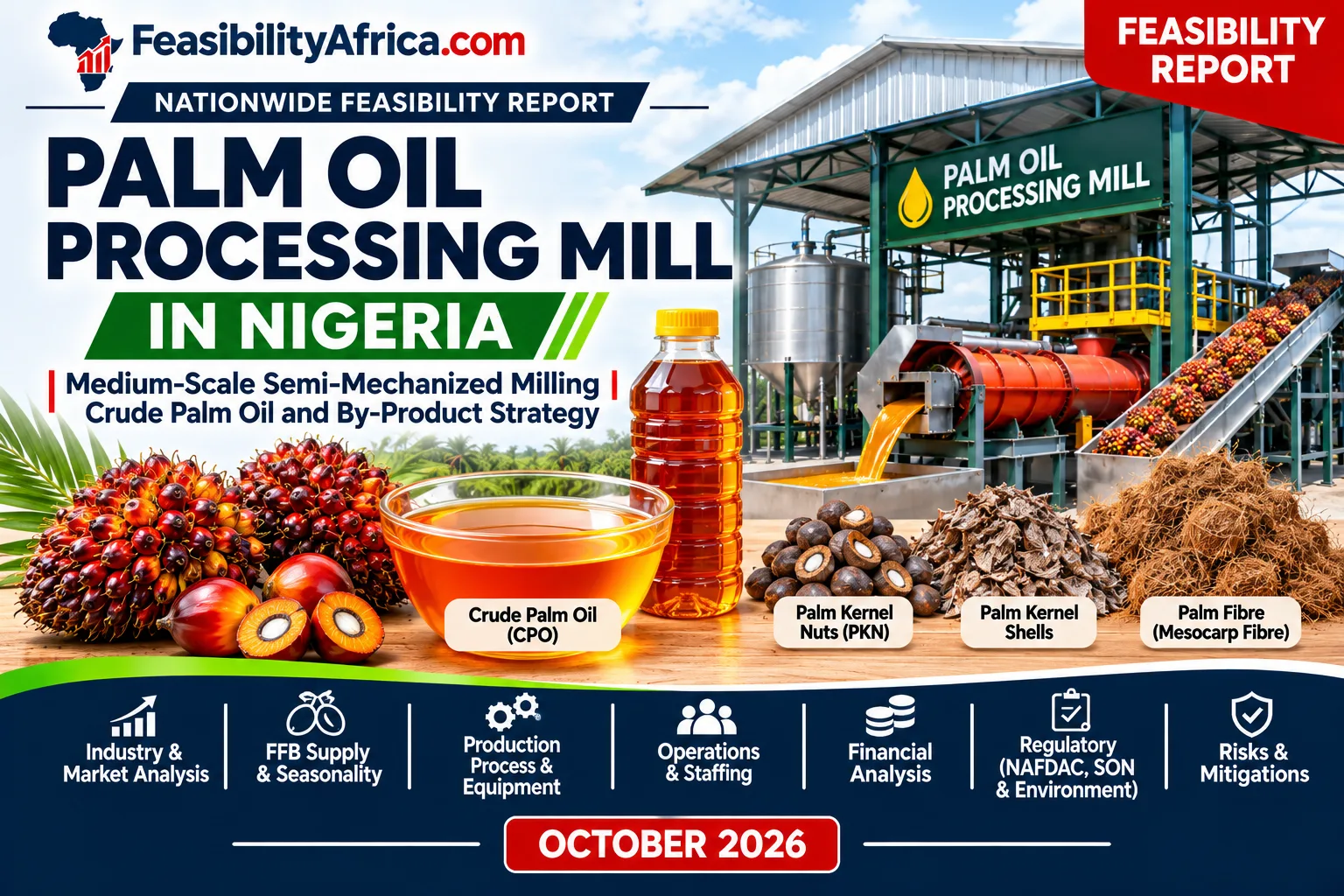
Introduction: Turning Palm Fruits into Commercial Value
Palm oil is one of the most familiar agricultural products in Nigeria. It is used in household cooking, food processing, soap production and several other industries.
Behind this everyday commodity is an extensive agricultural value chain involving oil palm farmers, fruit harvesters, transporters, small-scale processors, commercial mills, wholesalers and industrial buyers.
For entrepreneurs, palm oil processing presents an opportunity to participate in this value chain by converting Fresh Fruit Bunches (FFB) into crude palm oil and other useful products.
However, establishing a successful palm oil mill requires much more than purchasing processing equipment. The business depends on access to fresh fruits, efficient extraction, product quality, reliable buyers, effective waste management and sufficient working capital.
The most important question is not simply whether people buy palm oil. It is whether a proposed mill can consistently obtain enough fresh fruit at a price that allows it to process and sell the resulting products profitably.
Understanding the Palm Oil Processing Business
A commercial palm oil mill receives Fresh Fruit Bunches harvested from oil palm trees and processes them to extract crude palm oil.
The business model can take different forms depending on the scale of operation, available capital and degree of integration.
Small-scale manual processing
Traditional processors use relatively simple tools and labour-intensive methods to separate fruit, cook, pound and extract oil.
This approach may require less initial investment, but production capacity, extraction efficiency and product consistency can be limited.
Semi-mechanised processing
A semi-mechanised mill uses equipment for major processing operations while retaining some manual handling and labour.
It occupies an important position between artisanal processors and large industrial plantations. It can improve extraction efficiency, throughput and quality without requiring the full investment associated with an integrated plantation and refinery.
Large-scale integrated processing
Integrated operations may combine oil palm cultivation, fruit harvesting, milling, kernel processing and refining.
Such projects can offer greater control over raw material supply and downstream value addition, but they generally require substantially more capital, land and management capacity.
For many independent entrepreneurs, a medium-scale semi-mechanised mill may provide a more accessible entry point.
Why Palm Oil Processing Attracts Investors
1. Palm oil has multiple markets
Crude palm oil is used in household cooking and by commercial food manufacturers.
Industrial users include producers of noodles, snacks, margarine and other processed foods. Soap and detergent manufacturers also use palm-derived oils and related ingredients.
These different customer groups create opportunities for mills that can produce consistent quality and dependable volumes.
2. Processing adds value to agricultural produce
Instead of selling harvested palm fruits in their unprocessed form, a mill converts them into products that can be sold to wholesalers, traders and industrial users.
The business therefore creates value through processing, quality control, aggregation and distribution.
3. The industry supports rural economic activity
A processing mill can create demand for fruit supplied by smallholder farmers, cooperatives, family farms and larger estates.
It also creates work for transporters, machine operators, technicians, casual labourers and other service providers.
A well-managed mill can become an important commercial buyer within its surrounding agricultural community.
4. By-products can contribute to revenue
Palm oil processing produces more than crude palm oil.
Palm kernel nuts can be sold to kernel crushers, while palm fibre may be used as boiler fuel or for other applications.
Empty fruit bunches and other organic residues may also have agricultural or environmental uses.
A mill that manages these materials effectively can reduce waste and improve the economics of its operations.
Understanding the Main Products of a Palm Oil Mill
A commercial operator should understand the different outputs of the processing operation and the markets available for each.
Crude Palm Oil (CPO)
Crude palm oil is the principal product obtained from the fleshy mesocarp of the palm fruit.
It is commonly recognised by its red-orange colour and is sold to wholesalers, food processors and other buyers.
Its commercial quality is influenced by factors such as fruit freshness, extraction practices, clarification, moisture content and free fatty acid levels.
Palm Kernel Nuts (PKN)
Palm kernel nuts are recovered from the pressed fruit fibre and contain the kernels used in downstream palm kernel processing.
Kernel crushers purchase these nuts for further processing into palm kernel oil and palm kernel cake.
For an independent mill, selling palm kernel nuts can create an additional source of income without having to establish a separate kernel-crushing operation.
Palm Fibre
Palm fibre is produced during the extraction process.
It can be used as a source of boiler fuel or sold for other applications, depending on its quality and the availability of buyers.
The report identifies fibre as a potentially marketable by-product rather than material that should automatically be treated as waste.
Empty Fruit Bunches and Palm Oil Mill Effluent
Empty fruit bunches are generated after fruit removal, while palm oil mill effluent (POME) is produced during processing and clarification.
These materials require appropriate handling.
Empty fruit bunches may be composted or returned to agricultural land where suitable. POME requires proper treatment before discharge or reuse.
Environmental management should be included in the factory design and operating budget from the beginning.
The Importance of Fresh Fruit Bunch Supply
Raw material procurement is one of the most important factors determining whether a palm oil mill succeeds.
A mill may have modern machinery, trained workers and interested buyers, but it cannot operate without a reliable supply of fresh palm fruits.
Where can palm fruits be sourced?
Potential suppliers include:
- Smallholder oil palm farmers.
- Farmer cooperatives.
- Family-owned plantations.
- Larger commercial estates.
- Independent fruit aggregators.
- Agricultural communities within the mill's collection area.
The best supply strategy will depend on the location, local production patterns, transport infrastructure and relationships with farmers.
Why location matters
Fresh Fruit Bunches deteriorate after harvesting.
The report emphasises the importance of processing fruits within approximately 24 hours of harvest because delays can increase free fatty acid levels and reduce the quality and market value of the extracted oil.
This makes proximity to fruit-producing communities a critical site-selection factor.
A mill located too far from its suppliers may face higher transport costs and quality problems before processing even begins.
Seasonality and supply planning
Palm fruit availability is seasonal.
The report identifies June to October as a peak supply period in its illustrative operating environment, when fruit may be more abundant and prices lower. January to April is identified as a lean period, when supply becomes tighter and prices may increase.
These patterns vary by location and should be confirmed with farmers in the proposed catchment area.
A mill that plans its business around peak-season supply alone may struggle to cover its fixed costs during periods of shortage.
Operators should therefore develop relationships with multiple suppliers, understand local harvesting patterns and prepare a realistic lean-season procurement strategy.
Why written supply agreements matter
Informal assurances from farmers are not a reliable substitute for structured procurement arrangements.
A mill should negotiate written agreements with cooperatives and aggregators, specifying expected quantities, delivery schedules, quality expectations and pricing arrangements.
The report recommends securing commitments covering at least 60% of daily raw material requirements before proceeding with major construction and machinery commitments.
How a Commercial Palm Oil Mill Operates
A semi-mechanised palm oil mill uses a series of processing operations to extract crude palm oil.
1. Fruit reception and weighing
Fresh Fruit Bunches are received, inspected and weighed.
The operator should record supplier details, quantities, delivery time and other relevant information.
Over-ripe, bruised or old fruits may affect the quality of the final oil.
2. Sterilisation
The fruit bunches are exposed to steam in a steriliser.
Sterilisation helps loosen the fruits from the bunches and stops enzymatic activity that can contribute to deterioration in oil quality.
3. Threshing
The sterilised bunches are passed through a rotary drum thresher.
This separates the palm fruits from the empty fruit bunches.
4. Digestion
The separated fruits are fed into a digester, where they are heated and mashed.
This breaks down the fruit structure and prepares the material for oil extraction.
5. Pressing
The digested fruit mash is passed through a screw press.
The press extracts crude oil and produces a fibrous cake containing the palm kernel nuts.
Pressing performance affects oil recovery and the amount of residual oil left in the cake.
6. Clarification
The extracted crude oil contains water and suspended impurities.
It is heated and processed through a clarification system to separate unwanted materials and improve the quality of the oil.
7. Storage and dispatch
The clarified oil is transferred into storage tanks.
It is inspected for relevant quality parameters before being transferred into containers for sale or distribution.
Proper storage and handling help preserve product quality before delivery to customers.
Machinery and Equipment Required
The equipment configuration depends on the intended capacity, production method and available capital.
A medium-scale semi-mechanised operation may require:
- Steriliser tank and cage.
- Steam boiler.
- Motorised rotary drum thresher.
- Digester with heating system.
- Double screw press.
- Clarification tank with heating coil.
- Pumps and piping.
- Crude palm oil storage tanks.
- Generator and electrical installations.
- Weighing scales and handling tools.
- Spare parts and maintenance equipment.
A suitable processing line should be selected as an integrated system.
Investors should not purchase equipment based solely on advertised capacity. They should confirm actual throughput, extraction performance, power consumption, installation requirements, maintenance needs and the availability of technical support.
It is also advisable to obtain quotations from multiple suppliers and inspect comparable operating mills before committing capital.
Choosing the Right Location for a Palm Oil Mill
Location selection should begin with raw material availability, not simply the price of land.
The mill must be close enough to fruit-producing communities to receive and process harvested bunches promptly.
The report identifies several Nigerian regions with different advantages.
South-South
Akwa Ibom, Cross River, Edo and Delta are identified as important areas with oil palm activity and access to established trading markets.
These states may offer opportunities for mills located close to smallholder supply clusters.
South-East
Abia, Imo, Anambra and Enugu offer access to palm oil trading networks and industrial buyers.
Markets such as Aba and Onitsha are relevant to the movement of palm oil and related products.
South-West
Ondo, Ogun, Oyo and Osun have established agricultural and trading activity.
Ondo is highlighted in the report as an important FFB-producing state, while proximity to Lagos provides access to a major commercial market.
However, competition for fruit can be significant in established production areas.
North-Central and North-West
The report identifies states such as Kogi, Benue and Nasarawa as potential longer-term expansion areas, while Kaduna and Kano are considered important consumption and distribution markets rather than primary production locations for the proposed model.
A mill should be located near the source of fresh fruit, even if its customers are in distant markets. Transporting crude palm oil to buyers is generally more practical than transporting harvested bunches over long distances.
Quality Control: Why Good Palm Oil Commands Buyer Confidence
Industrial buyers and serious wholesalers require dependable quality.
A mill should establish routine checks for:
- Free fatty acid (FFA) levels.
- Moisture content.
- Colour and appearance.
- Clarity and sediment.
- Storage and handling conditions.
- Container cleanliness and sealing.
The report identifies a target FFA level below 5%, with lower levels desirable for certain industrial customers, and moisture below 0.5%.
The quality of the incoming fruits and the time between harvest and processing are important factors in achieving these targets.
Consistent quality can help a mill build long-term relationships with food processors and other commercial buyers.
Marketing and Selling Palm Oil
Producing crude palm oil is only one part of the business. The mill must also develop a dependable route to market.
Wholesalers and bulk traders
Wholesalers are important customers because they can purchase substantial quantities and arrange transportation from the factory.
Factory-gate sales can reduce the mill's logistics burden and help shorten the cash collection cycle.
Food-processing companies
Manufacturers of noodles, snacks, margarine and other food products may require consistent supplies that meet their quality specifications.
These customers can provide strategic opportunities, although their purchasing procedures and payment terms should be evaluated carefully.
Soap and detergent manufacturers
Soap producers and other industrial users may purchase palm-derived oils for manufacturing.
A mill that can supply dependable volumes and quality may develop relationships with these businesses.
Palm kernel buyers
Palm kernel nuts should have a separate sales strategy.
Kernel crushers and aggregators may purchase nuts in bags or bulk quantities. Establishing collection arrangements before production begins can prevent by-products from accumulating unnecessarily.
Cash management and credit policy
A common challenge in agro-processing is the temptation to extend credit to buyers in order to increase sales.
However, the mill must pay farmers and suppliers for fresh fruits, often immediately.
If customers delay payment, the business may lack the cash needed to continue procurement.
The report therefore recommends prioritising cash sales, particularly during the early operating period, and treating credit arrangements cautiously.
Managing Energy and Production Costs
Palm oil milling requires energy for sterilisation, digestion, pressing, clarification, pumping and other operations.
Where grid electricity is unreliable, a generator may become the primary power source.
Diesel consumption can therefore represent a significant operating expense.
A mill should monitor fuel consumption daily and compare actual use with production output.
The operator should also assess:
- Boiler efficiency.
- Equipment maintenance.
- Generator loading.
- Insulation and heat retention.
- Production scheduling.
- Availability of alternative biomass fuel.
Palm fibre and empty fruit bunches may provide opportunities for future energy integration, subject to appropriate boiler design and technical evaluation.
Environmental Compliance and Responsible Processing
Palm oil processing produces waste streams that must be managed responsibly.
POME is a particularly important consideration because untreated effluent can create serious environmental problems.
A factory should plan for appropriate effluent treatment, waste handling and environmental monitoring before construction.
The report identifies engagement with relevant environmental authorities, state ministries and local communities as part of the mill's licence-to-operate responsibilities.
A well-designed waste-management system can help prevent pollution, community complaints, regulatory interruptions and avoidable operating costs.
The Main Challenges Facing Palm Oil Mill Operators
Seasonal raw material shortages
The mill may struggle to obtain sufficient fruit during lean periods.
This can result in idle machinery, reduced revenue and continued fixed operating expenses.
Competition for Fresh Fruit Bunches
Established mills and traditional processors may compete for the same farmers and suppliers.
A new operator must offer reliable collection, transparent weighing, timely payment and commercially attractive terms.
Fluctuating raw material prices
When FFB prices increase faster than crude palm oil selling prices, processing margins can narrow.
The operator must monitor procurement and selling prices continuously.
Equipment breakdown
A malfunctioning steriliser, digester or press can disrupt the entire production chain.
Preventive maintenance, critical spare parts and access to skilled technicians are essential.
Energy expenses
Diesel price fluctuations can affect the cost of every production run.
Fuel management and equipment efficiency should be treated as core operating responsibilities.
Working-capital pressure
FFB procurement requires cash, and the mill may need to purchase large quantities during peak season to support lean-season operations.
Insufficient working capital can stop production even when machinery and customers are available.
Is Palm Oil Processing Suitable for Every Investor?
Palm oil milling may be attractive to entrepreneurs with agricultural experience, access to fruit-producing communities, strong supplier relationships and the ability to manage a processing operation.
It may also appeal to existing agro-processors who want to diversify their operations or move further into agricultural value addition.
However, it is not a passive investment.
The business requires close attention to procurement, production quality, cash management, maintenance, sales and community relationships.
An investor who intends to operate remotely without a trustworthy and technically competent mill manager may face significant challenges.
The ability to secure working capital beyond the initial machinery and construction budget is equally important.
Conclusion: The Opportunity Is in Procurement, Extraction and Discipline
Palm oil processing offers an opportunity to create value from one of Nigeria's important agricultural commodities.
But the commercial success of a mill is determined by more than the size of the market.
A successful operator must secure fresh fruits at competitive prices, process them promptly, achieve good extraction performance, maintain quality, sell by-products and manage cash carefully.
The strongest business case is built around reliable raw material supply and disciplined operations, not simply the purchase of modern machinery.
Before investing, entrepreneurs should evaluate the availability of FFB in the proposed location, confirm actual machinery costs, establish relationships with buyers and develop a realistic financial model based on local prices and seasonal conditions.
Planning to establish a palm oil processing mill in Nigeria?
The Palm Oil Processing Mill Feasibility Report in Nigeria (2026) provides a practical examination of the proposed medium-scale semi-mechanised milling business. It covers market analysis, location strategy, raw material procurement, seasonality, processing technology, machinery, staffing, quality standards, regulatory and environmental requirements, marketing, capital expenditure, working capital, financial projections, risk management and implementation planning.
The report is designed to help entrepreneurs and investors understand the requirements, challenges and conditions for establishing a commercial palm oil processing operation.
Get the complete feasibility report from FeasibilityAfrica.com and evaluate your palm oil processing investment with greater clarity.
Enjoyed this? Get the next one free
Every new article, straight to you. Free. Choose email, WhatsApp — or both.
Email newsletter
New articles in your inbox. Unsubscribe anytime.
WhatsApp newsletter
Get new articles directly on WhatsApp. No spam, just new ideas.
Related articles
Agri-Business
Egg Powder Production in Nigeria: Turning Surplus Eggs into Valuable Industrial Food Ingredients
Nigeria produces large quantities of eggs, yet food manufacturers still rely on imported egg powder for many industrial applications. Discover how surplus eggs can be converted into shelf-stable ingredients for bakeries, noodle manufacturers and confectioneries, the technology required, and the commercial challenges investors must overcome to build a viable local production business.
Agri-Business
Tomato Paste Manufacturing in Nigeria: Exploring the Opportunity in Local Food Processing and Import Substitution
Nigeria produces substantial quantities of tomatoes, yet local processing has struggled to meet the country's demand for tomato paste. Discover the business opportunities in industrial tomato processing, how fresh tomatoes are transformed into concentrated paste, the importance of seasonal sourcing and energy management, and what investors should consider before entering this challenging but strategically important food manufacturing sector.
Agri-Business
Animal Feed Milling Business in Nigeria: Exploring Opportunities in the Poultry, Fish and Livestock Industries
Nigeria’s livestock and aquaculture industries depend on reliable supplies of affordable, nutritious animal feed. Discover the opportunities in commercial feed milling, the raw materials and production processes involved, the customers to serve and the challenges entrepreneurs must overcome to build a competitive feed manufacturing business.