
Pasta Manufacturing in Nigeria: How to Build a Competitive Spaghetti and Macaroni Production Business
Nigeria's pasta market offers opportunities for manufacturers who can deliver consistent quality, competitive pricing and reliable distribution. Discover how spaghetti and macaroni are produced, why semolina sourcing and energy costs matter, how manufacturers compete with established brands, and what investors should understand before setting up a commercial pasta production plant.
By FeasibilityAfrica Research Team · · 15 min read
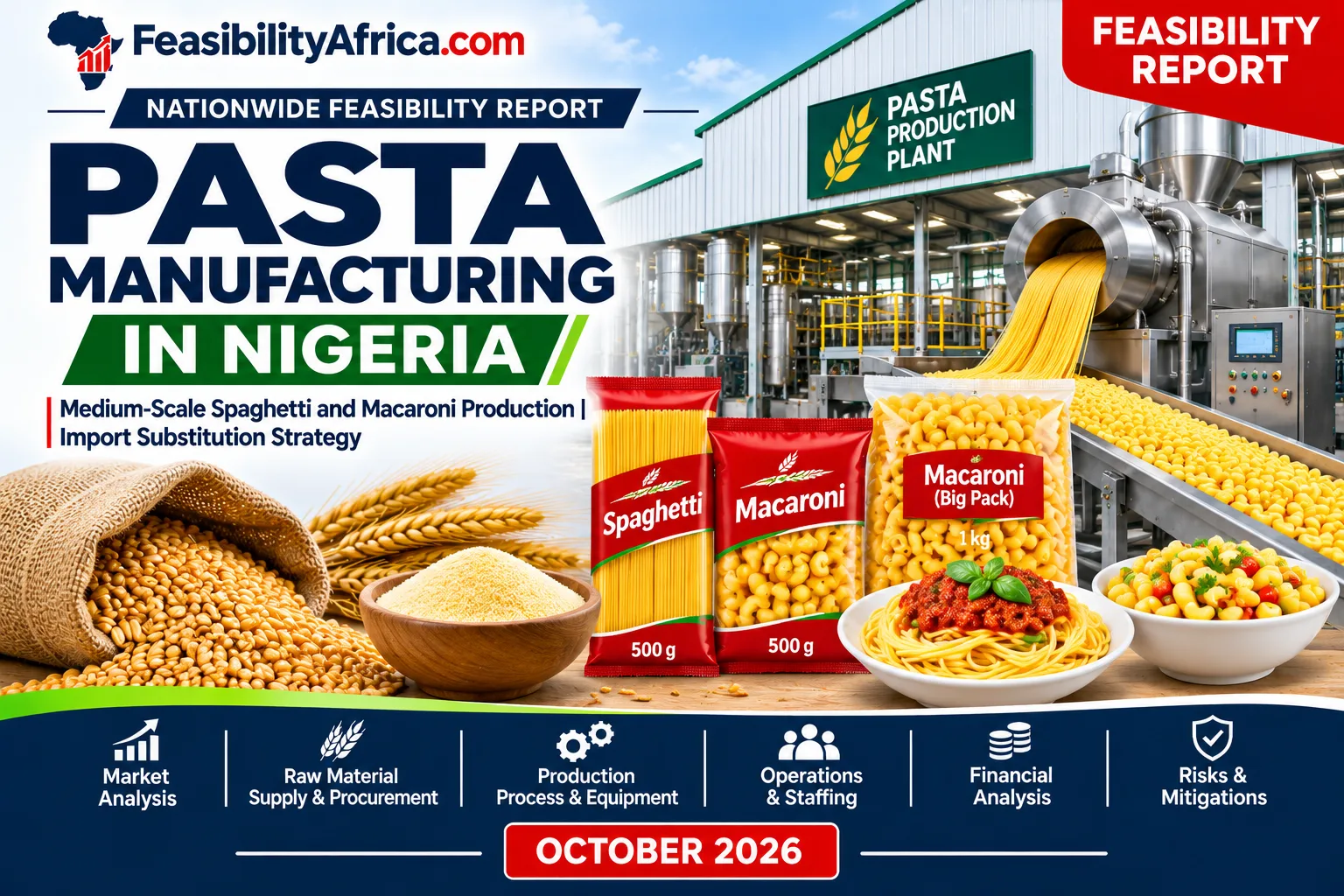
Introduction: An Everyday Food Product with Industrial Potential
Pasta has become a familiar part of the Nigerian food market. Spaghetti and macaroni are consumed in homes, restaurants, schools, hotels and other food-service establishments. Their affordability, convenience, shelf stability and versatility have made them important products in the country's packaged food industry.
For entrepreneurs considering food manufacturing, pasta production presents an opportunity to participate in a large, established consumer market.
But manufacturing pasta is very different from simply importing finished products or repackaging bulk supplies. It requires specialised machinery, technical production knowledge, reliable raw material sourcing, quality control, adequate working capital and an effective distribution network.
Nigeria already has major companies operating in this industry. A new entrant must therefore identify a realistic competitive position rather than assume that demand alone guarantees success.
The opportunity is particularly interesting for investors who can build strong regional distribution networks, secure competitive semolina supplies and maintain consistent production quality.
Understanding Nigeria's Pasta Market
The Nigerian pasta market is supported by everyday household consumption and demand from commercial food-service customers.
Spaghetti is particularly familiar to Nigerian consumers, while macaroni provides another product option for households, institutions and restaurants.
The feasibility report cites an estimated Nigerian pasta and noodles market value of approximately US$582.72 million in 2024, with a forecast of US$826.23 million by 2033. It reports a projected compound annual growth rate of 4.05% between 2025 and 2033.
An important feature of this market is that local production already plays a dominant role. Established Nigerian manufacturers have built substantial production capacity and distribution networks, successfully replacing much of the imported supply.
This means the opportunity for a new manufacturer is not simply to produce pasta that Nigerians already buy. It is to compete effectively in a market where consumers have existing brands and purchasing habits.
A new business needs a clear strategy for reaching customers, winning distributor confidence and maintaining a product that performs consistently.
Why Spaghetti and Macaroni Manufacturing Can Attract Investors
Pasta has several characteristics that make it attractive as a food manufacturing product.
Regular consumption: Pasta is used in everyday meals, creating repeat-purchase opportunities.
Shelf stability: Properly dried and packaged pasta can be stored and distributed without the refrigeration requirements associated with many fresh food products.
Multiple customer segments: The same factory can serve households, wholesalers, retailers, restaurants, caterers and institutional buyers.
Product diversification: A manufacturer can begin with spaghetti and macaroni before considering additional shapes and product formats.
Regional distribution opportunities: A new entrant may build a strong position in a defined geographic market before expanding into other regions.
However, these advantages must be considered alongside the industry's thin margins, high raw material costs, energy requirements and established competition.
Understanding the Main Products
A medium-scale pasta factory can manufacture different pasta products using an industrial extrusion and drying process.
1. Spaghetti
Spaghetti is generally the most recognisable product and can serve as the primary product for a new manufacturer.
Common retail formats include:
- 500g packs.
- 1kg packs.
The product can also be supplied in bulk formats for restaurants, institutional buyers and commercial food-service customers.
2. Macaroni
Macaroni, particularly elbow-shaped pasta, provides another product category for the same business.
It can be sold in 500g and 1kg retail packs, as well as bulk formats.
Macaroni helps diversify the product range and gives distributors more than one product to sell.
3. Bulk pasta packs
Larger formats, such as 10kg and 20kg packs, can serve institutional and commercial customers.
These include restaurants, caterers, food-service operators and other bulk purchasers.
For a new manufacturer, however, it may be wiser to begin with a focused range of high-demand products rather than introduce too many product variations immediately.
The feasibility report recommends concentrating initially on spaghetti in 500g and 1kg packs and macaroni in 500g packs. Bulk packs can be introduced after the production operation becomes more stable.
Who Buys Locally Manufactured Pasta?
A pasta factory needs a clear understanding of its customers before investing in production equipment.
Different customer categories have different purchasing requirements.
Households
Households are an important consumer segment. They purchase pasta for everyday meals and generally value affordability, cooking quality, availability and brand trust.
Distributors and wholesalers
Distributors and wholesalers are particularly important because they move large quantities of products into open markets, retail shops and other trading channels.
A new manufacturer needs to offer them an attractive commercial proposition, including reliable supply, competitive pricing and reasonable distributor margins.
Retailers
Supermarkets, neighbourhood stores, kiosks and other retail outlets provide access to final consumers.
Retailers are more likely to support a product that moves consistently and can be replenished reliably.
Institutional buyers
Schools, hospitals, prisons, military establishments and other institutions may purchase pasta in bulk.
These customers can provide significant sales opportunities, although procurement processes and payment arrangements may differ from ordinary retail distribution.
Hotels, restaurants and caterers
Commercial kitchens require dependable supplies and consistent cooking performance. Larger pack sizes can be useful for this market.
A manufacturer should not depend entirely on one customer category. A balanced distribution strategy can reduce the risks associated with changes in demand or payment behaviour in a particular segment.
The Main Ingredient: Durum Wheat Semolina
One of the most important considerations in pasta manufacturing is the quality and cost of the raw material.
Industrial pasta is commonly produced using durum wheat semolina, a granular product obtained from durum wheat.
Semolina contributes to the texture, strength, colour and cooking performance of finished pasta.
The feasibility report identifies semolina as accounting for approximately 70–75% of production cost. This makes procurement one of the most important commercial decisions in the business.
Where can manufacturers obtain semolina?
A manufacturer can consider two main sourcing options.
Local flour mills: Nigerian flour mills process imported durum wheat and can supply semolina locally. This may offer shorter lead times and easier purchasing arrangements.
Imported semolina: Manufacturers may also import semolina from international suppliers. This can provide another sourcing option but exposes the business to foreign exchange requirements, import procedures, shipping costs and port delays.
The report recommends establishing relationships with at least two local flour mills while maintaining an import option as a backup.
It also recommends holding approximately four weeks of semolina inventory to reduce the impact of supply interruptions and price changes.
Why raw material quality matters
Not all semolina is suitable for industrial pasta production.
The report identifies important specifications, including:
- Protein content of approximately 11.5–12.5% minimum.
- Moisture content not exceeding 14.5%.
- Coarse, granular texture.
- Uniform amber or yellow colour.
These characteristics influence dough formation, extrusion behaviour, finished-product appearance and cooking quality.
A manufacturer that purchases unsuitable raw material may experience production difficulties and inconsistent finished products.
How Spaghetti and Macaroni Are Manufactured
Commercial pasta production involves a sequence of controlled operations. The objective is to transform semolina and water into properly shaped, dried and packaged pasta.
1. Semolina receiving and storage
Incoming semolina is inspected and tested before acceptance.
Moisture and protein levels are particularly important because they influence processing consistency and finished-product quality.
2. Dosing and mixing
The semolina is mixed with water to produce a homogeneous, crumbly dough.
The report provides an illustrative water addition range of 30–35% of flour weight, with mixing typically taking 10–20 minutes.
3. Extrusion
The prepared dough is forced through specially designed dies under pressure.
The shape of the die determines the pasta product. Different dies can be used for spaghetti, macaroni and other pasta shapes.
The extrusion process must be controlled to maintain suitable dough temperature and product consistency.
4. Cutting
The extruded pasta is cut to the required length.
For spaghetti, length consistency is important for packaging and consumer presentation. For macaroni, cutting determines the desired product size.
5. Pre-drying
Freshly extruded pasta contains substantial moisture. Pre-drying removes surface moisture and prepares the product for final drying.
6. Final drying
This is one of the most critical stages of the manufacturing process.
The pasta is dried under controlled temperature, humidity and airflow conditions until it reaches the required moisture level.
The feasibility report identifies a final moisture target of approximately 12–12.5%.
Drying quality affects product stability, appearance, cooking behaviour and the risk of breakage.
7. Cooling
The dried pasta is cooled towards room temperature before packaging.
Packaging pasta while it is still excessively warm can create quality and storage problems.
8. Packaging
The finished product is weighed, filled into suitable packaging, sealed and coded.
Retail packaging may include 500g and 1kg formats, while larger packs can serve bulk customers.
9. Quality control and storage
Finished batches are checked for moisture, appearance and cooking quality.
Products that meet the required specifications can then be stored in cool, dry conditions before distribution.
Machinery Required for a Pasta Manufacturing Factory
A commercial pasta factory requires specialised equipment designed for mixing, extrusion, drying, cooling and packaging.
Depending on the production capacity, a typical production line may include:
- Flour mixer.
- Screw conveyor.
- Industrial pasta extruder.
- Interchangeable extrusion dies.
- Pre-dryer and final dryer.
- Cutting equipment.
- Cooling conveyor.
- Packaging machine.
- Air compressor.
- Industrial generator.
- Water treatment system.
- Laboratory and quality-control equipment.
The extruder determines the production capacity and the range of pasta shapes that can be produced.
However, the drying system is particularly important. Inadequate drying can lead to inconsistent moisture levels, product breakage and poor cooking performance.
The feasibility report identifies the dryer as the most critical and expensive individual item in the proposed equipment package.
Investors should therefore consider equipment reliability, supplier experience, after-sales support, spare-parts availability and the ability to maintain the production line.
A cheap machine that repeatedly breaks down or produces inconsistent pasta may become more expensive over time than a properly specified industrial system.
Why Location Matters
A pasta factory does not necessarily need to be located beside a wheat farm. Its location strategy should consider access to semolina suppliers, customers, energy, transport infrastructure and industrial services.
The feasibility report evaluates several Nigerian regions.
South-West Nigeria
Ogun and Oyo States are identified as attractive locations for a new entrant seeking access to Lagos, ports, flour mills, distributors and major consumer markets.
The region offers strong commercial infrastructure, although competition and land costs may be higher in certain locations.
North-Central Nigeria
Kwara, Nasarawa and the Federal Capital Territory offer potential advantages for businesses targeting northern and central markets.
A North-Central production hub may provide access to Abuja and surrounding markets, although raw material logistics from southern supply points require careful assessment.
North-West Nigeria
Kano and Kaduna offer access to large populations, wholesale trading networks and growing pasta demand.
A manufacturer targeting the North-West may find opportunities to build a regional distribution position, but must assess security, transport and semolina supply logistics.
South-East and South-South
The South-East offers established commercial networks, particularly around Onitsha and Aba, while the South-South provides access to markets around Port Harcourt and other commercial centres.
The report considers these regions more suitable as distribution hubs than as the primary production location in its illustrative strategy.
Ultimately, the best location depends on the target market, supplier relationships, cost of power and logistics.
Energy: A Major Operating Cost
Pasta manufacturing requires a reliable energy supply.
The extrusion and drying stages are energy-intensive, and interruptions during production can damage or ruin a batch.
A factory cannot treat electricity as a minor administrative expense. It must be included in the production cost from the beginning.
The feasibility report uses an illustrative 200 KVA generator and discusses diesel consumption of approximately 25–35 litres per hour under load.
It also highlights the importance of generator maintenance, fuel procurement and monitoring consumption.
For investors, the choice of location and production equipment should be evaluated partly on their effect on energy costs.
A factory that produces pasta efficiently but spends too much on diesel may struggle to compete on price.
Quality Standards and Regulatory Compliance
Food manufacturing requires appropriate quality management and regulatory approvals.
For pasta production in Nigeria, the feasibility report identifies the following key requirements.
Corporate Affairs Commission (CAC): The business must be properly registered.
National Agency for Food and Drug Administration and Control (NAFDAC): The product and manufacturing facility must meet applicable registration and food-safety requirements.
Standards Organisation of Nigeria (SON): The business must address applicable standards and MANCAP certification requirements.
Environmental and local authorities: Relevant environmental, business-premises and fire-safety requirements must also be considered.
Quality management should be built into the production operation.
Important product characteristics include:
- Moisture content not exceeding 12.5%.
- Protein content of at least 10.5%.
- Appropriate ash and acidity levels.
- Consistent colour and appearance.
- Good cooking performance.
- Absence of foreign matter.
The finished pasta should retain its shape during cooking rather than becoming excessively sticky or mushy.
Packaging is also important. Retail packs require suitable moisture-barrier materials and reliable seals to protect the product during storage and distribution.
How to Compete with Established Pasta Brands
A new pasta manufacturer will enter a market where established companies already enjoy brand recognition, production capacity and extensive distribution networks.
The feasibility report identifies major competitors including BUA Foods, Honeywell Flour Mills and Flour Mills of Nigeria, whose Golden Penny brand has a strong market presence.
Competing directly with these companies on national advertising expenditure or production scale may not be realistic for a medium-scale entrant.
A more practical strategy is to build strength in a defined region.
Focus on regional availability
A manufacturer can concentrate on serving distributors and wholesalers within a manageable geographic area.
Reliable deliveries and strong customer relationships can help build market share.
Maintain consistent quality
Consumers may try a new brand, but poor cooking performance can prevent repeat purchases.
Consistency in moisture, colour, texture and cooking quality is essential.
Give distributors a reason to sell
Distributors need commercially attractive margins and confidence that the manufacturer will supply products consistently.
A business should understand the economics of its distribution channel before setting its ex-factory prices.
Avoid competing on price alone
A new manufacturer may be tempted to undercut established brands.
However, selling below a sustainable cost can quickly damage the business.
The better approach is to combine competitive pricing with quality, availability and dependable customer service.
Marketing and Distribution Strategy
A pasta manufacturing business must establish its sales network before commercial production begins.
Potential channels include:
- Regional distributors.
- Wholesale traders.
- Open-market bulk buyers.
- Supermarkets.
- Neighbourhood retailers.
- Institutional procurement customers.
- Restaurants and caterers.
The feasibility report recommends recruiting distributors in priority markets and supporting them with product samples, promotional materials and volume incentives.
One suggested approach is to offer trial quantities to selected distributors to encourage them to test the product.
However, the business must manage credit carefully.
New customers should generally begin with cash-on-delivery arrangements. Credit should only be considered after a customer demonstrates a reliable payment history.
A manufacturing business can make sales on paper and still run into serious financial difficulties if distributors delay payment.
For this reason, receivables management is just as important as production planning.
The Financial Reality: Why Demand Does Not Guarantee Profit
Pasta manufacturing is a volume-driven business with relatively thin margins.
The cost of semolina, packaging, diesel, labour, maintenance and distribution can consume a large proportion of revenue.
A manufacturer must therefore achieve an appropriate combination of competitive raw material prices, selling prices, production efficiency and capacity utilisation.
The feasibility report models a 200kg-per-hour production line operating for 300 days annually, with theoretical production capacity of approximately 480 tonnes.
Its illustrative utilisation assumptions are:
- Year 1: 40%, approximately 192 tonnes.
- Year 2: 60%, approximately 288 tonnes.
- Year 3: 75%, approximately 360 tonnes.
The report also identifies a recommended planning capital of ₦250 million–₦300 million, including working capital and contingency, although the detailed capital expenditure table gives a broader total capital requirement of ₦252 million–₦347 million.
These figures are illustrative and should be validated with actual supplier quotations, semolina prices, distributor commitments and site-specific operating costs.
Most importantly, the report's financial model shows that the base case is loss-making at the assumed semolina and selling prices.
It identifies three possible routes towards viability:
- Securing semolina below the assumed base-case cost.
- Achieving higher selling prices through a competitive product proposition.
- Achieving exceptional operating efficiency and high capacity utilisation.
This is a critical consideration for anyone evaluating the investment. A large consumer market does not automatically translate into attractive manufacturing returns.
Common Challenges in Pasta Manufacturing
Investors should understand the risks before committing capital.
Semolina price volatility: Semolina prices are linked to imported durum wheat and foreign exchange movements. Changes in input costs can quickly affect production economics.
Energy expenditure: Diesel and generator maintenance can place pressure on operating margins.
Equipment breakdown: A malfunctioning extruder or dryer can interrupt production and result in losses.
Quality inconsistency: Poor drying or incorrect processing parameters can produce pasta that breaks easily or performs badly during cooking.
Distributor credit risk: Delayed payments can tie up working capital and prevent the business from purchasing raw materials.
Regulatory delays: The factory must complete the applicable approval processes before commercial sales.
Competition: Established manufacturers have strong brands and distribution networks. A new entrant must build customer trust gradually.
A well-designed risk-management plan should address these issues before the first commercial production run.
Expansion Opportunities
Once the initial operation becomes stable, a manufacturer can consider expanding its product range and distribution footprint.
Potential opportunities identified in the feasibility report include:
Additional pasta shapes: Products such as penne and twist pasta can diversify the range using additional dies and packaging arrangements.
Second production shift: Operating another shift can increase output without requiring the purchase of an entirely new production line.
Regional distribution depots: Additional warehouses or sales depots can extend market reach without immediately investing in another factory.
Second production plant: A new facility may be considered when sales volumes, raw material supply and distribution capacity justify the additional capital.
These options should be evaluated against actual market demand and the performance of the existing operation.
Is Pasta Manufacturing the Right Business for You?
Pasta manufacturing may be suitable for entrepreneurs with experience in food manufacturing, FMCG distribution or industrial operations.
It is particularly relevant to investors who can secure competitive semolina supplies, recruit technically competent personnel and build reliable distributor relationships.
However, the business is not necessarily suitable for a passive investor.
The feasibility report emphasises the importance of hands-on management, especially during the first 18–24 months when production processes, regulatory approvals, customer relationships and distribution systems are being established.
A competent Plant Manager and Quality Control Officer are among the most important hires.
The investor must also be prepared to manage working capital, monitor production costs and enforce strict payment policies.
The central lesson is that success depends on operational discipline, not simply on the popularity of spaghetti and macaroni.
Before You Invest, Understand the Full Business
Establishing a pasta manufacturing plant involves interconnected decisions about production capacity, semolina procurement, equipment specifications, factory location, energy requirements, product quality, regulatory compliance, packaging, distribution and financing.
A decision about any one of these areas can affect the commercial performance of the entire business.
The Pasta Manufacturing Business Feasibility Report in Nigeria (2026) provides a structured assessment of the opportunity to establish a medium-scale spaghetti and macaroni production plant.
The 33-page report examines the Nigerian pasta market, regional location strategy, competitive landscape, product range, semolina sourcing, manufacturing processes, machinery and equipment, staffing, regulatory requirements, marketing and distribution, capital expenditure, working capital, financial projections, risks and implementation schedule.
It also examines the conditions under which the business may become viable and explains why cost control and competitive raw material sourcing are essential.
Thinking of starting a spaghetti and macaroni manufacturing business in Nigeria? Purchase the full Pasta Manufacturing Business Feasibility Report (2026) from FeasibilityAfrica.com to evaluate the opportunity, understand the investment requirements and make a more informed business decision.
Enjoyed this? Get the next one free
Every new article, straight to you. Free. Choose email, WhatsApp — or both.
Email newsletter
New articles in your inbox. Unsubscribe anytime.
WhatsApp newsletter
Get new articles directly on WhatsApp. No spam, just new ideas.
Related articles

Manufacturing
Toothpaste Manufacturing Business in Nigeria: A Lucrative Opportunity for Entrepreneurs and Investors?
Thinking of starting a toothpaste manufacturing business in Nigeria? Discover the market opportunities, production process, raw materials, industry challenges and what it takes to build a competitive oral care brand in Nigeria.

Manufacturing
Tissue Paper Manufacturing Business in Nigeria: How to Tap Into the Growing Hygiene Products Market
Discover the opportunities in Nigeria's tissue paper manufacturing industry. Learn how toilet rolls, serviettes and facial tissues are produced, who buys them, how to compete and what entrepreneurs should know before entering this everyday consumer products market.
Manufacturing
PVC Pipes and Fittings Manufacturing in Nigeria: Exploring Opportunities in the Construction and Infrastructure Market
Nigeria’s demand for reliable plumbing, water supply, drainage and electrical conduit products creates opportunities for local manufacturers. Discover how PVC pipes and fittings are produced, the customers who need them, the challenges manufacturers face and what it takes to build a competitive brand in this growing industrial market.