
Poultry Egg Production Business in Nigeria: How to Build a Commercial Layer Farm
Nigeria's demand for table eggs creates opportunities for commercial poultry farmers, but success depends on more than keeping layers. Discover how a commercial egg farm operates, how to select point-of-lay pullets, manage feed costs, protect flock health, market eggs and generate additional value from spent layers and poultry manure.
By FeasibilityAfrica Research Team · · 11 min read
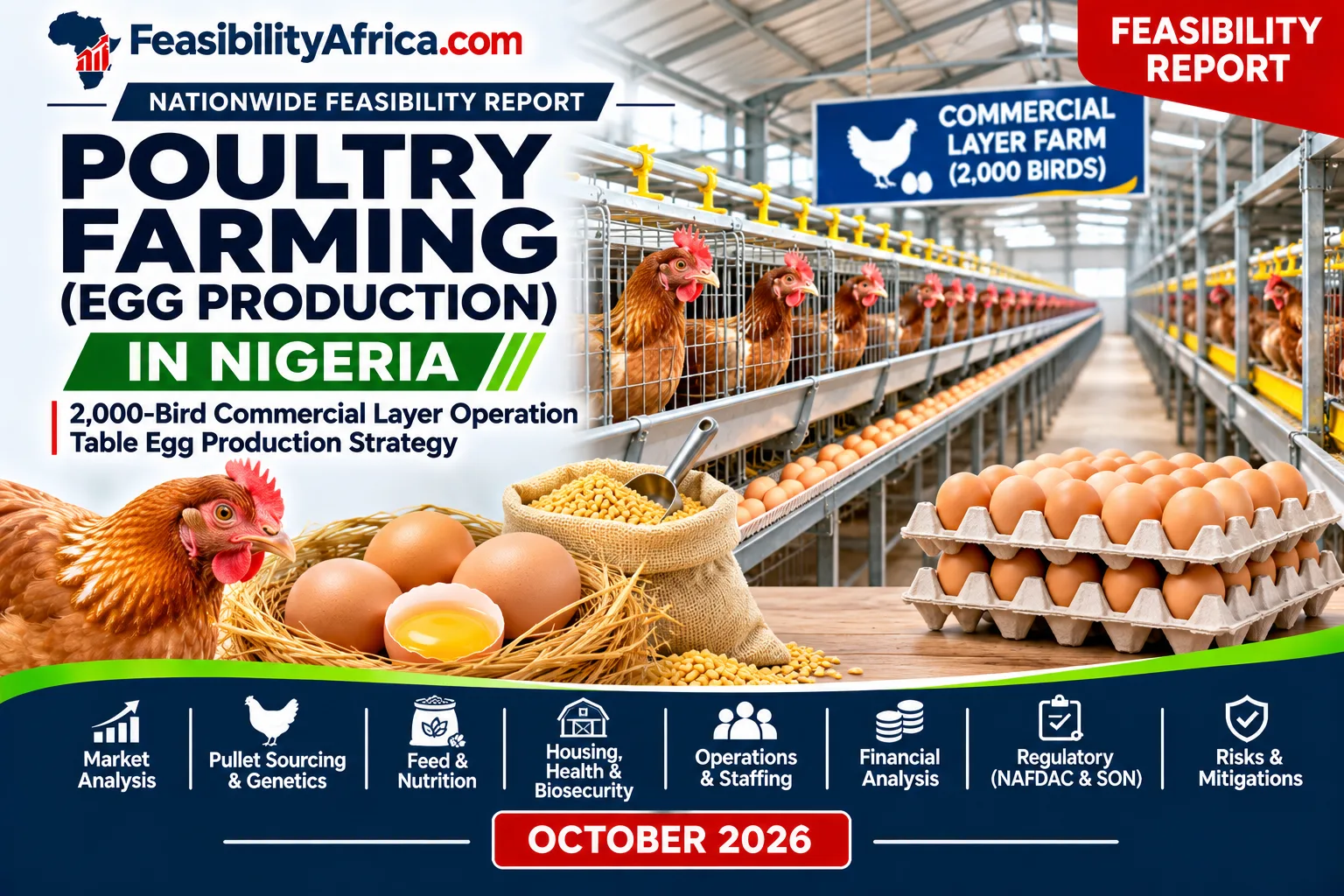
Introduction: An Everyday Food with a Commercial Opportunity
Eggs are among the most familiar sources of animal protein in Nigerian households. They are consumed at breakfast, used in baking and confectionery, served in restaurants and hotels, and sold through neighbourhood shops and open markets.
This widespread use creates a recurring market for table eggs. Unlike businesses built around occasional purchases, commercial egg production supplies a product that consumers and food businesses buy regularly.
For agribusiness entrepreneurs, this presents an opportunity to establish a poultry farm focused specifically on producing and selling table eggs.
But a successful layer farm is not simply a matter of buying birds, providing feed and waiting for eggs. It is a carefully managed production business in which feed costs, pullet quality, flock health, egg prices and distribution determine the financial outcome.
Understanding these factors before investing can make the difference between a productive farm and an expensive operation struggling to remain profitable.
Why Table Egg Production Attracts Investors
1. Eggs have diverse and recurring customers
The market for table eggs includes several customer categories:
- Households purchasing eggs for everyday consumption.
- Open-market traders and retailers.
- Bakeries and confectioneries using eggs as production inputs.
- Hotels, restaurants and catering businesses.
- Schools, hospitals and other institutional buyers.
These customers have different purchasing patterns and requirements. Household retailers may buy smaller quantities frequently, while wholesalers can absorb larger volumes.
A farm that develops dependable relationships with several customer groups can reduce its dependence on a single buyer.
2. Eggs are used across the food economy
Eggs are consumed directly and used as ingredients in bread, cakes, pastries, snacks and other prepared foods.
This gives commercial egg producers access to both household consumption and business-to-business markets.
Bakeries, for example, need reliable supplies and consistent egg quality. Hotels and restaurants also value dependable deliveries because interruptions can affect their operations.
3. Local production serves nearby markets
Eggs are fragile and perishable compared with many other agricultural products. Long-distance transportation can increase breakage and handling costs.
A farm located reasonably close to its target market can compete through freshness, regular delivery and reduced transport losses.
This makes location and distribution strategy particularly important in commercial egg production.
Understanding the Commercial Layer Farm Model
A commercial layer farm specialises in raising female chickens for table egg production.
One approach is to purchase point-of-lay pullets—young female birds approaching the start of their productive laying period—rather than rear birds from day-old chicks.
The farm houses the pullets, provides balanced layer feed, manages vaccination and biosecurity, collects eggs and sells them to customers.
At the end of the productive laying cycle, the birds are sold as spent layers for meat.
Poultry manure can also be collected, composted and sold as organic fertiliser.
This creates three potential revenue streams:
- Table eggs during the productive cycle.
- Spent-layer sales at the end of the cycle.
- Poultry manure as a secondary by-product.
The main business, however, remains the regular production and sale of table eggs.
Choosing the Right Layer Breed
The choice of breed affects laying performance, feed efficiency, egg quality and the overall productivity of the farm.
Several commercial layer strains are relevant to Nigerian poultry production.
ISA Brown
ISA Brown is a popular commercial layer known for good egg production and relatively docile behaviour.
It is identified in the feasibility report as a recommended option for a first-time commercial layer operation.
Lohmann Brown
Lohmann Brown is another commercial layer strain known for good laying performance and feed conversion.
It is an alternative for farmers who can obtain quality birds from a reputable supplier.
Bovan Nera
Bovan Nera is identified as a hardy, dual-purpose option with good laying potential.
It may be considered where the farmer values adaptability alongside egg production.
Novogen
Novogen is another commercial option associated with good laying performance and shell quality.
Whatever breed is selected, the source and health status of the birds are critical. A reputable supplier, verifiable vaccination records and appropriate bird weights are more important than simply buying the cheapest available pullets.
Point-of-Lay Pullets: A Critical Investment Decision
Purchasing point-of-lay pullets can shorten the time between investment and egg production compared with starting from day-old chicks.
However, it also introduces a significant procurement risk.
A pullet that is underweight, poorly vaccinated, stressed or incorrectly aged may fail to reach expected production levels.
Before purchasing, farmers should examine:
- Age, preferably around 16–17 weeks under the model described in the report.
- Body weight and general physical condition.
- Vaccination history.
- Source and hatchery reputation.
- Health status and signs of respiratory illness.
- Transport arrangements and adaptation requirements.
The report identifies a supply constraint in the pullet market and advises buyers to plan procurement several months in advance.
Farmers should obtain written quotations, verify the supplier's records and arrange inspection before committing funds.
Feed and Nutrition: The Largest Operating Cost
Feed management is one of the most important aspects of commercial egg production.
Layer birds require a balanced ration containing energy, protein, minerals and vitamins. Calcium is particularly important because it supports eggshell formation.
The report uses an illustrative daily feed intake of 115–125g per bird, with 120g as its base assumption.
For a 2,000-bird flock, this represents approximately 240kg of feed daily.
The scale of this requirement explains why even small changes in feed prices can have a significant effect on farm profitability.
Why feed quality matters
Poor-quality feed can reduce laying performance, affect egg size and weaken shell quality.
Farmers should pay attention to:
- Crude protein levels.
- Energy content.
- Calcium and phosphorus balance.
- Feed freshness and storage conditions.
- Mould contamination and aflatoxin risk.
- Consistency between feed batches.
Feed should be stored in a dry, rodent-proof area. Mouldy feed should never be given to the birds.
Can farmers reduce feed costs?
The report identifies on-farm feed mixing or custom milling as possible ways to reduce the cost of finished commercial feed.
This may create savings, but it requires access to quality raw materials, proper formulation, weighing equipment and reliable mixing.
Reducing feed costs at the expense of nutritional quality can damage production and ultimately cost more than it saves.
Poultry Housing and Farm Infrastructure
The housing system affects bird comfort, labour requirements, egg cleanliness, disease exposure and capital expenditure.
Two common options are deep-litter housing and battery cages.
Deep-litter system
In a deep-litter system, birds are kept on a floor covered with materials such as wood shavings or rice husks.
Advantages include lower initial housing costs and greater freedom of movement.
However, litter management is important. Poorly maintained litter can contribute to disease problems, odour and dirty eggs.
Battery-cage system
Battery cages house birds in organised compartments with feeding and watering systems.
The system can make egg collection, manure management and flock monitoring easier, although the initial investment is higher and animal-welfare considerations must be assessed.
The best system depends on the investor's budget, management capacity, market expectations and applicable requirements.
Essential farm facilities
A commercial layer operation also requires:
- Feed storage facilities.
- Clean and reliable water supply.
- Feeders and drinkers.
- Egg collection and storage areas.
- Adequate ventilation.
- Backup power where necessary.
- Security and perimeter control.
- Manure collection and composting facilities.
A well-designed farm should make daily operations efficient while reducing opportunities for disease transmission.
Biosecurity: Protecting the Investment
Disease is one of the most serious threats to poultry production.
Newcastle disease and avian influenza are particularly important concerns in the Nigerian poultry environment.
A disease outbreak can cause mortality, reduce egg production, increase veterinary expenses and disrupt sales.
Vaccination is essential, but it is not a complete substitute for biosecurity.
A practical biosecurity programme should include:
- Footbaths at poultry-house entrances.
- Restricted access for visitors.
- Dedicated farm clothing and footwear.
- Quarantine arrangements for new birds.
- Rodent and wild-bird control.
- Daily removal of dead birds.
- Regular cleaning and disinfection.
- Proper manure management.
- Daily observation of bird behaviour and health.
The farm should work with a qualified poultry veterinarian to develop and supervise its vaccination and health programme.
Any suspected serious disease outbreak should be handled promptly with veterinary guidance and appropriate reporting.
Daily Management and Egg Collection
Commercial layer farming requires consistent daily supervision.
Birds must receive adequate feed and clean water, while farm workers monitor their health, collect eggs and maintain the poultry house.
Eggs should be collected several times daily to reduce breakage and contamination.
The farm should also establish procedures for:
- Removing visibly damaged eggs.
- Sorting eggs by size and quality.
- Maintaining clean collection equipment.
- Recording daily production.
- Tracking feed consumption.
- Monitoring mortality.
- Recording medication and vaccination.
- Reconciling eggs produced with eggs sold.
These records help identify production problems early and provide useful information for financial management.
Marketing: Finding Buyers Before the Eggs Arrive
A farm's production capacity has little value if it cannot sell its eggs consistently.
The marketing plan should therefore be developed before the first eggs are produced.
Egg wholesalers
Wholesalers can absorb large quantities and distribute eggs to retailers and open markets.
A dependable wholesaler can provide a more predictable sales channel than relying entirely on individual customers.
Retailers and open-market sellers
Retailers serve household consumers and can help a farm establish regular local distribution.
A farm may supply several retailers directly or work through established distributors.
Bakeries and confectioneries
Bakeries use eggs as ingredients and may require regular deliveries.
A producer who can maintain consistent supply, quality and agreed delivery schedules may secure repeat business.
Hotels, restaurants and caterers
These customers may value freshness, reliable delivery and consistent egg sizes.
They can provide additional sales opportunities, particularly for farms located near urban centres.
Digital distribution
The report discusses the EggHome App, launched by the Egg Sellers and Distributors Association of Nigeria (ESDAN), as a digital channel intended to connect egg producers with buyers.
Platforms of this kind may help farmers reach customers beyond their immediate locality, although producers should assess actual buyer activity and commercial terms before relying on them.
Manage payment terms carefully
Eggs are perishable, and poultry farms need continuous cash flow to purchase feed and meet operating expenses.
For new customers, cash-on-delivery arrangements can help reduce payment risk.
Credit should be extended cautiously and only after a buyer has established a reliable payment record.
Additional Revenue from Spent Layers and Poultry Manure
Egg production is the main source of income, but the business can generate additional value from its by-products.
Spent layers
At the end of their productive laying cycle, the birds can be sold for meat.
The report illustrates a scenario in which approximately 1,862 birds remain saleable after the assumed pre-lay and laying-cycle mortality rates.
At an illustrative price of ₦4,000 per bird, this would generate approximately ₦7.45 million in gross sales.
The actual amount will depend on bird condition, mortality, market demand and prevailing prices.
Farmers should plan this sale in advance rather than waiting until the flock has reached the end of its productive cycle.
Poultry manure
A 2,000-bird flock can produce substantial quantities of manure.
When properly handled and composted, poultry manure can be sold to vegetable farmers, crop producers, nurseries and gardeners.
This provides an additional source of income and helps reduce waste-management problems.
Understanding the Economics of Egg Production
A commercial layer farm has recurring expenses that must be covered by egg sales.
These include:
- Feed.
- Labour.
- Veterinary services and medication.
- Electricity, water and diesel.
- Egg crates and packaging.
- Transportation.
- Repairs and other consumables.
Feed is particularly important because it represents a large share of the operating budget.
The farm's financial performance therefore depends on the relationship between the laying rate, egg selling price and feed cost.
A high laying rate increases the number of crates available for sale, but it does not automatically guarantee profitability if feed is expensive or selling prices fall.
Similarly, a farm may have a strong market but struggle financially if its pullets are poor quality or disease reduces production.
Investors should build their financial projections using actual supplier quotations and realistic farm-gate selling prices.
They should also include sufficient working capital to sustain operations through temporary price fluctuations, disease-related interruptions and unexpected expenses.
Where Should You Locate a Poultry Farm in Nigeria?
Location affects the cost of feed procurement, access to pullets, disease exposure and the ability to deliver eggs to customers.
The report evaluates several broad regions:
- South-West: Ogun, Oyo and Osun offer access to Lagos and established poultry-service networks.
- North-Central: The FCT, Nasarawa and Kogi provide access to Abuja and surrounding markets.
- North-West: Kano, Kaduna and Katsina offer access to large northern consumer markets, although pullet and feed logistics require attention.
- South-East: Enugu, Anambra and Abia offer access to established commercial networks, including Onitsha and Aba.
- South-South: Edo, Delta and Rivers provide access to markets including Benin City and Port Harcourt.
A suitable site should have dependable water, good road access, secure land tenure and adequate space for poultry housing.
The report recommends keeping a preferred separation of at least 500 metres from the nearest poultry farm to reduce disease exposure.
Location selection should also account for proximity to feed suppliers, pullet sources and the intended egg market.
Common Mistakes to Avoid
New poultry farmers can encounter serious problems when they underestimate the management requirements of commercial egg production.
Common mistakes include:
- Buying cheap pullets without verifying their health and vaccination records.
- Underestimating the quantity and cost of feed required.
- Ignoring biosecurity and allowing unnecessary visitors into poultry houses.
- Starting production without identifying reliable egg buyers.
- Extending excessive credit to distributors.
- Failing to maintain daily production and expense records.
- Underfunding working capital.
- Ignoring the cost of replacing the flock at the end of the laying cycle.
Perhaps the most important mistake is treating poultry farming as a passive investment.
A commercial layer farm requires daily supervision, disciplined management and prompt responses to changes in bird health and production.
Conclusion: Build a Productive Farm Around Sound Management
Commercial egg production offers an opportunity for entrepreneurs who want to participate in Nigeria's livestock and food supply industry.
The market has several customer segments, the product is consumed regularly, and farmers can generate additional value from spent layers and poultry manure.
However, the business is operationally demanding. Feed costs, pullet quality, disease prevention, laying performance and distribution all influence its financial outcome.
The most successful operators are likely to be those who combine sound livestock management with disciplined purchasing, reliable sales channels and adequate working capital.
Before investing, entrepreneurs should understand the full requirements of establishing and operating a commercial layer farm and test the financial assumptions against actual market quotations.
Planning to start a commercial poultry egg production business in Nigeria?
The Poultry Egg Production Feasibility Report in Nigeria (2026) provides a detailed assessment of a proposed 2,000-bird commercial layer operation. It covers market analysis, location strategy, breed selection, pullet procurement, feed and nutrition, housing, vaccination, biosecurity, staffing, marketing, capital expenditure, operating costs, financial projections, risk analysis and implementation planning.
Get the complete report from FeasibilityAfrica.com to examine the investment requirements, operational realities and conditions for establishing a commercial table egg production farm in Nigeria.
Make an informed investment decision before committing your capital.
Enjoyed this? Get the next one free
Every new article, straight to you. Free. Choose email, WhatsApp — or both.
Email newsletter
New articles in your inbox. Unsubscribe anytime.
WhatsApp newsletter
Get new articles directly on WhatsApp. No spam, just new ideas.
Related articles
Agriculture
Catfish Farming in Africa: Costs, Profits and How to Start
Pond options, fingerling sourcing and what one harvest cycle can earn you.
Agriculture
How to Start a Profitable Poultry Farm in Nigeria (2026 Guide)
Startup costs, breeds, feed strategy and how much you can realistically earn from 1,000 birds.
Agriculture
Goat Farming in Nigeria: Building a Profitable Commercial Livestock Business
Goat farming offers opportunities for Nigerian agribusiness entrepreneurs, but success requires more than purchasing animals and providing feed. Discover how commercial goat breeding and fattening work, the best breeds to consider, feeding strategies, housing and animal health requirements, market opportunities, and the financial realities of building a sustainable goat farm.